
Search Is Still the Floor
SEO vs AEO is not a fight where one tactic wins and the other gets thrown into a marketing dumpster. SEO helps your business get found in search results. AEO helps your business become a useful answer when buyers ask search engines and AI systems what to do, who to compare, or who to trust.
The owner question is simpler: which work brings more qualified customers, and which work stops you from losing customers who should have found you?
Nugentive’s validated keyword artifacts show seo vs aeo as an unowned phrase with estimated U.S. search volume of 880, keyword difficulty of 23, and commercial intent in DataForSEO’s July 30 capture. That makes it worth owning carefully because owners and marketers are trying to decide where the next dollar and hour should go.
The short answer: you usually need both. SEO builds the crawlable, useful, structured foundation. AEO builds the answer-ready proof layer that helps AI-assisted search understand, cite, and recommend the business.

What SEO Does for the Business
SEO is the work of making your site accessible, understandable, useful, and competitive in search engines. It includes technical access, site structure, internal links, service-page clarity, keyword intent, useful content, local signals, links, and ongoing improvement.
Google’s SEO Starter Guide frames SEO around helping search engines understand content and helping people find what they need (https://developers.google.com/search/docs/fundamentals/seo-starter-guide). Google’s Search Essentials also make the basics plain: content needs to be crawlable, indexable, useful, and not built around spammy shortcuts (https://developers.google.com/search/docs/essentials).
For an owner, SEO matters because customers still search with direct intent. They look for “commercial roofer near me,” “best accountant for restaurants,” “emergency AC repair,” “B2B lead generation help,” and thousands of other queries where a clear service page or local page can turn attention into a call.
Good SEO answers three business questions:
- Can search engines access the important pages?
- Do those pages match real buyer intent?
- Does the page help a visitor trust the business enough to take the next step?
What AEO Adds
AEO, or answer engine optimization, focuses on making your business easier to retrieve, summarize, cite, compare, and recommend in answer-style environments. That can include Google AI experiences, Bing Copilot-style answers, ChatGPT Search, Perplexity, Gemini, and other systems that synthesize information instead of only listing links.
Google’s AI features guidance says site owners do not need special markup to appear in AI experiences. The baseline is still eligible, accessible, helpful content that Google can use (https://developers.google.com/search/docs/appearance/ai-features). Translation: there is no secret “please cite me, robot overlord” tag. Tragic for plugin vendors. Healthy for everyone else.
AEO adds work that traditional SEO often under-emphasized:
- Clear entity information: who you are, where you serve, what you do, who you help, and what makes you credible.
- Answer-ready sections: concise explanations, FAQs, comparisons, definitions, steps, pricing context, and objections answered directly.
- Source reinforcement: reviews, listings, third-party mentions, case studies, author credentials, and consistent facts across the web.
- Citation usefulness: content that gives search and AI systems a reason to reference your page instead of a competitor’s softer, vaguer version.
- Conversion continuity: a next step that makes sense after the answer, not a limp “contact us” button floating in space.
AEO is not about tricking AI systems. It is about making your business retrievable, understandable, trusted, cited, and recommended across the places customers now use to make decisions.
SEO vs AEO: The Practical Difference
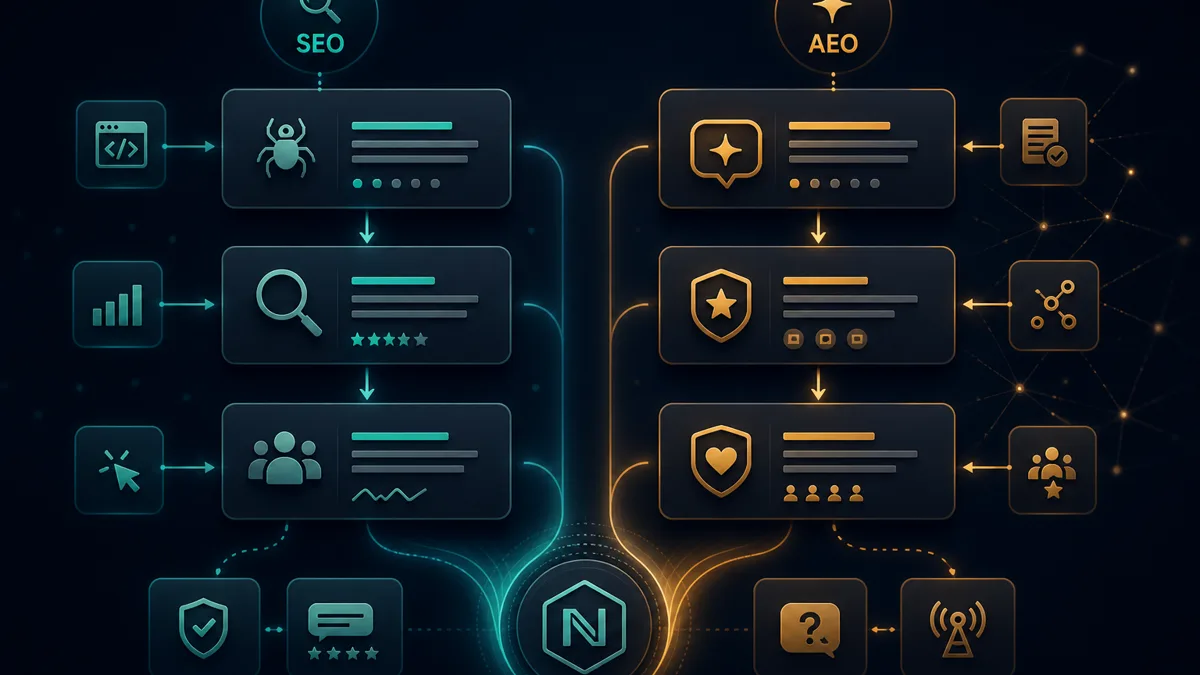
The cleanest way to compare SEO vs AEO is by job, not jargon.
SEO primarily asks, “Can we earn visibility when someone searches?” AEO asks, “Can we become part of the answer when a system summarizes the options?”
SEO often starts with pages, crawlability, rankings, snippets, internal links, backlinks, local pages, and search demand. AEO starts with buyer questions, answer formats, entity clarity, source patterns, citations, recommendation language, and whether the business is represented accurately across multiple trusted sources.
There is heavy overlap. A well-built service page can support both. A useful FAQ can support both. Strong reviews and consistent local listings can support both. Schema can support clarity, but Schema.org’s own documentation describes structured data as a vocabulary for describing entities and relationships (https://schema.org/docs/gs.html), not a magic wand for AI citations.
Which One Should You Prioritize First?
Start with SEO fundamentals when customers cannot reliably find your core pages, your technical setup is messy, your service pages are weak, or your site does not clearly explain what you sell. AEO cannot compensate for missing pages, broken crawl paths, or content that refuses to answer normal buyer questions because it wants to “start a conversation.”
Prioritize AEO when your SEO foundation is decent but AI-assisted journeys are muddy. That might mean competitors appear in AI answers and you do not. It might mean your business is mentioned but described incorrectly. It might mean AI systems cite directories, reviews, or old third-party content more confidently than your own site.
For many businesses, the right order is:
- Fix access and indexability on revenue-critical pages.
- Clarify service, location, audience, proof, and next-step information.
- Build content around buyer questions that happen before a call, booking, quote request, or purchase.
- Strengthen third-party proof: reviews, listings, partner mentions, case studies, and relevant citations.
- Test AI answers and search results for the prompts and queries that matter.
- Improve weak source patterns, missing answers, unclear positioning, and conversion gaps.
That sequence keeps the work tied to customers instead of acronym theater.
How to Measure SEO and AEO Together
SEO measurement is more mature. You can track rankings, impressions, clicks, indexed pages, conversions, assisted revenue, local pack visibility, backlinks, and technical health. Not perfectly, but well enough to make decisions if the setup is clean.
AEO measurement is still messier. Track prompt tests, brand mentions, citations, recommendation language, source URLs, competitor appearances, AI referral traffic where available, changes in branded search, and whether customers arrive with questions that suggest AI-assisted research. A single screenshot is not a KPI. It is a souvenir.
The useful reporting model combines both:
- Search visibility: are important pages gaining impressions and qualified clicks?
- Answer visibility: does the business appear, get described correctly, and earn citations or recommendations?
- Source strength: which pages, reviews, listings, and outside references influence answers?
- Conversion impact: are more qualified visitors calling, booking, asking better questions, or closing faster?
- Fix priority: what should be improved next to reduce wasted spend and win more customers?
That last point matters most. Reporting should create decisions. If your dashboard cannot tell you what to fix, it is just a weather report for your anxiety.

Common Mistakes in the SEO vs AEO Debate
The first mistake is declaring SEO dead. It is not dead. It is carrying more boxes. Search engines still need crawlable pages, useful content, links, structure, and trust signals. AI answers often depend on web content that had to be discovered and understood somewhere first.
The second mistake is selling AEO as one new trick. No, adding schema alone will not make ChatGPT recommend your business. Neither will an llms.txt file, one FAQ block, or a blog post titled “Ultimate Guide” that answers nothing ultimately.
The third mistake is measuring only visibility. Visibility is not the business outcome. Customers, revenue, qualified leads, booked calls, better close rates, and fewer wasted marketing dollars are the outcome. Visibility is useful when it moves those numbers or explains why they are stuck.
The fourth mistake is ignoring conversion. If AEO helps a buyer discover you but the landing page is vague, slow, unconvincing, or allergic to pricing context, you may win the mention and lose the customer.
Where Nugentive Fits
Nugentive treats SEO and AEO as connected parts of AI visibility, not rival religions. The goal is to make your business easier for customers and answer systems to find, understand, trust, cite, recommend, and choose.
That means we look at crawl access, service-page clarity, buyer-question coverage, local and third-party proof, structured information, AI answer testing, competitor source patterns, and the path from discovery to inquiry. Then we sort the fixes by owner impact instead of dumping forty recommendations into a spreadsheet and fleeing the scene.
If you are trying to decide whether SEO vs AEO should get the next marketing dollar, start with Nugentive’s paid $297 detailed AI Visibility Audit. It shows what is blocking customers now, what AI and search systems can understand, and which fixes should come before more ads, more content, or another tool subscription with a very confident dashboard.