
The Useful Question Is Not “Did AI Mention Us?”
AI visibility ROI is the difference between “we appeared in an answer somewhere” and “that answer helped a real buyer find, trust, and contact us.” One is a screenshot for the marketing meeting. The other is revenue. Guess which one pays the invoice.
The fresh signal today is that AI visibility measurement is moving from novelty reporting into revenue impact. Semrush published a guide on determining AI visibility ROI by linking mentions, citations, and AI referrals to leads and revenue (https://www.semrush.com/blog/ai-visibility-roi/). That is the right direction, because business owners do not need another chart that says “brand presence increased 14%” while the phone remains spiritually silent.
For Nugentive, the practical takeaway is simple: AI visibility should be measured like a customer acquisition system, not like a scavenger hunt for your brand name. Mentions matter. Citations matter. Referral traffic matters. But they only become useful when you can trace them toward buyer behavior: calls, forms, booked appointments, qualified conversations, proposals, and closed revenue.
Why AI Visibility ROI Is Harder Than Normal SEO Reporting
Traditional SEO reporting already had plenty of room for interpretive dance. AI search adds another layer because many AI answers summarize, recommend, compare, and influence decisions without always sending a clean click back to your site.
That does not mean AI visibility cannot be measured. It means each signal needs the right label. A ChatGPT mention is evidence of retrievability. A citation is evidence that your content or a source about your business was useful enough to reference. A lead is evidence that visibility moved closer to money.
Google's documentation on AI features says site owners do not need special new tags to appear in AI experiences and should focus on making content accessible, indexable, and useful in the same way they do for Search (https://developers.google.com/search/docs/appearance/ai-features). That is important because it keeps the conversation grounded. There is no magic “please recommend me” markup hiding behind the curtain. Very rude of the curtain, frankly.
The Nugentive AI Visibility ROI Chain
The cleanest way to measure AI visibility ROI is to separate the chain into stages. Each stage answers a different owner question, and each stage deserves different evidence.
- Findability: Can AI systems and search engines access and retrieve your business, pages, profiles, reviews, and third-party evidence?
- Understanding: Do those sources clearly explain what you do, who you serve, where you operate, and why you are a credible choice?
- Trust: Do reviews, citations, directories, case studies, source mentions, and entity consistency support the claims your website makes?
- Recommendation: Do AI assistants include, cite, compare, or recommend your business for realistic buyer prompts?
- Action: Do those appearances lead to visits, calls, forms, booked consultations, quote requests, or other trackable customer actions?
- Revenue: Do those actions produce qualified opportunities, proposals, closed deals, repeat work, or measurable revenue protection?
The mistake is trying to turn stage one into stage six. A visibility increase is not automatically ROI. It is a leading indicator. Useful? Absolutely. But if your agency treats every AI mention like a tiny cash register sound, you may want to check whether they also sell magic beans.
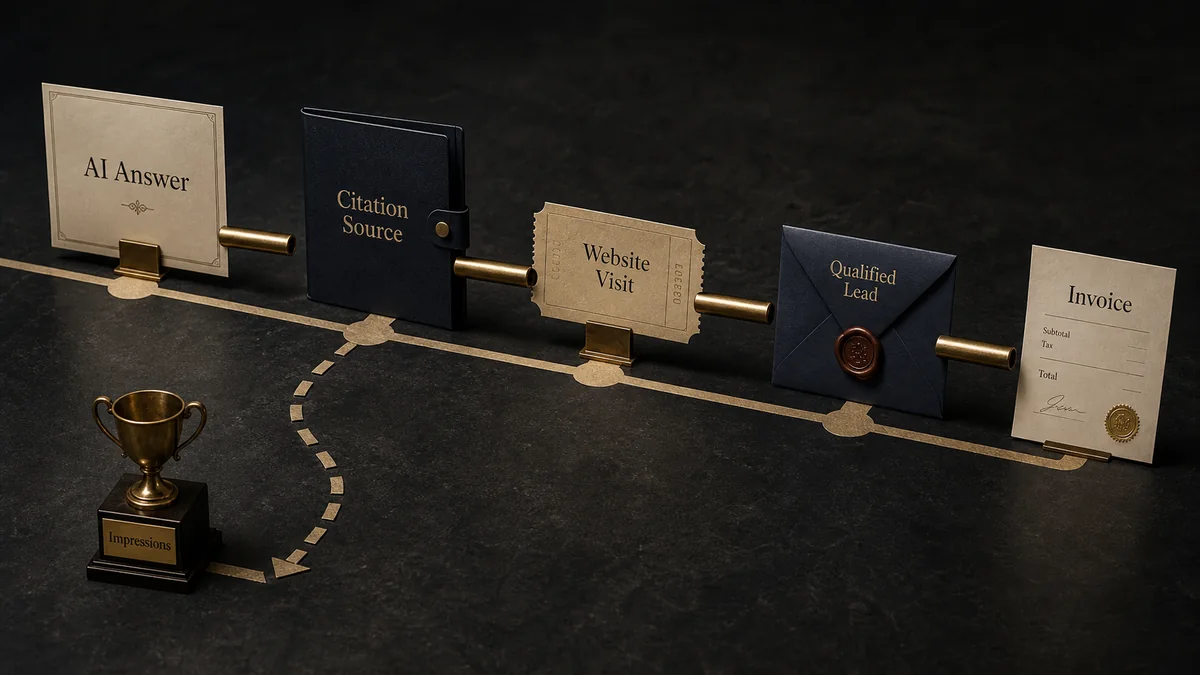
A healthy report shows the whole chain. It should tell you where the chain is strong, where it breaks, and what to fix next. If your business appears in AI answers but never gets cited, the issue may be source authority or content depth. If you get cited but no one clicks or calls, the issue may be weak offer clarity, poor conversion paths, or a recommendation that mentions you without making you compelling. If you get leads but they are unqualified, the issue may be prompt fit, positioning, or the wrong service pages being surfaced.
What To Measure Before Spending More
Before you throw budget at “AI SEO services,” measure the basics. Not because basics are glamorous. They are not. But they keep you from paying for advanced nonsense while the front door is locked.
Start with prompt coverage. Test realistic buyer prompts across ChatGPT, Gemini, Perplexity, and Google AI experiences where applicable. Record whether your business appears, which competitors appear, what sources are cited, and what reasons the answer gives.
Next, check citation and source quality. Do AI answers cite your website, directories, review platforms, news mentions, comparison pages, local listings, or third-party articles? If competitors are recommended and you are not, identify the evidence they have that you lack. Sometimes the difference is not a secret optimization trick. It is that their public proof is clearer.
Then connect traffic and leads. Look for AI referral traffic where available, but do not rely on it as the entire story. Many AI-assisted decisions will appear as direct traffic, branded search, local profile activity, or normal conversion paths. Use call tracking, form source fields, CRM notes, and intake questions to catch patterns.
Finally, connect qualified leads to revenue. Track close rates, average deal value, service category, location, lead quality, and sales cycle. AI visibility ROI is not just about more traffic. The bigger prize is fewer missed high-intent customers and less wasted spend.
A Simple Reporting Framework Owners Can Actually Use
A useful monthly AI visibility report should fit on one strong page before it expands into detail. The owner should be able to see what changed, why it matters, and what action comes next.
Include these five sections:
- AI answer presence: Which buyer prompts included your business, which did not, and which competitors appeared most often.
- Citation sources: Which sources AI systems used when discussing your business or competitors, including your site, profiles, reviews, directories, and third-party mentions.
- Conversion movement: AI referral visits when identifiable, assisted landing page activity, calls, forms, bookings, and qualified inquiries.
- Revenue context: Qualified opportunities, won deals, average value, service category, and whether AI-influenced leads behave differently from other channels.
- Fix list: The top three evidence, content, technical, or trust improvements most likely to remove the next bottleneck.

Notice what is missing: a giant vanity dashboard with 47 metrics and no decision. The goal is not to admire measurement. The goal is to decide what to fix so the business gets more of the customers it should already be winning.
Common Mistakes That Make AI Visibility Look Useless
The first mistake is measuring only mentions. Mentions are easy to count and easy to misunderstand. If an AI answer mentions your business as one of twelve options but gives no reason to choose you, that is not the same as a confident recommendation.
The second mistake is ignoring prompts that make you uncomfortable. If buyers ask comparison, pricing, location, “near me,” trust, or “who is best for” questions, those prompts belong in the audit. Measuring only prompts where you already look good is not reporting. It is decorating the scoreboard.
The third mistake is treating AI referral traffic as the only proof. AI influence can show up before the click, after the click, or without a clean referral label. That makes attribution messier, not impossible. Use multiple clues and be honest about confidence levels.
The fourth mistake is skipping conversion cleanup. If AI sends a qualified buyer to a confusing service page or a form that feels like tax paperwork, visibility did its job and the website fumbled.
How Nugentive Turns Measurement Into Action
An AI Visibility Audit should not end with “you are visible 38% of the time.” That is trivia unless it tells you what to do next. Nugentive looks at the full chain: crawler access, indexability, entity clarity, service and location signals, content usefulness, third-party trust, review evidence, citation patterns, and the actual answers AI systems give for buyer prompts.
From there, the work becomes practical. Fix pages AI systems cannot retrieve. Clarify services answer engines misunderstand. Strengthen weak proof with better reviews, citations, case studies, and source-worthy content. Track whether those fixes change recommendations, leads, and revenue over time.
That is the owner-friendly version of AI visibility ROI: fewer guesses, less wasted budget, a clearer fix list, and a better chance of being the business a buyer sees, trusts, and contacts when they ask an AI system who to choose.