What is the AI citation gap?
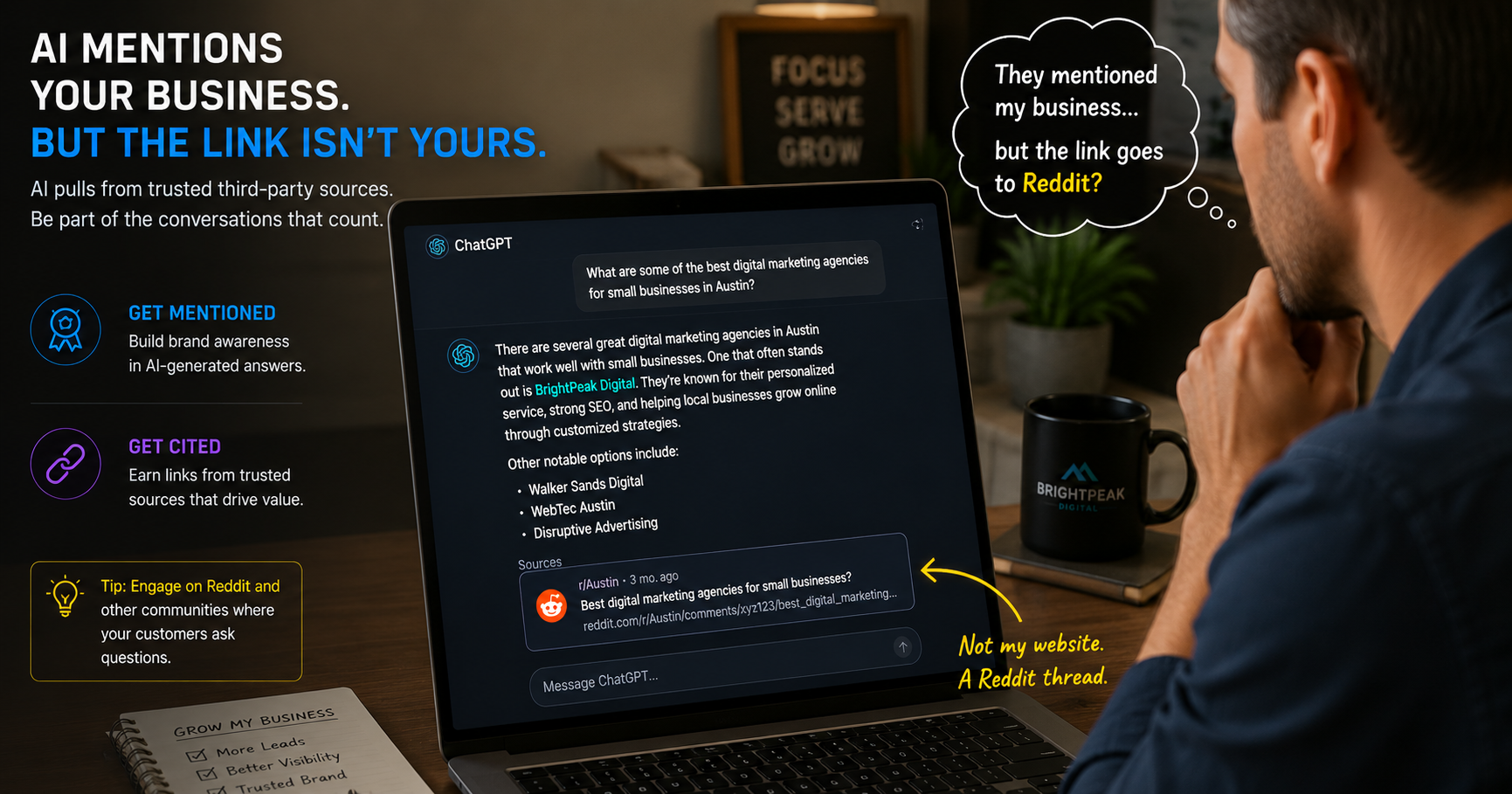
A potential customer asks ChatGPT for the best plumber in Calgary. Your business gets named in the answer. You feel good about it for about ten seconds, until you notice the actual link goes to a Reddit thread.
That's the citation gap. Your brand is mentioned, but a third-party site gets the click, the credit, and any traffic that comes from it. It happens constantly to small businesses, and most owners have no idea it's happening because they only check whether they're mentioned at all.
Being mentioned and being cited are two different things, and the gap between them is where most of your AI search opportunity is sitting.
What's the difference between an AI mention and an AI citation?
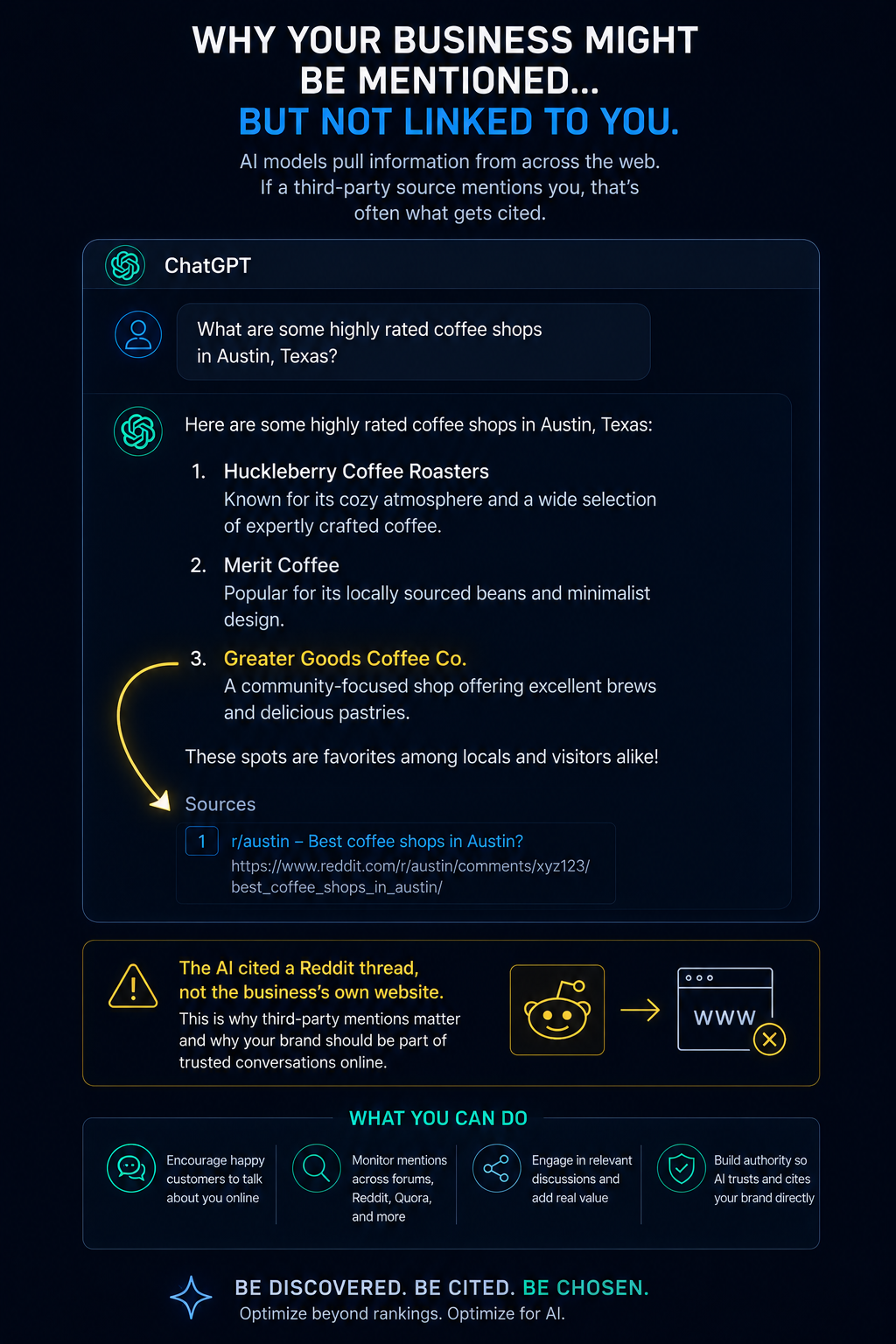
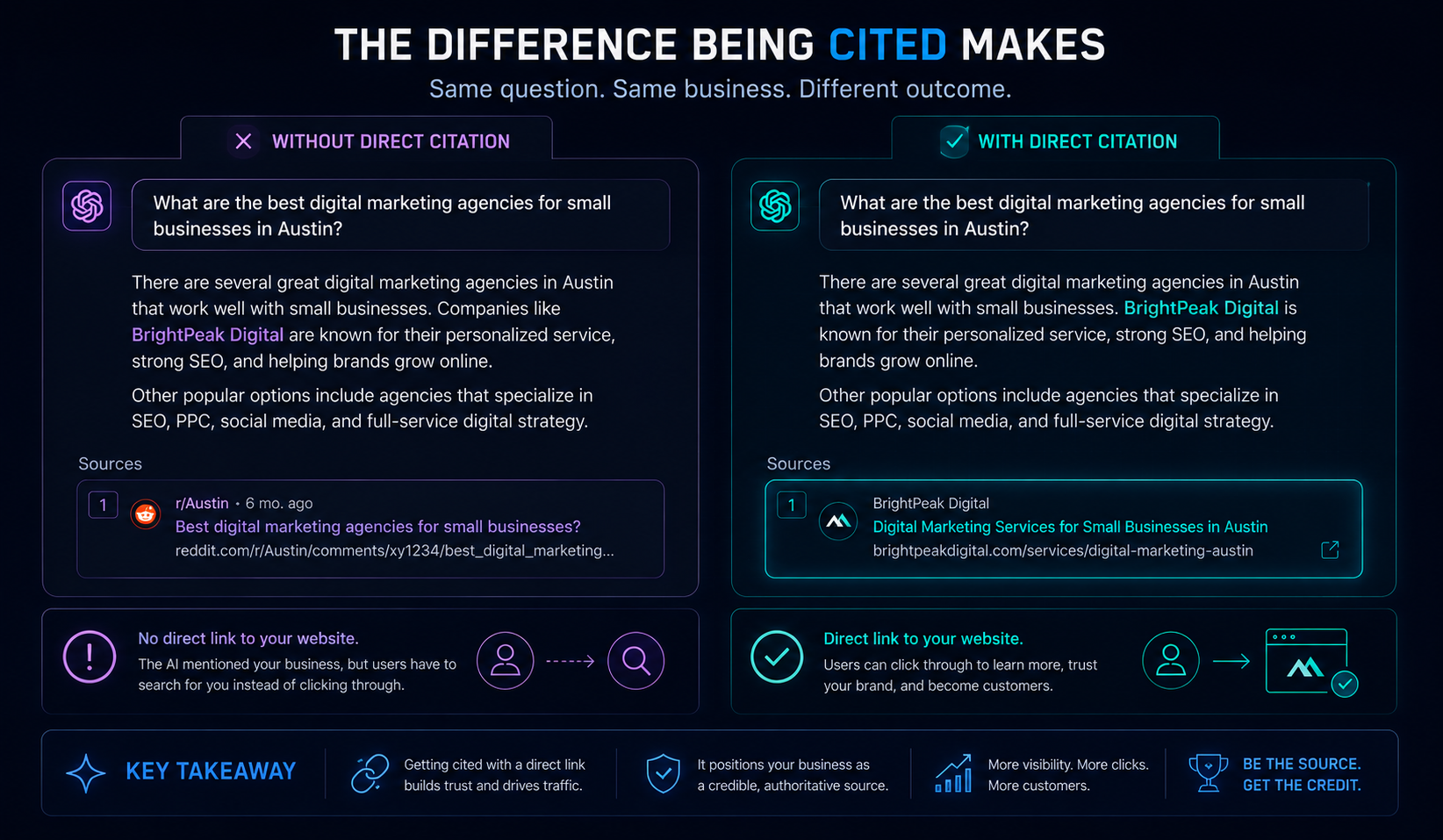
A mention is when an AI assistant says your business name in an answer. A citation is when it links to a specific page as the source for that claim.
Mentions are good for awareness. Citations are what drive clicks, traffic, and trust. When ChatGPT says "Bob's HVAC is well-reviewed in Calgary" but links to a Yelp page as the source, Yelp gets the visit. Bob gets a name-drop and nothing else.
Both matter, but they do different jobs. Mentions tell people you exist. Citations send them to you.
How can I tell if AI is citing my site or a third party?
The simplest check is to run the queries a real customer would ask, then look at where the source links actually point. Open ChatGPT, Perplexity, and Google's AI Overviews. Search for your business name, your trade in your city, and the most common questions a buyer would ask before hiring someone like you.
For each answer, note three things. Are you mentioned? Are you cited? If you're not the cited source, who is? That third column is the most important; it tells you which platforms AI already trusts for your category.
Why does AI cite other websites instead of mine?
AI assistants aren't trying to promote your business. They're trying to answer the user's question with the most credible evidence they can find. Your own website is rarely the most credible source on the question of whether you're any good.
Think about it from the AI's perspective. If a user asks "is this roofer reliable," your homepage saying "we're the most trusted roofer in town" is marketing copy. A Google Business Profile with 87 reviews averaging 4.8 stars is independent evidence. A Reddit thread with three customers describing their experience is firsthand testimony. The AI picks the evidence, not the marketing.
This is the same logic Google's E-E-A-T framework uses: Experience, Expertise, Authoritativeness, Trustworthiness. AI systems lean on the same signals. Independent corroboration beats self-promotion every time.
Why do AI tools trust review sites more than business websites?
Review sites carry a signal your own site structurally cannot: independent verification. A Google Business Profile with hundreds of star ratings or a Yelp listing with detailed customer write-ups gives AI something it can extract and present as evidence, not as a brand's claim about itself.
Your service page can be beautifully written and still get skipped, because for evaluative queries like "is X any good" or "best X in Y," AI is specifically looking for sources that aren't the brand. That's not bias against you. It's the same instinct a careful buyer would have.
Which third-party sources does AI cite for local businesses?
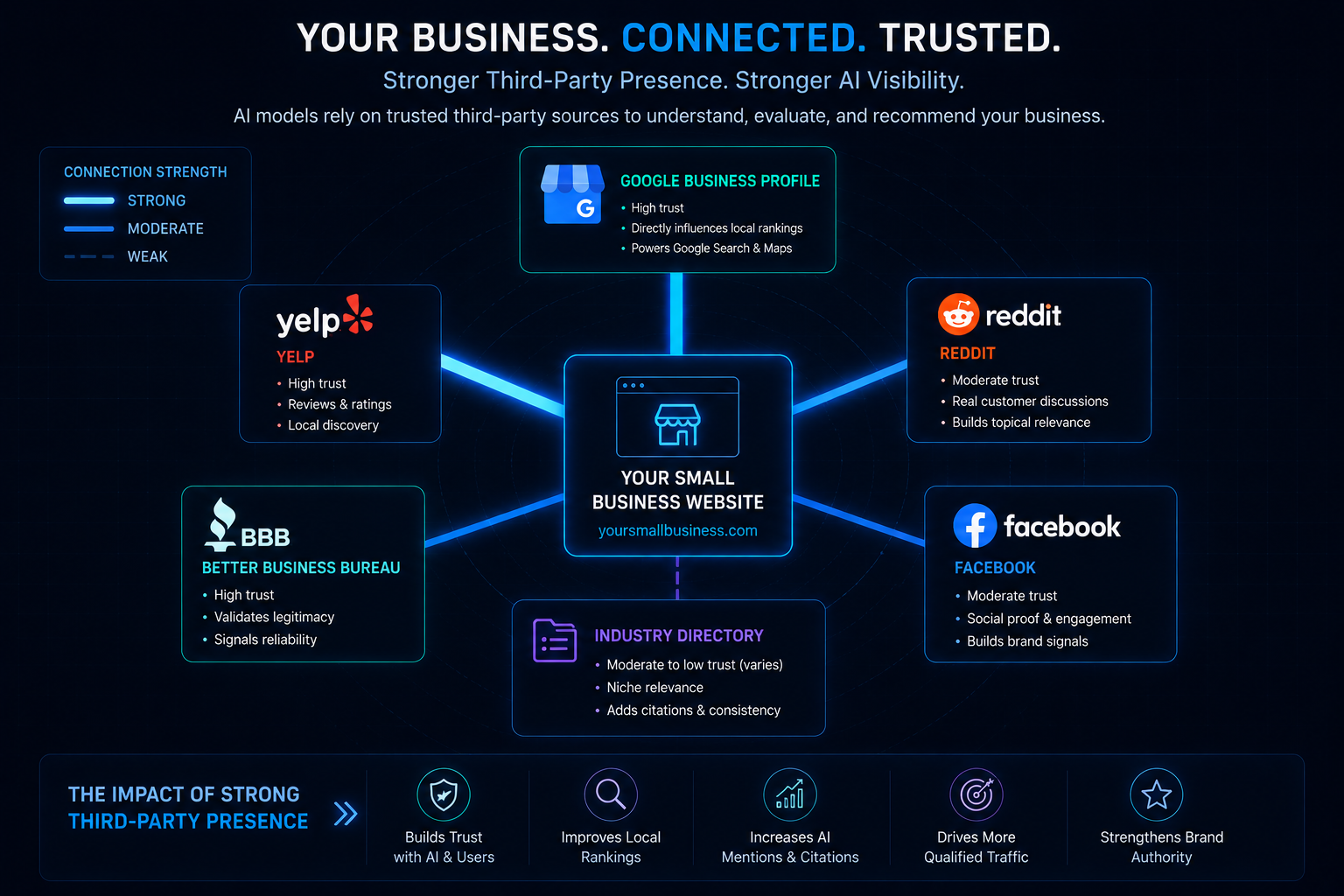
The mix varies by category, but for local service businesses and SMBs the pattern is fairly consistent.
Google Business Profile reviews and Q&A
Yelp listings and review pages
Reddit threads in city or trade subreddits like r/Calgary, r/HVAC, r/Plumbing
Better Business Bureau profiles
Local news coverage and trade publication writeups
Facebook business page reviews
Industry directories like Angi, HomeStars, or HomeAdvisor
For B2B and professional services, the mix shifts toward G2, Capterra, LinkedIn posts, and industry publications. Either way, the principle is the same: AI cites the platforms where independent voices have already validated your business.
If you're not present on those platforms, or your presence is thin or out of date, AI has nothing to cite about you, even if it knows your name.
Can my site rank on Google but still not get cited by AI?
Yes, and it happens all the time. You can rank on page one for "best electrician [your city]" and still be invisible in AI answers for the exact same query.
Search rankings reward backlinks, on-page SEO, and technical health. AI citation rewards entity recognition, cross-platform corroboration, and content that's structured cleanly enough to be extracted as a standalone answer. There's overlap, but they're not the same game.
A site can have great SEO and terrible AEO. The pages rank, but the content is buried under three paragraphs of throat-clearing before the actual answer shows up. AI skips it. The site has no Reddit footprint, no Q&A on Google Business Profile, and only a handful of reviews, so AI has no independent signal to cross-reference. The brand stays invisible.
Does optimising for AI hurt my Google rankings?
No. The structural moves that make a page citation-friendly, clean headings, single-purpose paragraphs, FAQ sections with proper schema, direct answers near the top, also tend to improve traditional search performance. The two strategies stack rather than compete.
What should I fix on my own site to get cited by AI?
Two problems usually combine to keep a small business out of AI citations: your own pages aren't citation-shaped, and you have no third-party footprint. The site fixes are the faster wins.
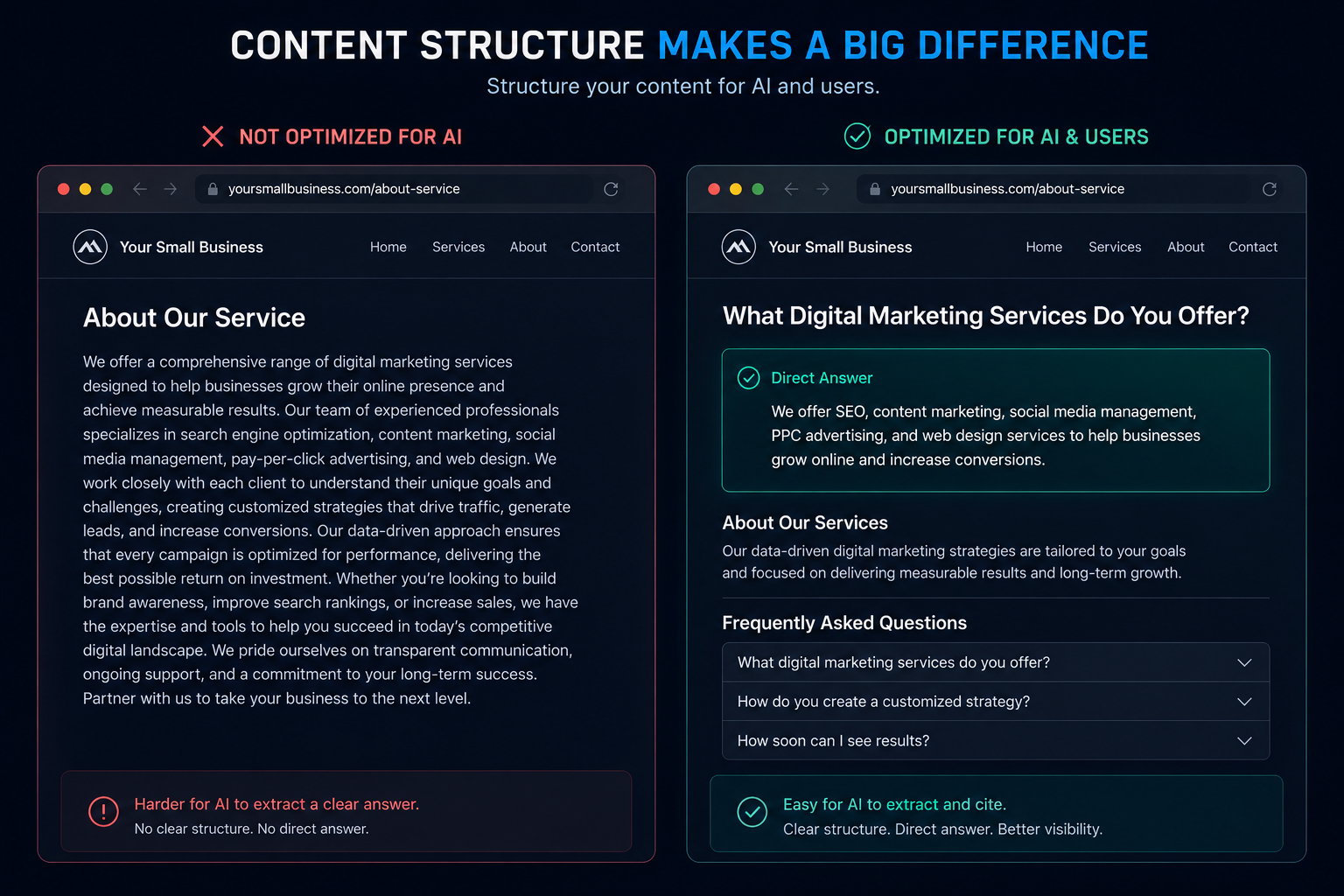
Lead with the answer
Every section of every page should open with a direct, complete answer to the question that section addresses. AI extracts from the top of sections first. If your "Service Areas" page opens with a paragraph about your founding story, AI gets nothing useful from the first chunk and often skips the whole section.
Use descriptive, question-shaped headings
A heading like "Our Process" tells AI nothing. A heading like "How a residential furnace tune-up works" gives AI a clear label to match against a user's question. Treat every heading as an index entry, would an AI looking for the answer to a specific question pick this section?
Keep paragraphs single-purpose
One idea per paragraph. AI extracts answers in chunks, and multi-idea paragraphs force it to make judgment calls about what to pull. Single-purpose paragraphs get cited cleanly.
Add real FAQ sections with FAQ schema
This is the highest-leverage fix most small business sites are missing. A page with three to five real questions, each with a complete two-to-four sentence answer, marked up with FAQPage schema, gives AI exactly the structure it wants to extract.
Make your business identity machine-readable
Your name, address, phone number, service area, and primary services should appear on every page in a consistent form, ideally with LocalBusiness schema. AI systems can't cite a business they can't unambiguously identify.
What should I fix off my site to get cited by AI?
The on-site fixes get your pages in shape. The off-site work earns you the independent corroboration AI uses to decide whether to trust those pages.
Keep your Google Business Profile complete, current, and active. Post updates, answer Q&A, respond to every review.
Build a steady review pipeline on the two or three review sites AI is already citing for competitors in your category.
Participate authentically in your trade or city subreddit when you have something genuinely useful to say. Authentic contributions get cited; advertising gets ignored or removed.
Pursue local press and trade coverage. A single mention in a regional paper or trade publication carries more citation weight than a dozen low-authority directory listings.
Keep your details consistent across every platform. Mismatched names, addresses, or phone numbers split your entity in AI's view and weaken every signal.
How do I know if I'm getting cited by AI more often?
You don't need an enterprise tool to track this. You need a repeatable check you actually run.
Pick the ten most important queries a real customer would ask before hiring you. Run them in ChatGPT, Perplexity, and Google's AI Overviews on the first of every month. For each answer, log three things: whether you're mentioned, whether you're cited with a direct link, and which other source got cited if it wasn't you.
Three months of that log will tell you more than any dashboard. The mentions move first. The citations follow. If neither is moving, the gap isn't closing, and the problem is almost always either content that AI can't extract or a third-party footprint that doesn't exist yet.
The citation gap is fixable, but it doesn't fix itself. It needs a deliberate plan covering both your own site and the platforms AI already trusts in your category.
A free Nugentive AEO audit shows you exactly where your citation gap is, which pages are extractable, which aren't, where your third-party footprint is thin, and which competitors are already getting cited for the queries you should own. Run yours at.