What this list actually is, and isn't
Most "AEO tips" lists are recycled SEO advice with the word "AI" pasted in. This one is different. Every tip below is either backed by research on what AI assistants actually cite, or named because it's being sold to small businesses and quietly not working.
The split matters. A small business owner has a finite Saturday morning. Spending it on llms.txt files or "AI directory submissions" is a waste. Spending it on a Foursquare claim and a Bing Places import is a measurable visibility move within weeks.
Seven tips that work. Four tactics to ignore. All of it sourced from research published between late 2025 and early 2026.
Tip 1: Claim your Foursquare listing, even if you've never used it
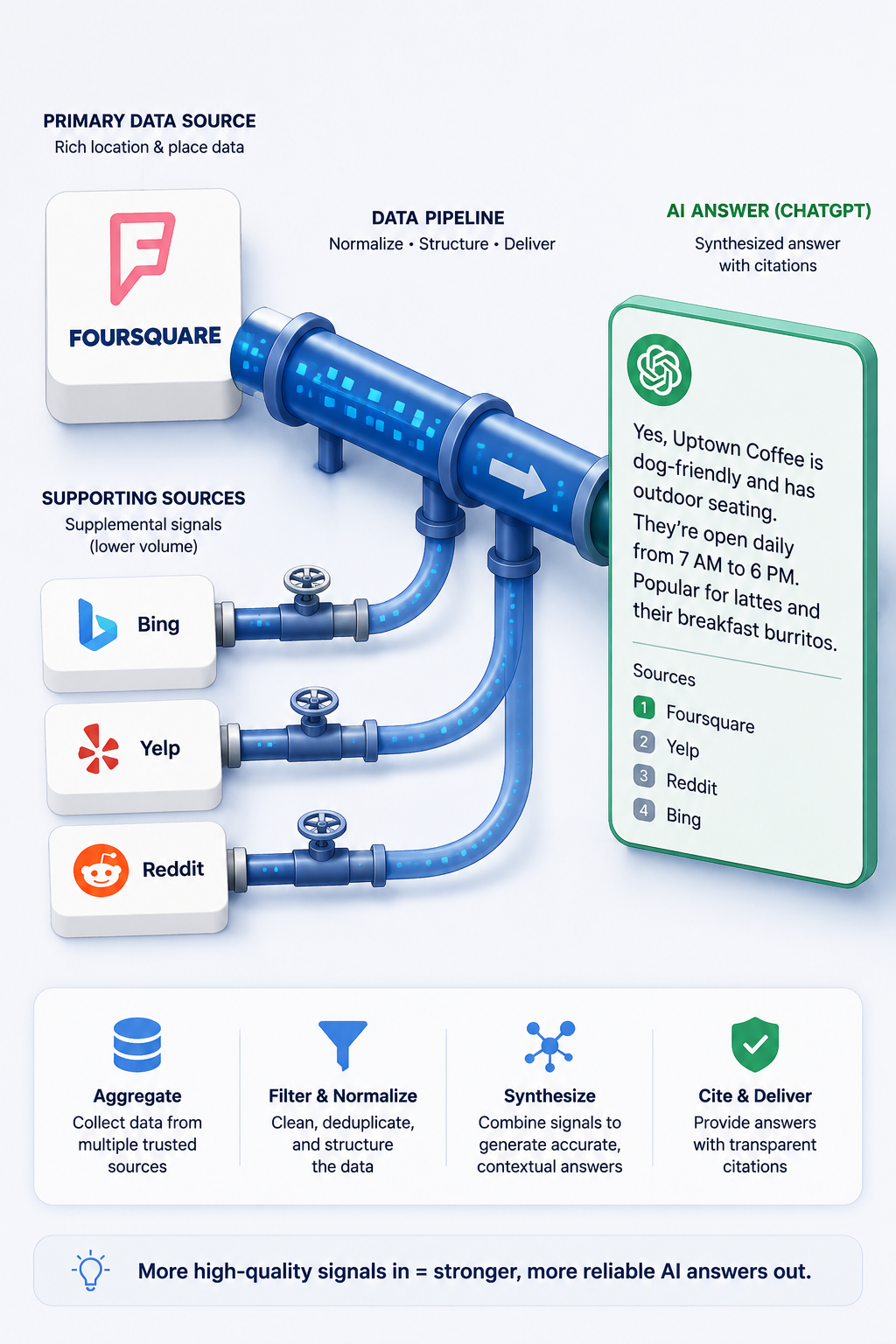
Foursquare is the single highest-leverage AEO move most local businesses have never made. Industry analyses estimate Foursquare's data feed powers roughly 70% of ChatGPT's local recommendations. That's because ChatGPT doesn't have a direct Google Business Profile integration; it pulls from Foursquare's database, supplemented by real-time Bing.
Most small business owners have never logged into Foursquare. Many have a stale listing from a check-in app they used in 2014. That listing is still flowing into ChatGPT's answers right now, with whatever errors it has.
Go to foursquare.com/business, claim your listing, fill out every field, name, address, phone, hours, categories, photos, description, and attributes. Post-claim, ChatGPT visibility for local queries typically shifts within two to four weeks.
Tip 2: Import your Bing Places listing in five minutes
ChatGPT's real-time web layer runs on Bing. Bing Places is the canonical Bing index entry for your business. If you have a Google Business Profile, claiming Bing Places is a five-minute task and one of the highest-ROI moves in local AEO.
Go to bingplaces.com. Click "Import from Google." Bing pulls your GBP data and creates the listing in about ten minutes. Verify ownership, fix anything that drifted in the import, and you're done. Note that ChatGPT doesn't read Bing Places data directly the way Bing's own search does, but a strong Bing Places listing improves how your business ranks in Bing's organic web results, and that's the index ChatGPT searches.
Tip 3: Make NAP character-identical across every listing
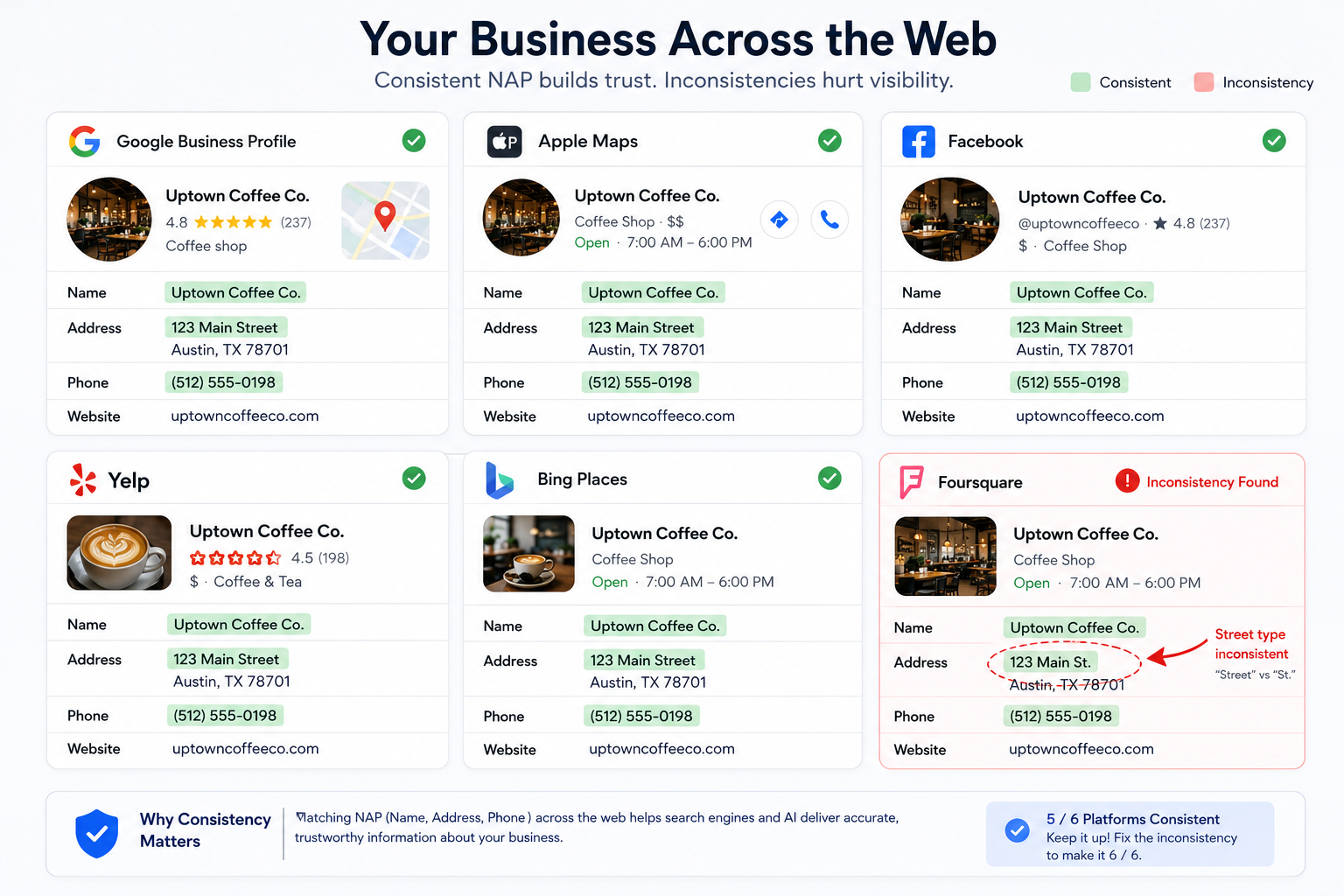
NAP (Name, Address, Phone) has to match exactly on every platform. Not roughly. Character-identical. "123 Main Street" and "123 Main St" are different signals. "Joe's Pizza" and "Joe's Pizza Restaurant" are different entities. Mismatches split your business in AI's view and lower the confidence score every signal feeds into.
Pick a canonical format and propagate it. Walk through your website footer, Google Business Profile, Bing Places, Foursquare, Yelp, Apple Maps, Facebook, Better Business Bureau, and any industry directory. Anywhere they don't match, fix the directory. Research suggests businesses with consistent NAP across 85% or more of their citations see roughly a 23% improvement in local pack rankings, and the same consistency feeds AI entity recognition directly.
Tip 4: Add real FAQs, not bare FAQ schema
Here's where most AEO advice goes wrong. Adding FAQ schema to a page without real FAQ content is worse than doing nothing. One study cited in late-2025 research found pages with cosmetic FAQ schema averaged slightly fewer ChatGPT citations than pages without, likely because the schema signalled FAQ content and AI then found nothing useful to extract.
The version that actually works: write three to five real questions a customer asks before hiring you, write complete two-to-four-sentence answers, then mark up the section with FAQPage schema. The schema is a signal that says "extractable Q&A is here." If the Q&A is real, it gets extracted. If it's empty, the signal hurts you.
Tip 5: Make your reviews recent and responded to, not just numerous
AI assistants don't just count reviews. They look at recency, response rate, and patterns of customer language across review platforms. A business with 200 stale reviews and zero responses performs worse in AI recommendations than a business with 50 recent reviews and a 100% response rate.
Two simple commitments: respond to every review, ideally within 24 hours, and keep a steady review pipeline going so the most recent batch isn't from two years ago. The response itself is content AI reads; it can extract phrases like "we appreciate the feedback about our weekend rates" as evidence the business is active and customer-focused.
Tip 6: Show up on Reddit, but only authentically
Reddit accounts for a meaningful share of citations, particularly on Perplexity; one analysis put it at roughly 24% in some categories, with that share growing 73% between October 2025 and January 2026. AI assistants treat Reddit as firsthand testimony, which is why threads about your trade or city show up in their answers more often than your homepage does.
The only Reddit strategy that works for AEO is genuine participation. Find the two or three subreddits relevant to your trade and your city. Answer questions when you have something useful to say. Don't pitch. Don't drop your business name unprompted. Authentic contributions get cited; promotional ones get ignored, downvoted, or removed by mods. Even one or two helpful threads a month, sustained, builds the kind of footprint AI uses to corroborate your business.
Tip 7: Run the search yourself once a month
The cheapest AEO measurement system is a spreadsheet and ten searches.
Pick the ten queries a real customer would ask before hiring you: your trade in your city, common pricing questions, common comparison questions, and your brand name. Run them in ChatGPT, Perplexity, and Google's AI Overviews on the first of every month. For each result, note three things: whether you're mentioned, whether you're cited with a link, and which other source got the citation if it wasn't you.
Three months of that log shows you everything a paid AEO tool would, for the level of detail a small business actually needs. Tools like Otterly, Profound, or HubSpot's AEO product earn their keep at a different scale, for a single-location SMB starting out, the spreadsheet is enough.
Stop wasting time on these four tactics
These are the AEO tactics being sold to small businesses right now that the data does not support.
llms.txt files. A test across 40 sites found only 12% saw any citation increase after 60 days. Google executives have publicly dismissed the format and no major AI company endorses it. If a consultant's pitch leans on llms.txt as a differentiator, that's a tell.
"AI directory submissions." A category largely invented by the people selling the service. AI engines don't crawl "AI business directories" with priority over normal directories, and most are zero-traffic single-page sites.
FAQ schema on every page without real FAQs. As covered above, cosmetic schema without real Q&A content is a small negative, not a positive. Schema is a signal that promises extractable content; an empty signal hurts you.
Keyword density tactics. A 2026 analysis of 1,548 brands found zero correlation between AI visibility and keyword density. The factors that did correlate: review presence, Wikipedia mentions, and genuine category authority; none of which are keyword-density problems.
If your AEO consultant is leading with any of these, ask for the citation data. The honest ones will admit the tactic is a hangover from older SEO playbooks.
Where to start if you only have one Saturday
If you're going to do exactly one of these in the next week, claim Foursquare. It's the highest-leverage move with the largest single payoff for local AEO, and most owners have never even logged in.
If you have a full Saturday morning, do Foursquare, Bing Places, NAP cleanup, and add one real FAQ section to your homepage. That's a meaningful baseline, and it's all owner-doable without an agency.
A free Nugentive AEO audit shows you what's still missing after that, which schema is broken, which competitors are getting cited for queries you should own, and where your third-party footprint needs work. Run yours at.