
Agent Browsers Are the New Customer Proxy
AI agent browser readiness is the work of making your website usable when a software agent, not a patient human with coffee and unlimited tolerance, is trying to inspect it on behalf of a buyer.
That is no longer a sci-fi edge case. Cloudflare just announced Kitesurf, an agent-first browser that runs in V8 isolates on Cloudflare Workers, and framed it as infrastructure for AI agents that need to browse the web at scale (https://blog.cloudflare.com/kitesurf/). In the same launch wave, Cloudflare argued that sites now need to be readable, discoverable, callable, and payable for agents, not just pretty for human visitors (https://blog.cloudflare.com/the-agentic-internet/).
For a business owner, the practical question is not, “Should I become an expert in agentic browser infrastructure?” Please do not add that to your week unless you are actively avoiding something worse. The better question is: if an AI assistant checks my site before recommending, comparing, booking, or calling, will it find the information a customer needs to choose us?

What an Agent Browser Changes
Traditional search mostly asked whether your pages could be crawled, indexed, understood, and ranked. That still matters. Google’s crawler documentation still separates different crawlers and fetchers by job, and site owners still need to avoid accidentally blocking the systems that discover or render content (https://developers.google.com/crawling/docs/crawlers-fetchers/overview-google-crawlers). Boring? Yes. Optional? No.
Agent browsers add a different layer. Instead of only collecting pages for an index, an agent may be trying to complete a task: compare providers, check service details, verify pricing context, inspect reviews, find a booking path, or summarize whether your business is a credible fit. Cloudflare’s WebMCP preview even describes making websites usable by browser AI agents without requiring a new origin API, while keeping the human in control (https://blog.cloudflare.com/webmcp/).
That shift changes the owner outcome. Your site is not just trying to win a blue-link click. It is trying to survive a machine-assisted buying process where the customer may ask an assistant who to trust, skim the recommendation, and move on with their life. Very rude. Also very real.
This does not mean every small business needs a custom MCP server, agent wallet, or whatever acronym gets launched next Tuesday. It means your public website has to make important customer decisions easy for both humans and machines.
The Readable, Provable, Actionable Test
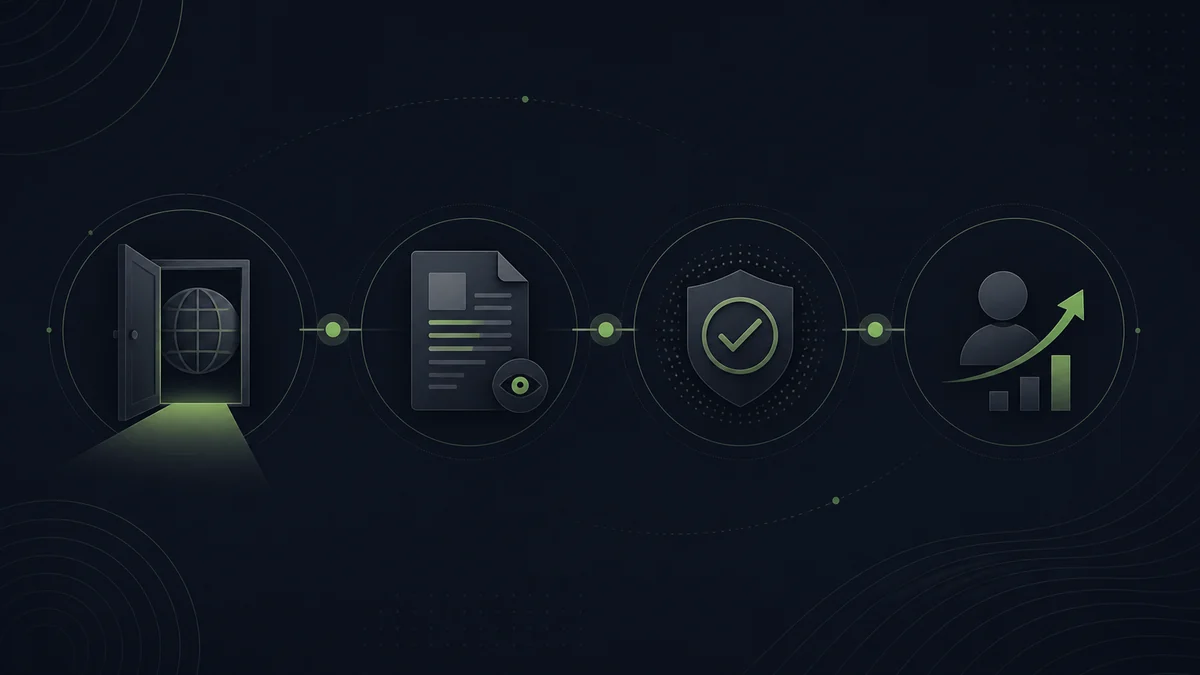
Nugentive’s simple test for AI agent browser readiness is readable, provable, and actionable.
Readable means the important information is available as normal page content. Your services, locations, audience, pricing context, process, limitations, and next steps should not be trapped inside images, vague hero copy, hidden accordions that never render cleanly, or scripts that break when a nonstandard visitor shows up. A beautiful website that hides the answer is still hiding the answer. Design awards do not pay invoices, sadly.
Provable means the agent can find evidence that supports your claims. Reviews, case studies, credentials, local listings, author profiles, service examples, comparison pages, and consistent third-party mentions all help an answer system understand whether you are a real option or just another site saying “trusted solutions.” If everyone says they are trusted, nobody has said anything useful.
Actionable means the path to the next step is obvious. Can the agent or user identify how to call, book, request a quote, compare plans, check service areas, or understand what happens next? If your contact path is a maze, AI will not admire the journey. It will probably recommend someone else with fewer interpretive dance requirements.
Why This Matters for AI Visibility
AI visibility is not about tricking ChatGPT. It is about making your business retrievable, understandable, trusted, cited, and recommended across the places AI systems use to form answers.
Agent browsers make that definition more operational. They expose the gap between “our website exists” and “our website can be used as evidence during a buyer task.” That gap can cost real opportunities, especially for service businesses where customers compare options before they ever fill out a form.
Google’s AI features guidance says site owners do not need special markup to appear in AI experiences and should continue following Search essentials around accessible, helpful, eligible content (https://developers.google.com/search/docs/appearance/ai-features). That is useful grounding. There is no magic “agent browser schema” that guarantees recommendations. If someone is selling that, ask whether the warranty is printed on pixie dust.
But fundamentals need to be applied differently when the buyer journey includes AI assistants. Content needs to answer the actual pre-sale questions. Technical access needs to be tested beyond robots.txt. Proof needs to be easy to connect to the service. Conversion paths need to be clear enough that a person, search engine, or delegated assistant can understand what to do next.
Common Ways Sites Fail Agent Browsers
Most failures are not dramatic. They are small frictions stacked into a wall.
- The important answer is only in a hero image, PDF, video, or decorative component.
- Service pages talk in broad categories instead of specific buyer problems.
- The site blocks or challenges unfamiliar automated visitors at the CDN, firewall, security plugin, or origin server.
- Reviews, locations, staff names, hours, and service details are inconsistent across the site and third-party sources.
- Contact and booking paths require too many unclear steps.
- Pricing context is absent, even when buyers clearly need a range, qualifier, or explanation.
- Internal links do not connect service pages, proof pages, FAQs, and comparison content.
- The site has content, but no clear reason the business should be recommended over competitors.
A site can have perfect robots.txt rules and still get blocked by Cloudflare like an overzealous nightclub bouncer. It can also be technically accessible while saying almost nothing useful. Agent readiness needs both access and substance.

A Practical Readiness Checklist
Start with the customer decision that matters most. Do not audit every possible agent scenario. That is how useful projects become haunted spreadsheets.
Use this sequence:
- Pick one revenue-producing service or offer.
- Ask what a buyer would need to know before choosing you.
- Check whether the service page answers those questions in plain, crawlable text.
- Confirm the page explains who the service is for, who it is not for, what happens next, and what proof supports it.
- Review robots.txt, meta robots, sitemap inclusion, server responses, CDN rules, WAF settings, and security plugins for accidental access blocks.
- Test key pages with normal browser rendering and text-only extraction to see what survives.
- Compare your proof against the competitors AI systems already mention.
- Fix the pages, sources, and conversion paths that influence real customer decisions first.
That last phrase matters: real customer decisions. Agent browser readiness is not a scavenger hunt for perfect technical scores. It is a way to remove the reasons AI-assisted buyers cannot understand, trust, or act on your business.
Where Nugentive Fits
Nugentive treats AI agent browser readiness as part of a larger visibility diagnosis, not a standalone gimmick. We look at whether AI and search systems can access your pages, understand your positioning, find proof, compare you fairly, and connect a recommendation to a next step that could become revenue.
The useful deliverable is not “your site scored 73 on a tool.” The useful deliverable is a prioritized fix list: unblock this, rewrite that service page, strengthen this proof source, clean up those listings, add this comparison answer, and stop paying for traffic that lands on a page doing its best impression of a locked filing cabinet.
If you want to know whether your website is ready for AI-assisted buyers, Nugentive’s paid $297 detailed AI Visibility Audit gives you the access, answer, proof, and conversion gaps to fix first. No publishing tricks. No guaranteed AI recommendations. Just the next practical work that makes your business easier to find, understand, trust, and choose.