
The Shortcut Is Usually the Long Way Around
If you want to know how to rank in ChatGPT search, start with the boring answer: make your business easy to find, understand, trust, compare, and contact across the sources AI systems can use. Not glamorous. Also not optional.
The bad version of this advice sounds like “add an llms.txt file, sprinkle schema, and wait for the robot applause.” Useful pieces? Sometimes. A strategy? No. If one file made ChatGPT recommend your business, every SEO plugin would now include a tiny money printer and a confetti cannon.
The owner question is simple: when a buyer asks an AI tool who to hire, what to buy, or which company to trust, does your business have enough accessible evidence to deserve a place in the answer?
What ChatGPT Search Has to Work With
AI search systems do not rank businesses by reading your hopes. They form answers from retrievable information: accessible pages, referenceable sources, understandable entities, and public proof that makes a recommendation defensible.
OpenAI publishes crawler documentation for site owners, including GPTBot and OAI-SearchBot (https://platform.openai.com/docs/bots). Google’s AI features guidance points site owners back to Search fundamentals: accessible, indexable, helpful content and eligible preview controls (https://developers.google.com/search/docs/appearance/ai-features). Bing’s Webmaster Guidelines emphasize crawlability, quality, relevance, and trustworthy site signals (https://www.bing.com/webmasters/help/webmaster-guidelines-30fba23a).
That tells owners something important. Ranking in ChatGPT search is not a separate trick drawer. It sits on top of the same evidence: clear service pages, crawlable content, useful answers, local proof, consistent details, and third-party mentions.
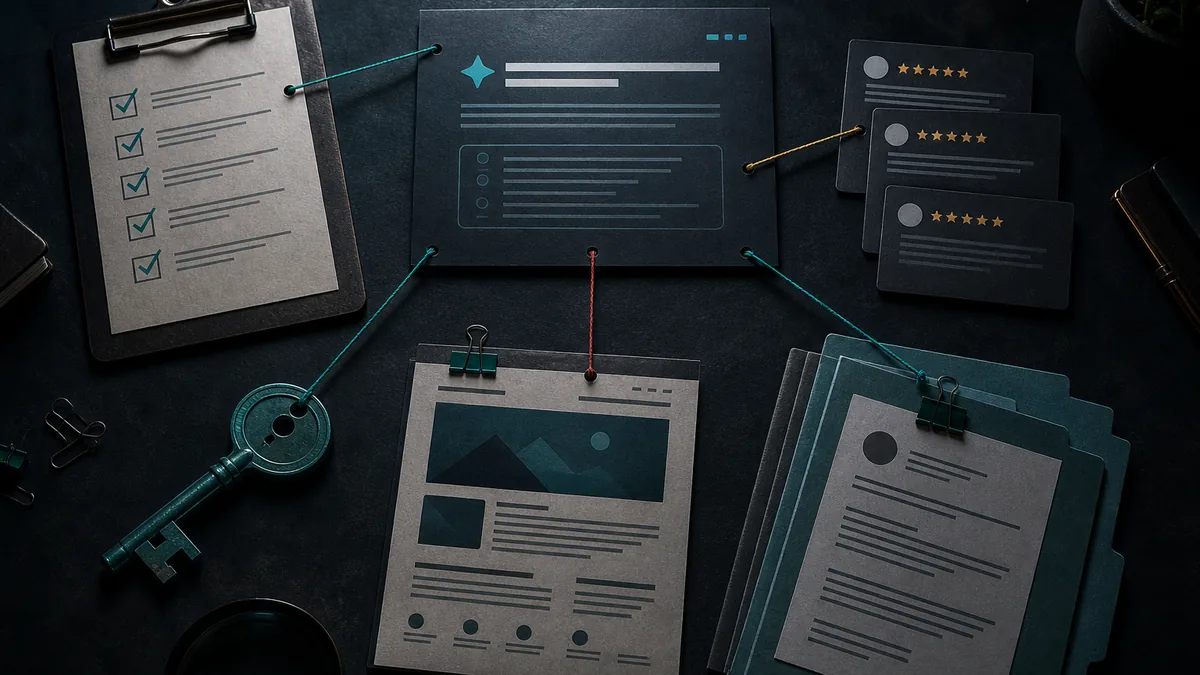
The difference is the finish line. Traditional SEO asks whether your page appears in search results. AI visibility asks whether your business becomes part of the answer, citation set, shortlist, or recommendation before the buyer clicks anything.
The Five-Part ChatGPT Search Readiness Framework
Nugentive looks at ChatGPT search visibility through five practical layers. None guarantees a recommendation. Together, they reduce the reasons an AI system might ignore you, misunderstand you, or pick a competitor with better public evidence.
- Retrievability: Can crawlers and search systems access the pages that explain what you do, who you serve, and where you operate?
- Clarity: Do your pages use plain, specific language that matches how buyers ask for help?
- Proof: Do reviews, case evidence, credentials, comparisons, photos, directory profiles, and third-party mentions support your claims?
- Extractability: Can a machine pull direct answers, service details, prices or ranges where appropriate, locations, qualifications, and next steps without decoding a brochure written by committee?
- Conversion path: When a buyer does visit, can they quickly understand the offer and take action without entering a form maze designed by a suspicious raccoon?
Start there before buying another “AI ranking hack.” Most businesses have a public-evidence problem, a confusing-page problem, or a trust problem that AI systems make more visible.
Fix the Pages Buyers Actually Need
The fastest useful work usually starts with service and comparison pages. Each high-value service should state the service, location relevance, buyer problem, qualifications, process, proof, objections, and next step.
AI answers often need concise, quotable passages. “Innovative solutions for modern businesses” gives a machine almost nothing. “We help Denver homeowners replace hail-damaged roofs, document insurance evidence, and schedule code-compliant repairs” gives humans and machines something concrete.

Use direct-answer sections near important page tops. Add short definitions, plain-language criteria, location details, service boundaries, and proof points. Google’s helpful content guidance is still a good sanity check: content should be created for people first, demonstrate experience or expertise where relevant, and avoid being made mainly to manipulate rankings (https://developers.google.com/search/docs/fundamentals/creating-helpful-content).
The goal is not to write for robots. The goal is to stop making robots guess what a human buyer would have understood if your page were clearer.
Make Technical Access Less Dramatic
Before wondering why ChatGPT search does not mention you, confirm that important pages can be crawled, indexed, and rendered. Robots.txt rules, noindex tags, canonical tags, sitemap coverage, CDN settings, WAF rules, and bot controls can all decide content availability. A site can have perfect marketing copy and still get stopped at the door by security wearing sunglasses indoors.
Check the basics:
- Make sure service pages return normal 200 status codes and are not blocked by robots.txt.
- Confirm important pages do not carry accidental
noindexdirectives. - Review canonical tags so valuable pages do not point somewhere irrelevant.
- Check whether CDN, firewall, or bot-management rules block legitimate crawlers.
- Keep XML sitemaps clean, current, and focused on indexable pages.
- Use structured data where it accurately describes real content, not as decorative JSON confetti.
Schema can help machines understand entities, services, locations, FAQs, reviews, and organization details when implemented honestly. It is not a bribe. It is a label.
Build Proof Outside Your Own Website
ChatGPT search visibility is harder when your entire reputation lives on your own domain. Your website can claim you are trusted. Reviews, directories, partner mentions, local profiles, earned media, industry listings, podcasts, case studies, and customer language help make that claim less lonely.
This is where owners can make steady progress without turning marketing into a moon landing. Clean up Google Business Profile details. Make NAP information consistent across major directories. Ask for detailed reviews that mention the actual service, location, and outcome. Pursue third-party mentions that match your category, not random backlinks from websites assembled during a power outage.
Fresh industry coverage points at the same measurement problem. Search Engine Land reported that AI systems may cite content without naming the brand, creating “ghost citation” gaps in visibility reports (https://searchengineland.com/ghost-citation-problem-ai-483794). Another Search Engine Land article covered a large AI Mode citation study and the way specific passages may be highlighted and reused (https://searchengineland.com/what-15-7-million-ai-mode-citations-reveal-about-getting-quoted-by-google-483393). Treat those as industry signals, not universal law. The owner takeaway is practical: source-worthy passages and visible brand proof matter.

If AI systems can find ten clear signals for your competitor and two vague signals for you, do not be shocked when the competitor gets the cleaner recommendation.
Measure Prompts, Sources, and Outcomes
A serious ChatGPT search visibility program should measure more than mentions. Mentions can wobble by prompt wording, location, model, device, freshness, and source availability. If your reporting treats one prompt result like gravity, the spreadsheet is wearing a costume.
Track practical signals instead:
- Which buyer prompts matter most for revenue?
- Which competitors appear repeatedly?
- Which sources are cited or referenced?
- Which of your pages are eligible, accessible, and useful?
- Which third-party profiles or reviews support your claims?
- Do AI referrals, branded searches, calls, forms, or assisted conversions change after improvements?
The useful goal is not “force one AI answer to say your name today.” The useful goal is to improve the evidence environment around your business so recommendation systems have more reasons to include you over time.
What to Do This Week
If you want a practical starting plan, do this in order.
- Pick five high-intent buyer questions, not fifty vanity prompts.
- Search those questions in ChatGPT, Google AI features where available, Perplexity, and standard Google results.
- Record which competitors appear, which sources get cited, and which claims are repeated.
- Audit your matching pages for clarity, crawlability, proof, structured data, and conversion path quality.
- Fix the highest-value page first, then improve supporting proof outside your site.
- Recheck the same prompt set on a schedule, but do not panic over single-result movement.
Owners usually prefer fix lists. They are cheaper than panic and easier to hand to a team.
The Nugentive View
Ranking in ChatGPT search is not about tricking ChatGPT. It is about making your business retrievable, understandable, trusted, cited, and recommended across the places AI systems use to form answers.
If your site is blocked, vague, thin on proof, inconsistent across the web, and hard to contact, AI search will not politely solve that for you. It will move on to a business with cleaner evidence. Efficient, in the most annoying way possible.
Nugentive’s AI Visibility Audit looks at practical blockers: crawl access, service-page clarity, prompt visibility, competitor recommendations, source gaps, local proof, structured data, and conversion friction. The deliverable is not a magic score. It is a prioritized list of what to fix so more of the right customers can find, trust, and contact you.
If you want to know how to rank in ChatGPT search, start there: better evidence, cleaner access, clearer pages, stronger proof, and fewer expensive guesses.