Your Customer Wants an Answer, Not Another Tab
AEO for small business is the work of making your company easy for search engines and AI assistants to understand, quote, compare, and recommend when a customer asks a real buying question. It builds on ordinary SEO rather than replacing it. The practical goal is not to win an acronym contest. It is to help more qualified customers find a clear answer, trust the evidence behind it, and take the next step.
A customer might ask Google, ChatGPT, or another assistant, “Who repairs old slate roofs near me?” or “Which bookkeeper works with construction companies?” The system has to identify plausible businesses, understand what each one does, compare available evidence, and assemble a useful response. If your website says “quality solutions for every need,” the system has learned roughly nothing. Your customer has not learned much either.
The good news is that small businesses do not need to become software companies. They need accurate public facts, useful pages, credible proof, consistent local information, crawlable content, and a conversion path that does not make people solve a puzzle before calling.
Good AEO makes the business easier to retrieve, verify, explain, and choose.
What Answer Engine Optimization Changes
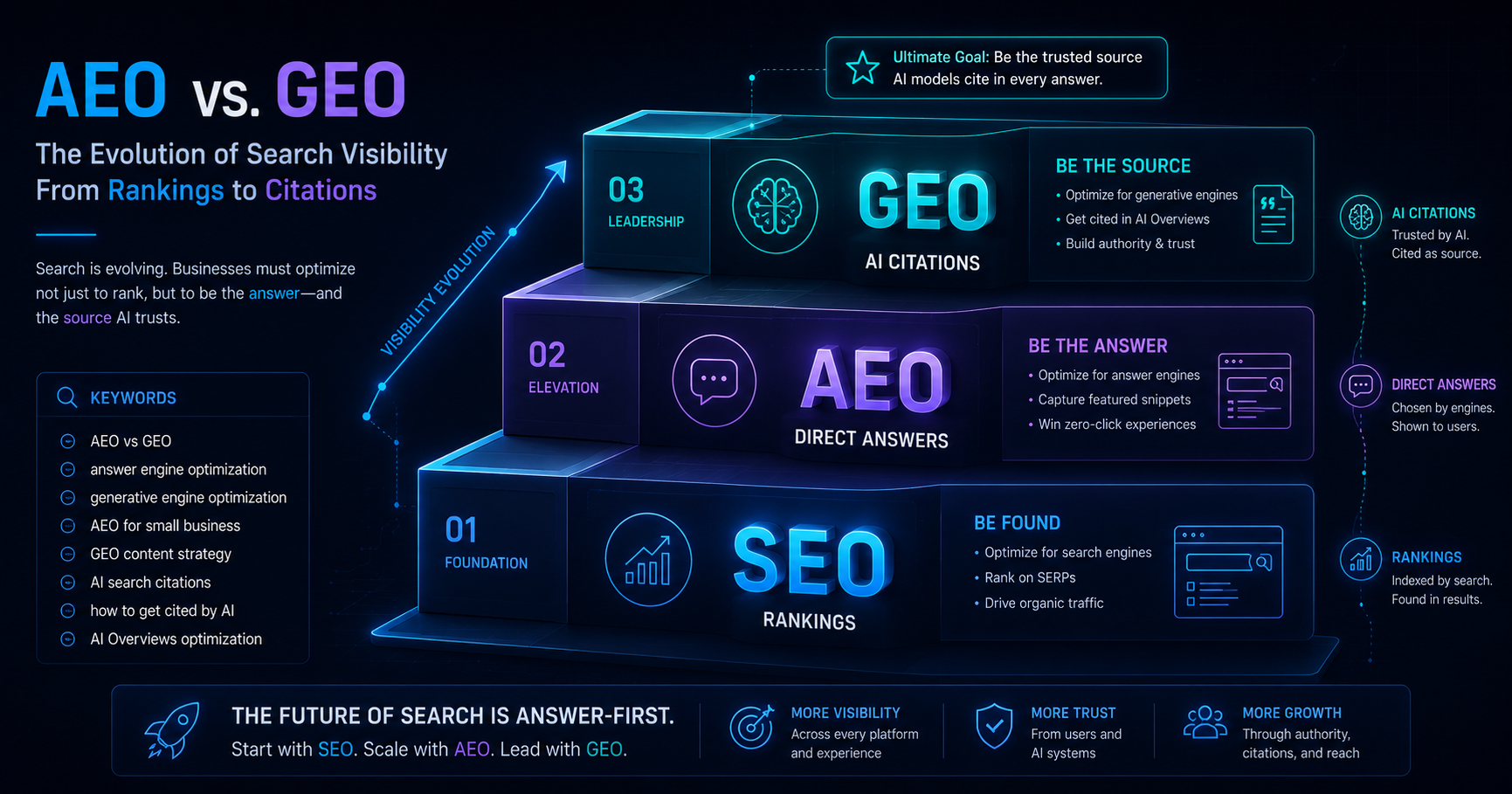
Traditional SEO helps pages become discoverable in search results. Answer engine optimization improves the odds that a business or its content can support a direct answer, summary, comparison, or recommendation. The foundations overlap heavily: crawlability, indexability, relevance, useful content, internal links, structured information, authority, and a good customer experience still matter.
Google says its AI search features use established Search systems and that the familiar SEO fundamentals remain relevant. Pages must be indexed and eligible to appear with a snippet to be used as supporting links. Google also recommends accessible content, important information in text, useful images and videos, accurate structured data, and current Business Profile or Merchant Center information where applicable (https://developers.google.com/search/docs/appearance/ai-features).
AEO adds a sharper question: Can a system extract a dependable answer from the evidence available about your business? That evidence may come from your website, local profiles, reviews, industry directories, publisher mentions, product feeds, documentation, and other public sources. No business controls the final answer. You can control whether the source material is clear, consistent, specific, and useful.
This is why AEO is not a hidden technical trick. There is no special markup that forces an assistant to recommend a company. If there were, every plugin vendor would have retired to a private island by now.
Start With the Questions Closest to Revenue
Small businesses often begin content planning with broad keywords. Customers begin with situations. They have a leaking pipe, an unfamiliar tax notice, a broken garage door, a wedding date, an allergy, a budget, or a deadline. Strong AEO starts by documenting those situations in the language customers actually use.
Build a question set from real business evidence:
- Questions asked on sales calls and contact forms
- Objections that delay a purchase
- Service-area and eligibility questions
- Pricing factors customers misunderstand
- Comparisons between services, products, or approaches
- Urgent symptoms that indicate a customer needs help
- Fit questions that help the wrong customer self-select out
- Follow-up questions asked immediately before booking or buying
Then rank those questions by business value. A query with modest search volume may be far more useful than a broad topic if it comes from someone ready to act. “What is bookkeeping?” may attract a large educational audience. “Can a bookkeeper clean up two years of contractor job-costing records?” is narrower, but the owner asking it has a specific and expensive problem.
Assign one primary job to each important page. A service page should explain the offer and convert qualified demand. A location page should prove genuine local relevance. A comparison page should help a buyer choose between reasonable options. A guide should answer a recurring problem and lead naturally to the appropriate service. Publishing six pages that all vaguely answer the same question creates more URLs, not more clarity.
Make the Business Easy to Understand
An answer engine cannot confidently explain a business that describes itself differently on every page. Establish a plain-language source of truth before adding more content.
At minimum, make these facts explicit:
- The exact services or products you offer
- The customers, industries, or situations you serve best
- The locations you serve and any meaningful boundaries
- The problems you solve and the outcomes customers seek
- The process a customer should expect
- The qualifications, experience, or evidence behind your claims
- The conditions, exclusions, and tradeoffs that affect fit
- The next step for calling, booking, requesting a quote, or buying
Specificity helps both systems and people. “We provide dependable home solutions” is warm oatmeal. “We repair and replace residential sump pumps in the north Denver metro, including battery-backup systems and emergency failure diagnostics” gives a customer something to evaluate.
Use the same core facts across your home page, service pages, contact page, local profiles, directory listings, and relevant third-party profiles. The language does not need to be copied word for word. The underlying facts should agree. Conflicting phone numbers, service areas, business names, opening hours, product availability, or credentials create uncertainty exactly where trust is needed.
Google’s Business Profile guidelines tell businesses to represent themselves consistently and accurately as they are known in the real world, use a precise address or service area, and choose the fewest categories needed to describe the core business (https://support.google.com/business/answer/3038177?hl=en). That is local-search guidance, but the owner lesson travels well: clean facts are easier to use than a marketing identity crisis.

Build Pages That Can Supply a Direct Answer
A useful answer page does not bury the conclusion beneath a ceremonial introduction. State the answer, then explain the conditions, evidence, and next step.
For each high-value customer question, use a structure like this:
Give the short answer first
Open with two or three sentences that directly resolve the question. If the honest answer is “it depends,” name what it depends on. A pricing page might explain the main cost drivers. A service-area page might state the covered cities and the exceptions. A comparison page might say who each option fits.
Add decision details
Explain the factors a customer should evaluate, the mistakes that create expense, and the signals that indicate a particular choice. Use real constraints rather than universal claims. “Always,” “best,” and “guaranteed” tend to become less impressive when evidence enters the room.
Show proof near the claim
If you mention experience, identify it. If you describe a result, show a real case or project where disclosure is appropriate. If qualifications matter, name them. If reviews repeatedly praise a specific strength, surface that pattern without inventing quotes or cherry-picking a miracle story.
Make the next step clear
Tell the reader what to do after receiving the answer. Call, book, request an estimate, check availability, visit the shop, or review the relevant service. A page can be wonderfully extractable and still fail the business if the conversion path is hidden under three menus and a form that wants the customer’s life history.
Google’s people-first content guidance recommends creating content for an intended audience, demonstrating first-hand expertise, and leaving readers feeling they learned enough to achieve their goal (https://developers.google.com/search/docs/fundamentals/creating-helpful-content). That is a better writing brief than “make it 2,000 words because a tool said so.”
Strengthen the Evidence Around the Answer
Answer engines do not rely only on the sentence you wish they would quote. They can encounter a wider evidence trail, and customers do too. Small-business AEO therefore requires more than rewriting headings.
Useful evidence can include:
- Detailed service and product pages
- Original project photographs with relevant context
- Named certifications, licenses, memberships, or author expertise
- Reviews that describe the service, problem, location, and outcome
- Case studies with honest scope and limitations
- Current policies, warranties, returns, delivery, or booking information
- Local profiles and reputable industry directories
- Independent mentions from associations, publishers, partners, or community organizations
- Consistent contact, location, and business identity details
Not every business needs every item. A bakery does not need a white paper about croissants. It does need accurate hours, current products, clear ordering options, good photographs, allergy information where relevant, local details, and proof that customers can actually collect the order they were promised.
Third-party evidence matters because a business saying “we are trusted” is an advertisement. Customers describing why they trusted the business is evidence. An association confirming a credential is evidence. A local publication documenting a real project is evidence. The goal is not to manufacture mentions. It is to make genuine business activity visible and consistent.
Reviews deserve particular attention. Ask for honest feedback after real transactions, respond professionally, and study the language customers use. Do not buy reviews, script fake enthusiasm, or pressure customers into claims they would not make. Manipulated proof is not a durable visibility strategy. It is a future cleanup project wearing a five-star hat.

Fix Access Before Polishing Answers
Excellent content cannot help much if search systems cannot reliably reach it. Technical access is the unglamorous floor beneath AEO. Nobody posts a victory selfie with a crawlable link, but broken foundations remain stubbornly unimpressed by marketing.
Check that important pages:
- Return a successful status instead of an error or redirect loop
- Are not accidentally blocked by robots.txt or a firewall
- Are indexable and use the intended canonical URL
- Appear in a current sitemap where appropriate
- Can be reached through normal internal links
- Put essential facts in visible text rather than only in images or interactive widgets
- Load usable content without requiring a login, consent failure, or unsupported script path
- Work on mobile devices and do not hide the primary action
Google explains that links are generally crawlable when they use an anchor element with an href value and a resolvable destination (https://developers.google.com/search/docs/crawling-indexing/links-crawlable). For an owner, the practical test is simpler: can a person and a crawler move from the home page to the important service, proof, location, and contact pages without guessing?
Different AI providers use different crawlers and controls. OpenAI, for example, publishes separate documentation for its user agents and explains that site owners can manage access through robots.txt (https://developers.openai.com/api/docs/bots). A robots.txt rule is only one layer. CDNs, security tools, bot protections, authentication, and rendering behavior can still affect access.
Do not open every bot-shaped door without understanding the tradeoff. Document which crawlers you intend to allow, which uses you accept, and how those choices support the business. Access policy should be deliberate, not inherited from a plugin somebody installed during the previous geological era.
Use Structured Data for Clarity, Not Magic
Structured data can help search systems understand the meaning of page content and can make pages eligible for certain search features when they meet the requirements. Google recommends JSON-LD where practical and requires markup to represent visible page content accurately (https://developers.google.com/search/docs/appearance/structured-data/intro-structured-data).
For a small business, relevant markup may include Organization or LocalBusiness details, products, offers, articles, breadcrumbs, events, or other types that genuinely match the page. The exact choice depends on what the business and page actually are.
Structured data should reinforce facts already visible to customers. It should not add invented ratings, unsupported prices, fake locations, or services the page never mentions. Validate the implementation, monitor Search Console, and update markup when the visible facts change.
Schema helps with machine understanding. It does not manufacture reputation, customer satisfaction, editorial authority, or recommendations. Useful? Absolutely. Sorcery? Regrettably unavailable.
Connect Local Visibility to a Real Customer Path
Many small-business questions have local intent even when the customer does not type a city. Someone asking for an emergency plumber, dog groomer, family photographer, or gluten-free bakery usually needs a provider they can actually reach.
Make local fit obvious on the site. Explain the real service area, where customers visit you, whether travel fees or delivery limits apply, and which location handles the work. Create location pages only when they contain genuine local information and serve a distinct customer need. Swapping a city name across fifty copies is not local expertise. It is a mail merge with ambitions.
Keep hours, address, phone, categories, appointment links, and service details current on the profiles customers use. Add original location and work photographs. Answer common local questions. Earn reviews from real customers across the areas you genuinely serve.
Then inspect the customer path. If an assistant or search result introduces the business, can the customer confirm availability, understand fit, see proof, and act? Recommendation readiness ends in operations. A restaurant with the wrong hours, a contractor with a dead quote form, or a clinic with unclear eligibility can lose the customer after winning visibility.
Measure AEO by Business Outcomes
AEO measurement is noisy because generated answers can change by wording, location, account context, platform, and time. A single prompt is not a ranking report. Treat it as one observation.
Use a layered scorecard:
Retrieval and answer visibility
Test a stable set of valuable customer questions on a consistent schedule. Record the exact wording, date, market, device or account context where relevant, businesses named, claims made, and sources linked. Track patterns rather than celebrating one lucky screenshot.
Source and accuracy quality
Check whether the answer describes the business correctly. Note which pages or third-party sources support the response, whether those sources are current, and whether competitors supply stronger evidence. A mention with the wrong service area is not a win. It is a customer-confusion delivery system.
Website behavior
Use Search Console and analytics to review landing pages, search demand, referrals where identifiable, engagement, calls, forms, bookings, directions, purchases, and assisted journeys. Attribution will be incomplete. Label what the evidence shows instead of assigning every mysterious direct visit to AI because it makes the chart more exciting.
Customer and revenue outcomes
Track qualified inquiries, lead quality, booked work, order value, close rate, and customer acquisition cost where possible. Ask new customers how they found the business and what influenced the decision. Sales notes often reveal useful paths that analytics cannot reconstruct.

AEO should improve the quality of the public evidence and the customer journey even when a specific AI mention cannot be attributed. Clearer service pages, stronger proof, accurate local profiles, cleaner access, and better conversion paths are useful assets across search, referrals, sales, and direct visits.
A 90-Day AEO Plan for a Small Business
A practical rollout does not require rebuilding the entire site at once.
Days 1–30: establish the truth
Inventory the business facts, high-value services, customer questions, service areas, profiles, reviews, and current pages. Fix obvious inconsistencies. Identify the five to ten questions closest to revenue. Check whether the pages that should answer them are accessible, accurate, and assigned a clear job.
Days 31–60: improve the evidence
Rewrite the highest-value page first. Add a direct answer, fit details, process, constraints, proof, and a clear next step. Update supporting local profiles. Strengthen internal links from relevant pages. Add accurate structured data where it genuinely applies. Request honest reviews through a repeatable post-service process.
Days 61–90: test and refine
Create a fixed prompt and query set. Record answer visibility and source patterns. Compare those observations with Search Console, analytics, lead records, and customer-source responses. Fix inaccurate facts, weak cited sources, missing proof, and conversion friction. Choose the next page based on customer value, not the loudest dashboard color.
At the end of 90 days, the business should have a cleaner source of truth, one or more stronger revenue pages, better supporting evidence, a documented access posture, and a baseline for measurement. That is progress an owner can inspect. “We did GEO things” is somewhat harder to deposit at the bank.
Common AEO Mistakes Small Businesses Can Avoid
The first mistake is treating AEO as a replacement for SEO. If the site is difficult to crawl, poorly organized, irrelevant to the question, or weak for customers, adding an AI-flavored label does not repair it.
The second is publishing generic answer posts at scale. More pages can create duplication, maintenance work, and unclear ownership. Publish when a page has a distinct customer question, credible evidence, and a business job.
The third is chasing mentions without checking accuracy or outcomes. A business can appear in an answer that sends the customer elsewhere, cites an outdated directory, or describes the service incorrectly. Visibility needs context.
The fourth is using schema as a substitute for proof. Markup can clarify facts. It cannot make those facts impressive or trustworthy.
The fifth is measuring only mention counts. Track sources, accuracy, qualified visits, leads, bookings, and revenue indicators. Mention volume is easy to admire and surprisingly difficult to use for payroll.
The sixth is forgetting the customer after optimizing for the machine. The page still has to persuade a person. It needs specificity, evidence, good judgment, and a next step that works.
The Small-Business Advantage Is Specificity
Large brands may have more mentions, links, and publishing resources. Small businesses can compete by being more specific, locally relevant, operationally accurate, and genuinely useful for a narrow customer need.
Answer engine optimization for small business is not about tricking an assistant into saying the company name. It is about creating a dependable public record: what you do, who you help, where you operate, why customers trust you, and how someone can take action.
Start with the questions closest to revenue. Make the answers clear. Support them with proof. Keep business facts consistent. Protect technical access. Measure customer outcomes. That is less glamorous than a secret AI ranking hack, which is inconvenient because it is also far more useful.
If you need a prioritized view of the access, answer, evidence, local-profile, and conversion gaps costing the business opportunities, an AI Visibility Audit can show what to fix first.