Fix the Evidence Path Before the Acronym
GEO website optimization is the work of making your site useful evidence for AI answer systems and search engines. Not louder. Not stuffed with “AI-ready” confetti. Useful.
The owner question is practical: when a customer asks an AI system who to trust, does your website give that system enough accurate proof to include you?
Nugentive’s validated keyword work found geo website optimization as a direct supporting phrase with U.S. search volume of 40 in the 2026-07-30 DataForSEO related-keyword capture. The volume is not huge, but the intent is useful. Owners are trying to understand what has to change on the actual website, not just which new acronym gets added to the invoice.
That distinction matters because the market is already noisy. Search Engine Journal recently covered the GEO trust gap: marketers want AI visibility data, but they are skeptical of the platforms selling it (https://www.searchenginejournal.com/the-geo-trust-gap-seos-want-the-data-but-not-the-platforms-selling-it/585161/). Healthy skepticism keeps “buy our AI dashboard” from becoming the default answer.

What GEO Website Optimization Means
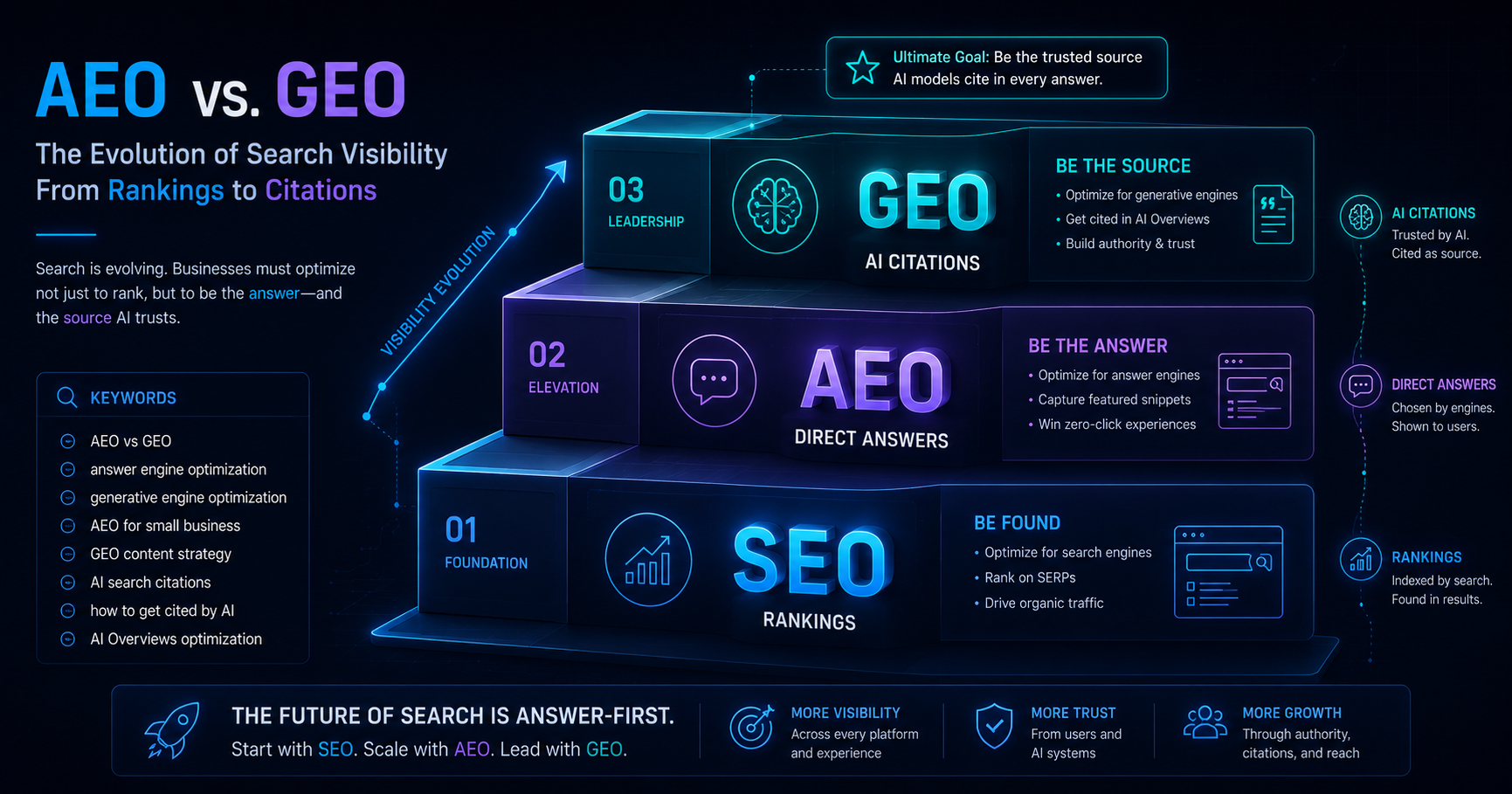
GEO website optimization means improving the pages, structure, proof, and technical access that help generative AI systems retrieve, understand, cite, compare, and recommend your business accurately. It overlaps with SEO, AEO, local SEO, content strategy, conversion work, and technical cleanup.
Very inconvenient for anyone hoping this was one magic tag.
Google’s guidance for AI features does not tell site owners to use a secret AI-only file or special markup to appear in AI experiences. It points back to normal Search eligibility, accessible content, and preview controls (https://developers.google.com/search/docs/appearance/ai-features). Google’s SEO Starter Guide still emphasizes useful pages, clear structure, descriptive links, and content built for people (https://developers.google.com/search/docs/fundamentals/seo-starter-guide).
So the foundation is familiar: make the site accessible, clear, useful, and credible. The GEO layer asks whether that evidence can survive being compressed into an AI answer.
The Business Problem It Solves
A customer used to search, click a few sites, compare, and call. Now that same customer may ask ChatGPT, Gemini, Perplexity, Copilot, or Google’s AI features for a shortlist, a comparison, a price expectation, or a recommendation. Very rude of them to skip your carefully designed homepage. Also very real.
If your website does not explain the business clearly, AI systems may summarize you badly, cite weaker sources, recommend competitors, or leave you out entirely. The same problem also hurts humans. A confusing service page is not suddenly redeemed because a robot read it first.
GEO website optimization solves three owner-level problems:
- It reduces wrong or vague AI descriptions of the business.
- It gives answer systems better source material for comparisons and recommendations.
- It improves the human landing experience when the buyer does click through.
That last point matters. AI visibility that sends people to a vague page is not a win. It is a longer path to the same shrug.
The Five Website Fixes That Matter Most
Start with fixes that help both people and machines. If the site is weak for a real buyer, it is probably weak for answer systems too.
1. Make important pages accessible
AI systems and search engines cannot use what they cannot reach. Check robots.txt, noindex tags, canonical tags, sitemap coverage, server errors, JavaScript rendering, CDN rules, WAF settings, and whether important content appears as readable text.
OpenAI publishes bot documentation for site owners, including different user agents for search-related crawling and user-requested retrieval (https://developers.openai.com/api/docs/bots). That distinction matters. Some machine traffic crawls broadly. Some fetches a page because a user asked. A serious optimization plan should not treat every bot request like the same suspicious raccoon.
2. Clarify what you sell
Your service pages should answer basic buyer questions quickly: what you do, who you help, where you operate, what problems you solve, what the process looks like, and what the next step is.
If the page says “innovative solutions for modern businesses,” it has failed. That phrase could describe a software company, a consultant, a chair with Bluetooth, or absolutely nothing. Use plain language. Machines like it. Humans like it more.
3. Add proof near the decision
GEO website optimization is not only content formatting. It is evidence design.
Add reviews, case details, photos, credentials, certifications, process notes, guarantees where appropriate, pricing context, service-area details, staff expertise, comparison guidance, and third-party mentions where they help the buyer decide. Put proof near calls to action, not buried in a lonely testimonial page nobody visits.
Schema can help machines interpret real page information. It does not manufacture trust. If schema alone created AI recommendations, every plugin would be retired on a yacht by now.
4. Answer comparison questions
AI answer systems are often used for comparison. Buyers ask who is best, who is near them, what to watch out for, how providers differ, what costs more, and what questions to ask before hiring.
Your site should answer some of those questions honestly. That does not mean trashing competitors. It means explaining fit, tradeoffs, service limits, price factors, timelines, red flags, and what makes a provider a safe choice. Honest boundaries often build more trust than heroic claims.
5. Connect pages into a clean path
A strong site helps customers and crawlers follow the logic. Core service pages should link to relevant FAQs, location pages, proof pages, pricing context, process pages, and contact paths. Internal links are not just an SEO chore. They are how your site says, “Here is the evidence trail. Please stop guessing.”

What to Measure After Fixing the Site
Measure the things tied to decisions:
- Which buyer prompts include your business.
- Which competitors appear when you do not.
- Which pages or outside sources AI systems cite.
- Which facts are wrong, missing, or vague.
- Whether AI referral traffic appears in analytics where identifiable.
- Whether calls, forms, bookings, or qualified leads improve after fixes.
Bing’s Webmaster Guidelines emphasize quality, relevance, credibility, and value for users (https://www.bing.com/webmasters/help/webmaster-guidelines-30fba23a). That is still the right standard. The answer surface changed. The customer still wants a credible reason to choose.
Common GEO Website Optimization Mistakes
The first mistake is treating GEO as separate from SEO. It is not. If your site cannot be crawled, understood, or trusted in search, it probably will not become brilliant inside AI answers through positive thinking.
The second mistake is publishing thin synonym pages. “AI visibility for dentists,” “AI visibility for local dentists,” and “AI visibility for dentist offices near me” should not become three pages unless each serves a distinct buyer need. Otherwise you are building a content junk drawer and calling it strategy.
The third mistake is optimizing for AI summaries while ignoring conversion. If the page earns a mention but hides the phone number, buries proof, or makes the next step confusing, you are leaking the customer at the expensive part of the journey.
The fourth mistake is buying reporting before fixing obvious gaps. Measurement is useful when it leads to action. Without implementation, it is just a very polite way to watch competitors keep winning.

A Practical Starting Sequence
If you are deciding what to fix first, use this order.
- Check whether important pages are accessible and indexable.
- Rewrite core service pages so a buyer understands the offer in thirty seconds.
- Add proof near the call, quote, booking, or consultation path.
- Clean up business facts across profiles, directories, and third-party sources.
- Add comparison and FAQ content that answers real buyer objections.
- Link related pages into a clear evidence path.
- Test buyer prompts and compare how AI systems describe you versus competitors.
That sequence is less glamorous than “dominate AI search.” It is also more likely to produce work that a customer can feel.
The Bottom Line
GEO website optimization is not about tricking ChatGPT or decorating pages with the latest acronym. It is about making your business easier to find, understand, verify, compare, and choose across search and AI answer systems.
Start with the evidence path. Can machines reach the page? Can humans understand it? Does it prove the business is a safe choice? Does it answer comparison questions? Does it make the next step obvious?
If the answer is no, fix that before buying another report. The goal is not a prettier visibility score. The goal is fewer missed customers, fewer wasted marketing guesses, and a website that gives AI systems and real buyers enough proof to move toward the sale.