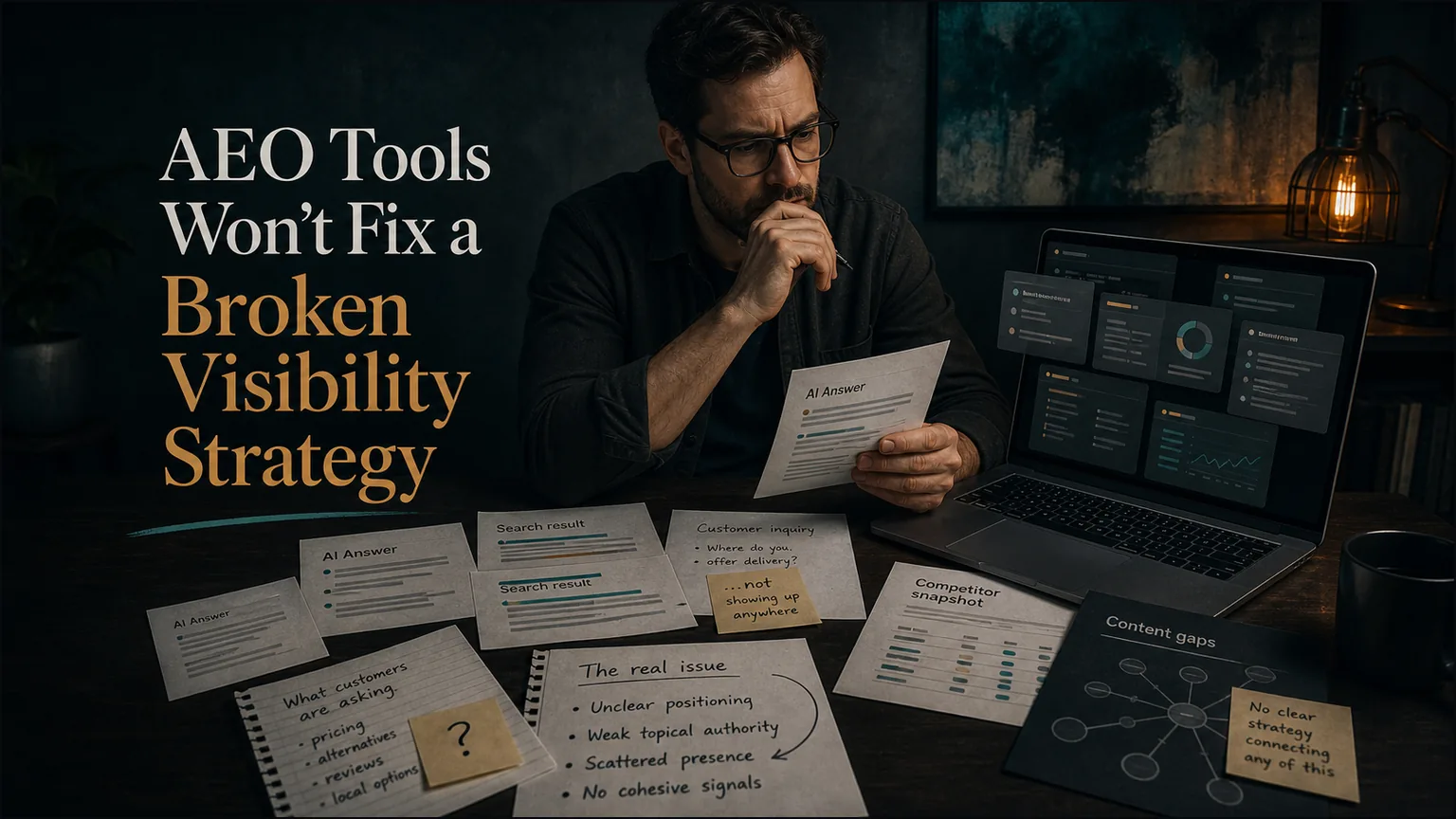
Start With the Questions, Not the Software
Answer engine optimization tools are useful when they help you see where your business appears, where competitors get mentioned, which sources AI systems cite, and which buyer questions you fail to answer. They are much less useful when they become an expensive mirror for a strategy that was already vague.
That is the part most owners care about. Not whether the dashboard has a tasteful gradient. Not whether the vendor uses GEO, AEO, LLM SEO, or AI SEO. The owner question is simpler: will this help me win more customers, stop losing easy-fit prospects, and avoid another month of marketing guesswork?
The honest answer is: sometimes. AEO tools can reduce confusion, but they do not replace the work. They can show whether AI systems are ignoring you, which sources get cited, and where competitors own the answer before the customer reaches a website. But they cannot magically create trust, clarity, proof, service pages, reviews, or useful content. If they could, every dashboard login would come with a tiny money printer. Tragically, still not a feature.
Fresh market chatter points in the same direction. Recent Reddit discussions are asking which platforms can track GEO performance accurately, and Semrush published a fresh agency-focused list of AI visibility tracking tools (https://www.semrush.com/blog/ai-visibility-tracking-tools-for-agencies/). Treat vendor lists as market signal, not gospel. Tool demand is rising because measurement is messy; the first shiny platform still may not fix the business problem.
Why Owners Are Looking at AEO Tools Now
The old SEO reporting stack was never perfect, but at least it felt familiar: rankings, impressions, clicks, traffic, leads. AI search makes that neat little chain more irritating. Customers can ask an AI system who to trust, skim a compressed answer, compare a few named businesses, and never click the companies that were left out.
Google’s AI features guidance still points site owners back to Search fundamentals: make pages accessible, useful, and eligible for Google Search features rather than chasing a separate AI-only switch (https://developers.google.com/search/docs/appearance/ai-features). Google’s SEO Starter Guide is still about helping search engines and people understand your content (https://developers.google.com/search/docs/fundamentals/seo-starter-guide). In other words, the foundation did not vanish. The reporting surface got weirder.

That weirdness creates real business anxiety. If leads are flat, is it because rankings slipped? Because AI answers are naming competitors? Because reviews look thin? Because your service page explains “comprehensive solutions” with the confidence of a fog machine? A good AEO tool should help separate those causes. A bad buying process just adds another subscription to the pile.
What Answer Engine Optimization Tools Should Actually Measure
The useful version of answer engine optimization tools is not “tell me my AI visibility score.” Scores can be helpful shorthand, but only if they connect to evidence and decisions. Otherwise you are paying for a number that politely says “do better,” which is the dashboard equivalent of a fortune cookie.
A serious tool or manual process should measure four things.
First, it should test prompts that map to real buyer intent. “Best plumber near me,” “who handles emergency roof repair in Denver,” and “is this agency worth it” are different from generic category prompts. If the questions do not resemble customer decisions, the report may look busy while teaching you very little.
Second, it should capture answer appearance. Are you named? Are competitors named? Are you compared fairly? Are you recommended, merely cited, incorrectly summarized, or missing entirely? A citation without a recommendation may still matter, but it is not the same as being the suggested provider.
Third, it should record source patterns. Repeated source appearances are clues. Your website, Google Business Profile, review sites, directories, Reddit threads, publisher mentions, partner pages, and comparison articles can all shape what the machine finds credible enough to use.
Fourth, it should connect visibility to outcomes. The point is not to collect AI mentions like commemorative spoons. The point is more qualified calls, booked appointments, quote requests, sales conversations, and revenue. If the tool cannot help prioritize fixes that influence those outcomes, it may be interesting, but interesting does not pay invoices.

The Buy-Versus-Fix Framework
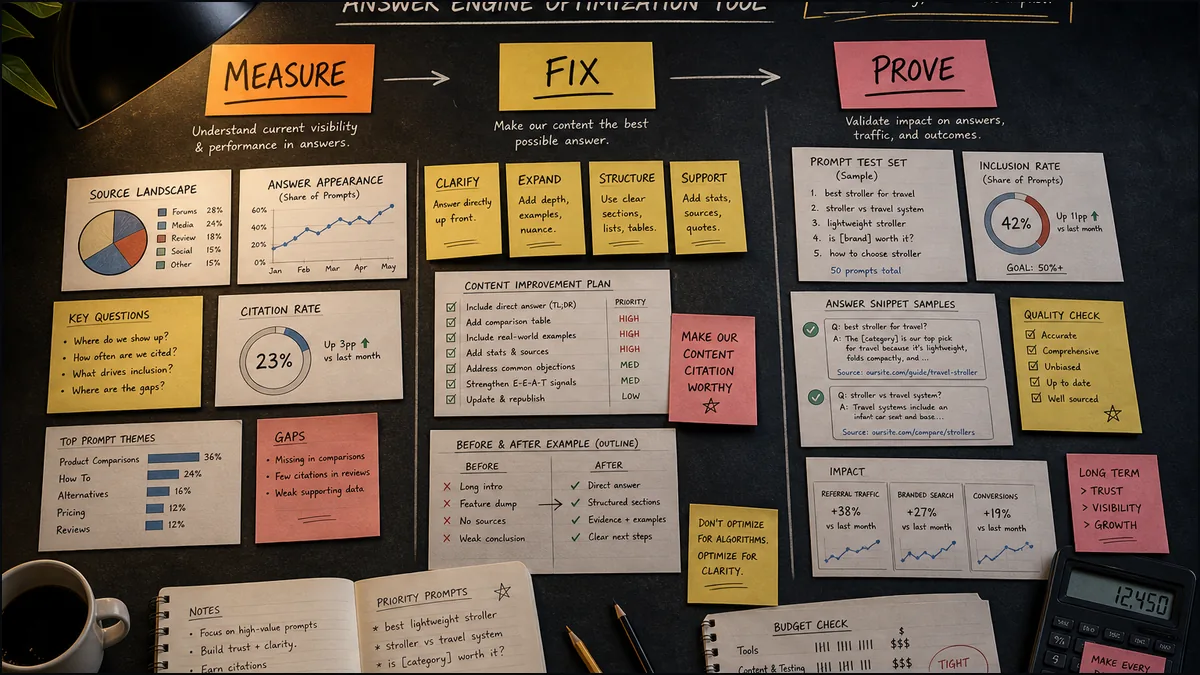
Before buying AEO software, use a simple diagnostic: measure, fix, prove.
Measure means establishing the current state. Run a small prompt set around your highest-value services, locations, buyer objections, and comparison questions. Check whether AI systems mention you, cite you, ignore you, or describe you incorrectly. Record the sources they use. You need direction before you need enterprise theater.
Fix means improving the assets that influence the answers. That usually includes clearer service pages, better internal links, extractable answer sections, current reviews, stronger proof, accurate business profiles, useful FAQs, and third-party corroboration where appropriate. Google’s helpful content guidance emphasizes reliable, people-first content rather than content made mainly to manipulate rankings (https://developers.google.com/search/docs/fundamentals/creating-helpful-content). Conveniently, people-first content is also much easier for AI systems to summarize without making your business sound like a haunted brochure.
Prove means checking whether the fixes changed the answer environment and the business results. Did your brand start appearing for more high-intent prompts? Did cited sources improve? Did wrong descriptions disappear? Did qualified leads or booked calls improve over time? If not, keep diagnosing instead of declaring victory because the chart went up by 11 percent.
When a Tool Is Worth Paying For
AEO tools are more likely to be worth paying for when the business has enough complexity to justify ongoing measurement. Agencies, multi-location companies, ecommerce brands, competitive B2B services, franchises, healthcare groups, legal firms, home-service operators, and high-ticket local businesses may need repeatable prompt tracking, competitor monitoring, source analysis, and reporting.
They are also useful when several stakeholders need one shared view. If the owner, marketing director, SEO vendor, PR team, and content team are all guessing from different spreadsheets, a good platform can reduce meeting fog. Meeting fog is expensive.
But for a small business with unclear pages, weak reviews, thin proof, and no consistent content strategy, software may simply document the obvious. You do not need a $500 monthly platform to discover that AI systems ignore a website that never clearly says what the business does, where it operates, or why anyone should trust it.
In that case, start with a focused audit and a practical fix list. Buy tooling once there is something worth monitoring.
Red Flags When Comparing AEO Tools
Be careful with any tool or vendor that promises guaranteed ChatGPT recommendations. AI systems vary by query, source access, personalization, retrieval method, and platform behavior. Nobody gets to guarantee the machine will love you. That is not strategy; that is séance marketing.
Watch for these red flags:
- The tool reports one vague “AI visibility score” without showing prompts, answers, competitors, sources, and dates.
- The vendor cannot explain how prompts are selected or why they match buyer intent.
- Reports measure mentions but ignore whether those mentions produce leads or revenue.
- The platform treats every citation as equally valuable.
- The recommendation is always “create more content,” which is suspiciously convenient for everyone selling content.
- It ignores technical access, crawlability, reviews, local profiles, third-party proof, and conversion paths.
- It cannot distinguish between informational prompts and buyer-ready prompts.
None of these makes a tool useless by itself. But they are signs that you may be buying a prettier version of confusion.
A Practical First Step
If you are evaluating answer engine optimization tools, start with ten buyer questions that should lead to revenue. Run them across the AI systems your customers are likely to use. Save the answers, named competitors, cited sources, wrong claims, and missing proof. Then inspect the pages and third-party sources those answers seem to rely on.
That small exercise will make tool demos more useful. Instead of asking “does this track AI visibility?” you can ask sharper questions: can it track these prompts, in these markets, against these competitors, with source history, answer changes, and outcome reporting? Can it show what to fix next? Can it separate a vanity mention from a customer-producing recommendation?
That is where Nugentive fits. Our AI Visibility Audit is not built to hand you a mystery score and wander off. It identifies where your business is losing discoverability, trust, citations, recommendations, or conversions across search and AI systems, then turns that into a prioritized fix list.
If you are about to buy another tool because AI visibility feels confusing, pause for one minute. The tool may help. But the strategy has to come first.