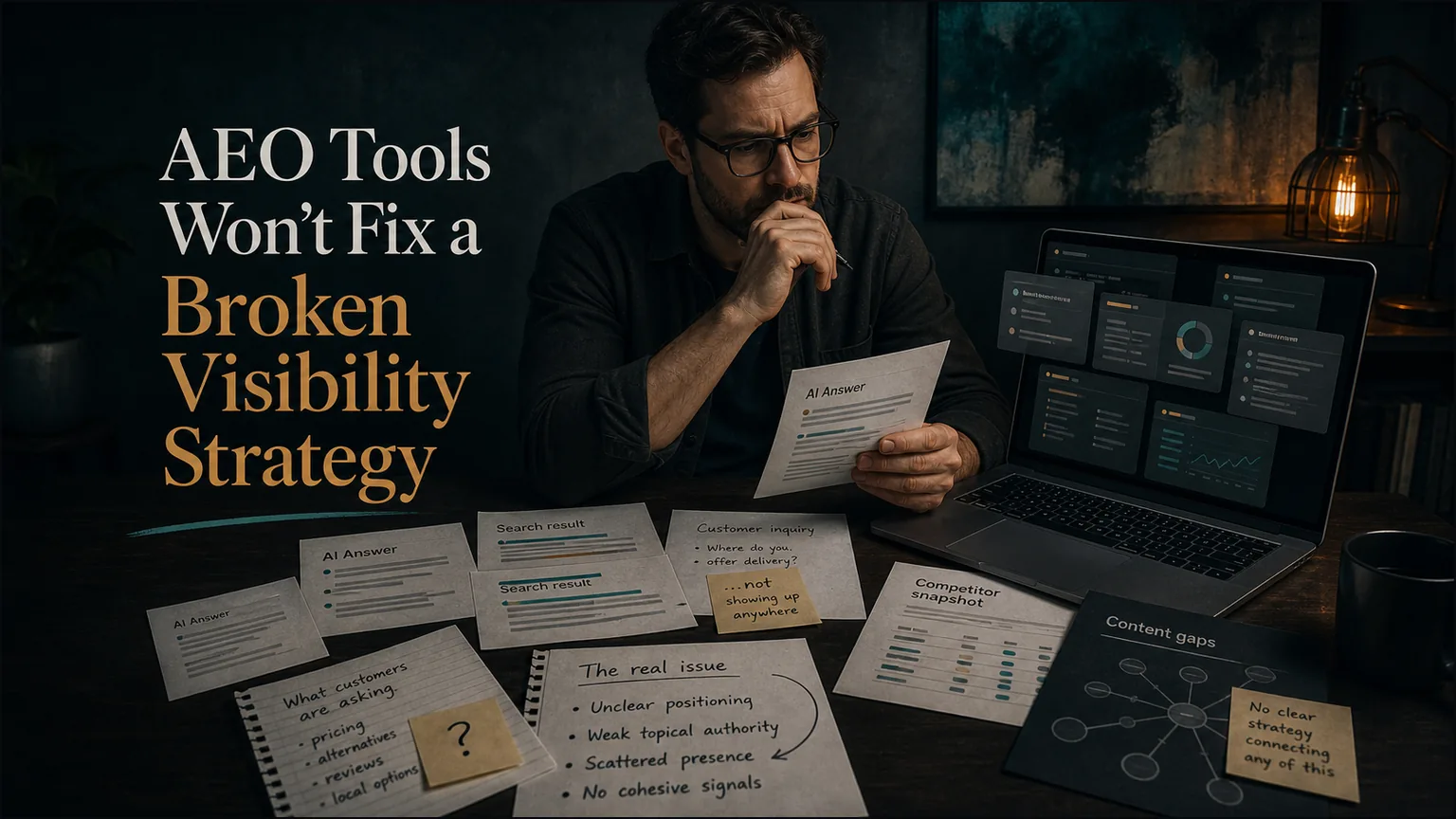
A Score Is Not a Strategy
An AI visibility checker should answer one practical owner question: can customers find, trust, and choose your business when they ask AI systems for help? If the tool only gives you a score and a confetti animation, congratulations, you have purchased a mood ring for your marketing.
The phrase matters because there is real demand behind it. Nugentive’s validated keyword research found ai visibility checker as an unowned supporting phrase with estimated U.S. search volume of 260, keyword difficulty of 5, and informational intent in DataForSEO’s related-keyword capture. That does not mean every checker deserves a product roadmap parade. It means owners are trying to measure a problem they can feel: competitors showing up in AI answers, fewer obvious clicks, and no clean way to know what to fix first.
A useful checker does not promise that ChatGPT, Google AI Overviews, Gemini, or Perplexity will recommend you tomorrow. It shows where your business is retrievable, where it is missing, where sources are weak, where technical access may be blocking discovery, and where visibility fails to turn into leads. The owner outcome is not “higher AI score.” The outcome is fewer blind spots between search attention and customers.

What an AI Visibility Checker Should Actually Check
A good AI visibility checker starts with buyer questions, not vanity prompts. “Tell me about this brand” is useful for context, but it is not the same as “best emergency plumber near me,” “which accounting firm handles restaurants,” or “who should I call for commercial roof repair in Denver?” One question creates trivia. The other might create revenue.
The checker should test multiple prompt types: branded searches, category searches, local-service searches, comparison questions, problem-aware questions, and buying-stage questions. Then it should separate four things that often get mashed together like dashboard potatoes.
First, does the AI system know you exist? Recognition is the floor. It is not the win.
Second, does it describe you correctly? A wrong service area, outdated offer, or confused specialty can cost real customers before your phone ever rings.
Third, does it recommend or cite you for money-relevant questions? Being named in a random answer is different from being recommended when a buyer is choosing a provider.
Fourth, what sources does the answer rely on? Your website, Google Business Profile, reviews, directories, press mentions, partner pages, YouTube, social profiles, and third-party references can all shape how credible you look. AI visibility is not just a website problem. Annoying? Yes. Also true.
The Access Layer Most Checkers Skip
If AI and search systems cannot fetch, parse, or trust your important pages, your visibility work starts with plumbing. Not glamorous plumbing. Still plumbing.
Google’s documentation for AI features says site owners do not need special markup to appear in AI experiences; the baseline is following Search essentials and making eligible, useful content available to Google (https://developers.google.com/search/docs/appearance/ai-features). Google’s SEO Starter Guide also emphasizes helping search engines understand content and helping people find what they need (https://developers.google.com/search/docs/fundamentals/seo-starter-guide).
That means a serious checker should inspect basics before prescribing content volume: indexability, robots.txt rules, canonicals, page rendering, internal links, structured data, crawl errors, location pages, service-page clarity, and whether important facts are buried in scripts or images. Cloudflare’s bot documentation shows how bot management and automated traffic classification can affect access at the infrastructure layer (https://developers.cloudflare.com/bots/concepts/bot/). A business can have decent content and still treat useful crawlers like suspicious teenagers at a mall.

The Difference Between a Checker and an Audit
A checker is a measurement tool. An audit is a decision tool.
The checker can show that your business appears in 3 of 20 test prompts, gets cited by one source, loses five comparison prompts to competitors, and has inconsistent service descriptions across directories. Useful. But the next question is where money is leaking.
For example, imagine a local HVAC company. A checker finds that AI answers mention two competitors for “emergency AC repair near me,” but not the company. The cause might be thin emergency-service content, weak review signals, inconsistent hours, missing local proof, blocked resources, or simply competitors having stronger third-party references. “Improve AI visibility” is not specific enough. That is like telling a mechanic the car is “not doing car things.”
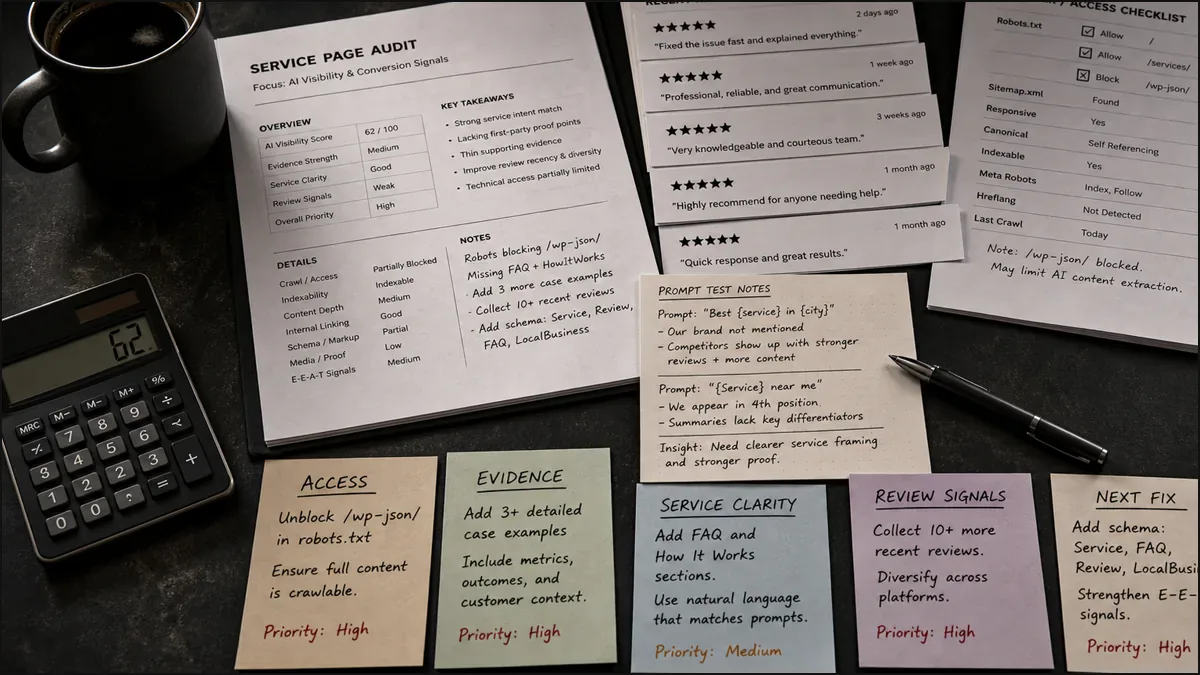
An audit turns findings into a prioritized fix list:
- Which buyer questions are worth owning?
- Which pages need clearer service, location, pricing, proof, or next-step information?
- Which outside sources need cleanup or strengthening?
- Which technical access issues could stop search and AI systems from using the content?
- Which fixes are closest to calls, forms, bookings, or sales?
That priority matters. Owners do not need forty recommendations delivered in alphabetical order. They need to know what to fix first, what can wait, and what is probably vendor noise wearing a blazer.
What a Bad AI Visibility Checker Gets Wrong
The weakest checkers over-focus on generic brand prompts. If a tool only asks whether AI can summarize your company, it may miss the questions buyers actually use before choosing someone. Brand summaries feel reassuring because your name appears on the screen. Revenue does not care about your feelings. Very rude of it.
Another problem is treating all mentions as equal. A mention without recommendation value can be a footnote. A recommendation without citation support can be unstable. A citation from an outdated or irrelevant source can create the wrong story. The checker should show the difference.
Watch for tools that hide methodology. You should know which platforms were tested, which prompts were used, when the test ran, whether location or personalization affected results, what sources appeared, and how the tool defines a win. AI answers can shift over time, so a one-time snapshot should not be sold as permanent truth.
Also be skeptical of any checker that jumps directly from “low score” to “publish more content.” More content helps only when it answers distinct buyer questions with credible proof and accessible pages. More generic pages can create cannibalization, dilute internal links, and make the site harder to understand. Nobody needs a content landfill with schema on top.
A Simple Owner-Friendly AI Visibility Checker Framework
Before trusting any AI visibility checker, ask whether it covers five layers.
- Buyer question coverage: Does it test the actual searches and prompts that happen before customers call, book, compare, or buy?
- Answer presence: Does it separate recognition, accuracy, citations, recommendations, and competitor visibility?
- Source proof: Does it show which pages, profiles, reviews, directories, and third-party sources influence the answers?
- Technical access: Does it check whether search and AI systems can access and understand the important content?
- Revenue priority: Does it turn findings into fixes tied to service pages, local pages, lead paths, and conversion?
If a checker does those five things, it can help you stop guessing. If it only gives a score, it may still be useful as a quick smoke test. Just do not confuse smoke with a fire inspection.
Where Nugentive Fits
Nugentive uses AI visibility checks as part of a larger business diagnosis. The goal is not to impress an owner with a mysterious score. The goal is to show whether the business is retrievable, understandable, trusted, cited, recommended, and ready to convert attention into customers.
That means we look at AI answers, source patterns, competitor mentions, crawlability, service-page clarity, proof gaps, local data, internal links, and conversion paths. Then we sort the findings by practical impact. A blocked page, weak service proof, wrong business description, or missing high-intent page should not sit behind “write twelve thought-leadership posts” just because a template got excited.
If you want to know whether AI systems can find and recommend your business for the questions that matter, start with Nugentive’s paid $297 detailed AI Visibility Audit. It gives you a prioritized fix list before you spend more money on ads, content, tools, or another dashboard that quietly judges you in colors.