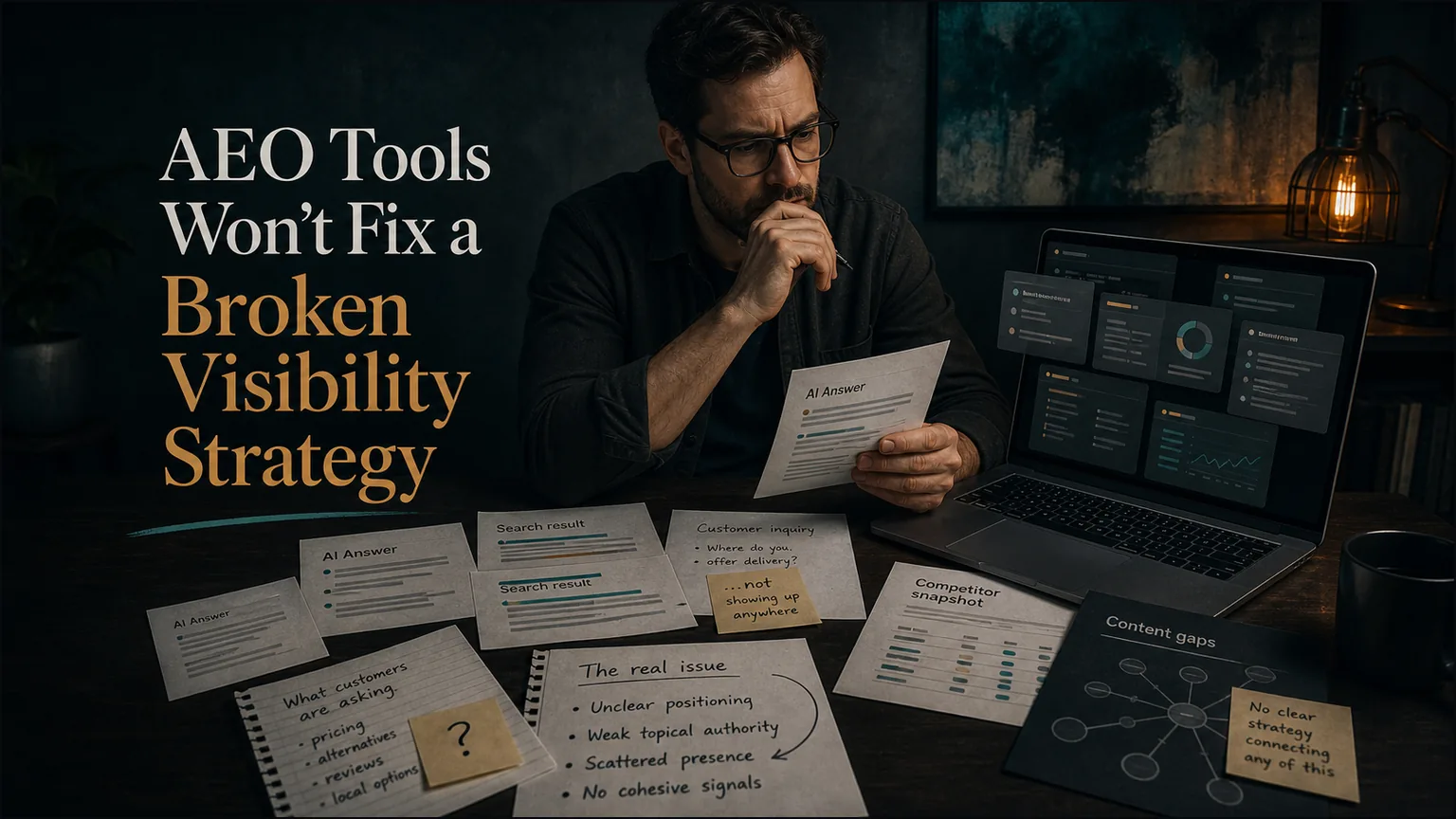
The Tool Is Not the Strategy
Answer engine optimization tools can help you see where your business shows up in AI answers. They can also become a very polished way to spend $300 a month discovering that your website is vague, your proof is thin, and competitors answer customer questions better than you do. Useful information, yes. A bargain therapy session, no.
The owner question is simple: should you buy AEO software now, or fix the measurement basics first?
My answer: buy the tool only when you know which customer questions are worth tracking, what a good answer would say, which sources should support that answer, and how the data will change your next marketing decision. Otherwise you are not buying visibility. You are buying a dashboard-shaped shrug.
Why AEO Tools Are Getting Attention
AI answers are influencing buyers before they click a website. Google’s guidance for AI features still points site owners back to familiar requirements: make content accessible, useful, eligible for Search, and controlled with standard preview settings where appropriate (https://developers.google.com/search/docs/appearance/ai-features). That matters because AI systems need retrievable source material before they can summarize, cite, or recommend anything useful.
At the same time, business owners and marketers are trying to answer newer questions: does our brand appear in ChatGPT, Gemini, Perplexity, and Google AI results? Which competitors appear instead? Which prompts are weak? Which sources get cited? Are we improving after the work?
That demand is real. A fresh Search Engine Journal article framed the “GEO trust gap” as a category problem: practitioners want AI visibility data, but they are skeptical of the platforms selling it (https://www.searchenginejournal.com/the-geo-trust-gap-seos-want-the-data-but-not-the-platforms-selling-it/585161/). A fresh Reddit thread in the same-day source collection asked whether SEOs are actually paying $300+ per month for AI visibility tracking. Reddit is not proof; it is a smoke detector for market confusion. This one is beeping.
AEO tools have a place. The mistake is treating them like the first step.
What Answer Engine Optimization Tools Actually Do
Most AEO tools are trying to measure some version of four things:
- Whether your business is mentioned for important prompts.
- Which competitors are mentioned instead.
- Which domains or pages get cited.
- Whether the answers are accurate and improving.
That can be valuable. If an HVAC company never appears for emergency furnace repair near its service area, the owner should know. If competitors keep getting cited because they have clearer pages or stronger reviews, the report can point toward actual work.
The problem is that tool output can look more precise than the category deserves. AI answers vary by platform, prompt wording, location, timing, and source availability. A single score can hide a lot of mess. Very official mess, often with gradients.
The $300 Question Owners Should Ask First
If the answer is “we want to know our AI visibility,” that is too vague. Visibility for what: emergency calls, appointments, bids, bookings, or sales conversations? Pick the five to ten buyer questions that could create real revenue. Now a tool has something useful to measure.

A Practical Buying Framework
Use this framework before paying for an AEO platform, agency dashboard, or “AI visibility command center,” because apparently software naming committees are paid by the syllable.
1. Define prompts that match money
Start with buyer intent, not vanity prompts. Track questions a real customer might ask before choosing a provider. Include service, location, problem, urgency, comparison, and trust language.
Bad prompt: “Tell me about our brand.”
Better prompt: “Who should I hire for emergency AC repair in [city]?”
The second one can turn into a call. The first one can turn into a meeting where everyone nods at a chart and nothing happens.
2. Decide what a good answer should include
Before measuring answers, define the standard. A good answer might include the right service category, accurate location, clear differentiators, reviews or proof, availability, price context, and a next step. If you do not define quality, the tool may reward any mention, even a weak one.
3. Track cited sources, not just brand mentions
Sources matter because they show what AI systems can retrieve and trust. Your own service pages, Google Business Profile, review platforms, directories, news mentions, YouTube videos, and partner pages may all influence answers.
This is where Google’s helpful content guidance still matters. Google says useful, reliable, people-first content should demonstrate experience, expertise, and clear value to readers (https://developers.google.com/search/docs/fundamentals/creating-helpful-content). For owners, that means proof is not decorative. It is machine-readable trust fuel, which sounds dramatic but is still cheaper than guessing.
4. Separate measurement from fixing
An AEO tool can show that competitors appear more often. It cannot, by itself, rewrite your service pages, clean up inconsistent profiles, improve reviews, add comparison content, fix crawl access, or make your offer easier to understand.
That distinction matters. If the tool costs $300 per month and no one acts on the findings, the annual cost is $3,600 for reporting. Reporting is only worth that if it helps prioritize fixes that protect or grow more than $3,600 in revenue. Simple math. Rude, but helpful.
5. Check whether the tool explains uncertainty
Good tools should show sampled prompts, answer text, cited sources, date captured, platform, location assumptions, and change over time. Weak tools hide behind one score with no receipts.
If a platform cannot show what it tested and what changed, you are being asked to trust a black box that measures other black boxes. That is a lot of boxes for one invoice.

When Free or Manual Tracking Is Enough
Many businesses do not need a paid AEO tool on day one. They need a small, repeatable measurement habit.
Start with a spreadsheet and ten high-value questions. Once a month, test those questions in the AI systems your customers are likely to use. Record whether your business appears, which competitors appear, what sources are cited, whether the answer is accurate, and what fix the result suggests.
This is not perfect research. Prompt results can vary. But it can reveal obvious problems: missing service pages, unclear location language, weak review proof, outdated categories, poor comparison content, or competitor pages that answer the question directly.
Manual tracking is enough when you have a small service area, a short list of high-value services, limited budget, and no one assigned to act on weekly reports. Chatbot output is a starting point, not the court transcript.
When Paid AEO Tools Make Sense
Paid tools start making more sense when the business has enough complexity to justify them: multiple locations, many service lines, strong competitors, active content production, a sales team asking for source material, or leadership that needs trend reporting across platforms. They can also help agencies avoid turning a spreadsheet into a haunted filing cabinet.
The buying rule is straightforward: pay for software when it saves more time, prevents more bad spending, or reveals more revenue-relevant fixes than it costs.
For a local business, that may mean buying a tool for a limited diagnostic window rather than forever. Run a 60- or 90-day baseline, identify prompt gaps, citation gaps, and source weaknesses, fix the highest-value problems, then decide whether ongoing monitoring still pays for itself.

Common Mistakes With AEO Tool Buying
The first mistake is buying the platform before defining prompts. This creates a report full of data that may not connect to revenue. It feels productive because there are charts. Charts have been enabling questionable decisions for decades.
The second mistake is treating competitor mentions as defeat. Study why they appear. Do they have better service pages, clearer pricing context, stronger reviews, more third-party mentions, or content that answers comparison questions? That is your fix list.
The third mistake is measuring AI answers but ignoring the website. If the site is thin, slow, blocked, inconsistent, or unconvincing, measurement only confirms the obvious with nicer typography.
The Bottom Line
Answer engine optimization tools are useful when they connect AI answer data to customer acquisition decisions. They are wasteful when they turn uncertainty into a subscription and leave the business no clearer about what to fix next.
Start with the buyer questions that matter. Define what a good answer should say. Track mentions, competitors, sources, accuracy, and customer actions. Fix the pages and proof that influence those answers. Then decide whether software helps you move faster.
The goal is not to own the prettiest dashboard. The goal is to make your business easier to retrieve, understand, trust, cite, and choose when customers ask AI systems who deserves their money.
A tool can help measure that. It cannot care about it for you.