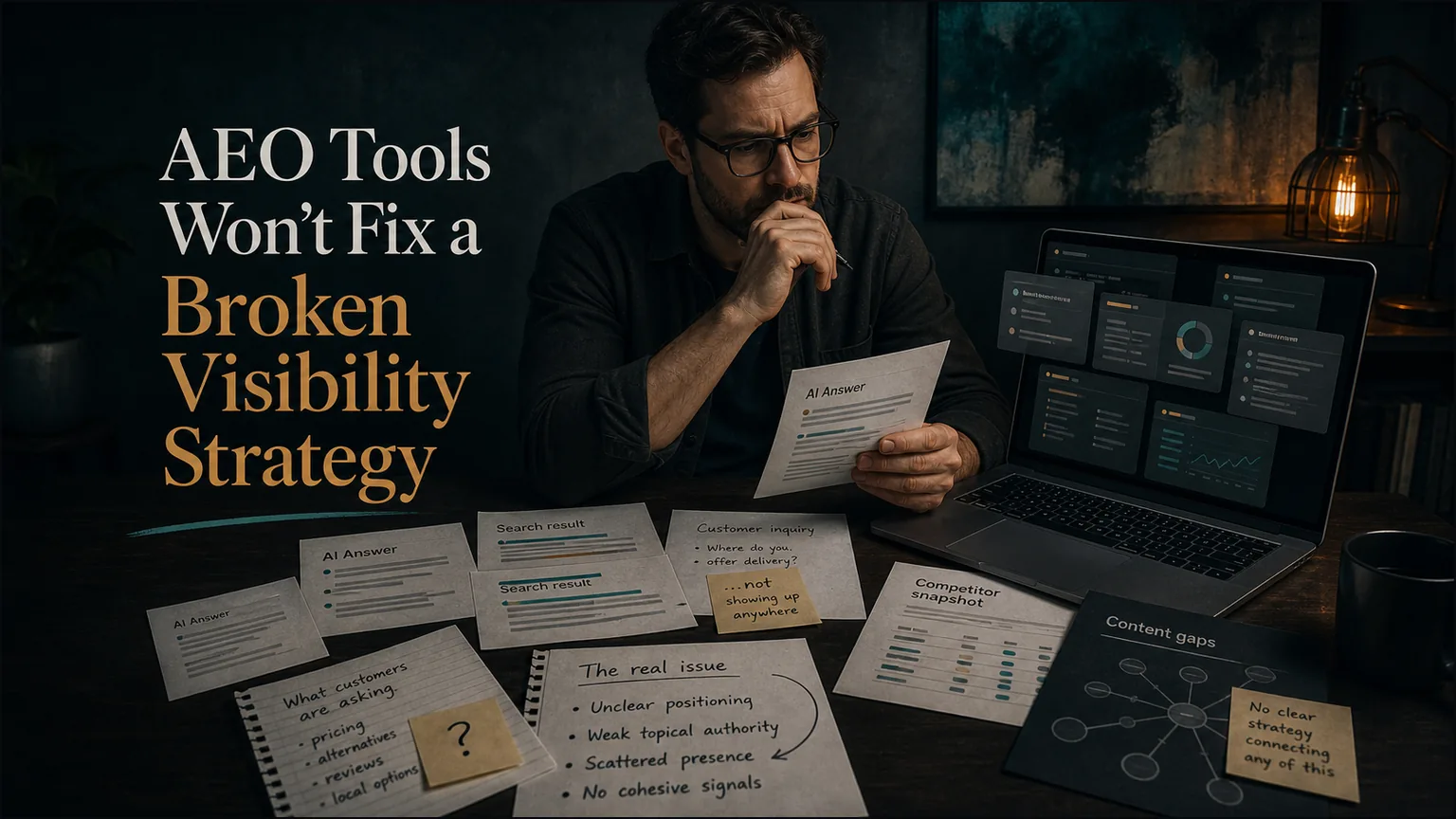
The Tool Is Not the Strategy
Answer engine optimization tools can help a business understand whether AI systems can find, understand, cite, and recommend it. That does not mean every owner needs a new dashboard subscription before lunch. Some dashboards are useful. Some are expensive weather reports: pretty, interesting, and not the reason the roof is leaking.
The owner question is simpler than the software category makes it sound: “Which measurements show whether AI search is helping me win customers, protect revenue, or stop wasting time?” If a tool cannot help answer that, it may still have lovely gradients. Business owners, tragically, cannot deposit gradients.
Validated Nugentive keyword research found answer engine optimization tools as a useful supporting-content opportunity with reported US search volume of 390 and DataForSEO keyword difficulty of 16 in the July 30, 2026 artifact set. Treat that as demand evidence, not a magic rankability coupon. The same source set also showed that commercial AEO, GEO, and AI SEO service phrases carry meaningful CPC estimates, which usually means buyers are expensive to reach through paid channels. Again: CPC is an estimate for one paid-ad click, not a lead, booked call, or customer.
There is also visible market confusion. A current Reddit r/SEO thread in the same-day collection asked about “best ai visibility tools” and focused on reliable tracking and useful reports. Reddit is not technical proof, but it does show what people are confused about in public.
What AEO Tools Should Prove
AEO tools should not be judged by how futuristic they look. They should be judged by whether they help the owner make better decisions about discoverability, trust, and customer acquisition.
Cloudflare’s AEO framing is useful here because it separates two jobs: agent readiness, or whether machine visitors can discover and read a site, and answer engine optimization, or whether AI assistants recommend the business (https://blog.cloudflare.com/aeo/). That distinction matters. A business can be technically accessible and still not be trusted enough to recommend. It can also be mentioned by an AI answer without receiving a single worthwhile visitor.
Good AEO measurement usually covers four layers:
- Access: Can important crawlers and search systems reach the pages that matter?
- Understanding: Do pages explain the business, services, locations, proof, and next steps clearly?
- Citation and recommendation: Does the brand appear in relevant AI answers, and are those mentions accurate?
- Business impact: Do AI-influenced searches, referrals, branded queries, calls, forms, or sales conversations improve?
If a tool only shows layer three, the owner gets a scoreboard without diagnosis. If it only shows crawler logs, the owner gets plumbing notes without revenue context. Both can be useful. Neither is the whole job.
Start With Access Checks
Before paying for advanced AI visibility reporting, confirm the basics. Can the systems you care about reach the pages that explain what you sell?
OpenAI publishes crawler and user-agent documentation for how its systems may access web content (https://developers.openai.com/api/docs/bots). Perplexity also documents its crawlers and user agents (https://docs.perplexity.ai/docs/resources/perplexity-crawlers). Those docs are not marketing folklore. They are where tool claims should start.
A practical access check should review robots.txt rules, server responses, CDN or firewall behavior, important page status codes, canonical tags, and whether valuable service pages are blocked, redirected badly, or hidden behind scripts a crawler may not process well. A site can have perfect intentions and still get treated like a suspicious raccoon by an overzealous firewall. Intent is not a crawlability strategy.
Owners do not need to memorize every user agent. They do need someone to verify that their site is not accidentally locking the front door while buying a brighter sign.
Measure Citations, But Do Not Worship Them
AI citation tracking tools can show whether a brand appears in prompts, answer summaries, AI Overviews, ChatGPT-style responses, Perplexity answers, or other answer environments. That is useful because old rank tracking does not fully capture the new buyer path.
But citations have traps. Prompt wording changes results. Location changes results. Personalization can change results. Some systems cite sources directly; others summarize without visible citations. A brand mention may be flattering and commercially useless. A competitor recommendation may expose a real trust gap, or it may reflect the tool’s prompt design. The answer is not to ignore citations. The answer is to sample them like evidence, not read them like prophecy.
A stronger citation report shows:
- The exact prompt tested
- The market or location context
- The answer engine tested
- Whether the brand appeared, was cited, or was recommended
- Which competitors appeared
- Whether the answer was accurate
- Which source pages or third-party proof seemed to support the answer
The report should also separate branded prompts from category prompts. “Tell me about Nugentive” is not the same business problem as “Who should I trust for AI visibility help?” One checks recognition. The other checks market consideration.

Connect Tool Data to Customer Behavior
The most useful AEO reporting connects visibility data to behavior the owner already understands: calls, forms, booked consultations, demos, store visits, sales conversations, and high-intent branded searches.
This is where many tools get squishy. They can show that AI crawlers scraped pages or that a brand appeared in sample prompts, but proving revenue impact is harder. Microsoft Clarity’s AI Scrape-to-Referral Ratio, covered by Semrush, shows the market moving toward comparing crawler consumption with referral value (https://www.semrush.com/blog/microsoft-clarity-scrape-to-referral/). Useful idea, as long as nobody pretends one ratio explains the whole journey.
Owners should ask for reports that combine signals:
- AI crawler activity on important pages
- AI referral traffic where referrers are available
- Branded search trend changes
- Conversions from assisted or direct visits
- Sales-call language, such as “ChatGPT mentioned you” or “I saw you in an AI answer”
- Accuracy fixes completed on site pages, profiles, and proof assets
None of this guarantees attribution perfection. Attribution has always been a committee meeting with poor lighting. The goal is not perfect certainty. The goal is enough evidence to decide what to fix next.
The Owner’s Tool Selection Checklist
A business owner choosing answer engine optimization tools should not start with the vendor logo parade. Start with the decision the tool must support.
Use this checklist:
- Does it show whether important AI crawlers can access key pages?
- Does it track prompts that match real buyer questions, not vanity prompts?
- Does it separate mentions, citations, and recommendations?
- Does it show competitors and source patterns?
- Does it flag inaccurate or weak information about the business?
- Does it connect findings to pages, profiles, reviews, PR, or content that can be improved?
- Does it connect visibility signals to traffic, leads, or sales conversations?
- Does it explain uncertainty instead of pretending every chart is a court verdict?
If a tool cannot tell you what action to take, it is not a strategy tool. It is a screensaver with invoices.

Common Mistakes
The first mistake is buying a tracker before fixing the website. Tracking weak visibility is sometimes useful. Paying monthly to admire weak visibility is less useful.
The second mistake is treating every AI mention as equal. A passing mention in a low-intent prompt does not carry the same value as being recommended for a service a buyer is ready to purchase.
The third mistake is ignoring third-party proof. AI systems often lean on sources beyond your website: reviews, directory profiles, publisher mentions, product pages, documentation, and other corroborating material.
The fourth mistake is confusing measurement with optimization. AEO tools can find gaps. They do not automatically write clearer service pages, earn better proof, fix blocked crawlers, clean up inconsistent profiles, or improve conversion paths. Very rude of them, considering the subscription price.
Nugentive’s Practical View
For most owners, answer engine optimization tools belong inside a larger visibility system. First confirm access. Then test real buyer prompts. Then inspect sources and competitors. Then fix the pages, profiles, reviews, and proof that shape those answers. Then measure whether the work is producing better customer signals.
That order matters. If you start with a dashboard and never connect it to revenue, you may end up with a beautiful chart explaining why competitors are eating your lunch. Helpful, in a documentary sense. Not enough.
An AI Visibility Audit should make the next move obvious: which technical blocks, content gaps, trust signals, and conversion problems are most likely costing the business qualified customers. The tool stack is only valuable when it helps prioritize those fixes.
Bottom Line
Answer engine optimization tools are useful when they measure access, citations, recommendations, accuracy, competitor patterns, and customer impact together. They are much less useful when they sell “AI visibility” as a mysterious score without showing what to fix.
Owners do not need more marketing mysticism. They need evidence that points to action: can AI systems reach the business, understand it, trust it, cite it, recommend it, and send buyers who can become customers? Measure that, and the tools start earning their keep.