
A Service Should Produce Fixes, Not Acronyms
Answer engine optimization services should help your business become easier for AI systems and search engines to retrieve, understand, trust, cite, and recommend. That sounds technical because, inconveniently, it is. But the owner-level question is simpler: will this help more of the right customers find us, trust us, and contact us instead of a competitor?
If the answer is a fog machine with “GEO,” “AEO,” “LLM SEO,” and six mystery dashboards, keep your wallet in your pocket. A service that cannot explain the business outcome probably cannot manage the technical work either. Acronyms are not a strategy. They are, at best, tiny hats for confusion.
Validated Nugentive keyword research found answer engine optimization services with 480 estimated US searches, low organic keyword difficulty from DataForSEO, and an estimated CPC of $36.37 captured on July 30, 2026. That CPC is an estimate for one paid-ad click, not a lead, booked call, invoice, or promise from the marketing gods. Still, it tells us the market sees commercial value in this problem.

Why Owners Are Shopping for AEO Help Now
Customers used to search, click a few links, and decide who looked trustworthy. They still do that, but now they also ask AI systems for recommendations, comparisons, and “who should I call?” answers. Very rude of them to change the buying path without filing paperwork. Also real.
Cloudflare recently framed the shift as moving from ranking to being recommended, with agent readiness and answer engine optimization focused on whether agents can discover and read a site and whether assistants recommend it (https://blog.cloudflare.com/aeo/). Google’s AI features guidance also points site owners back to the fundamentals: make content useful, eligible, and accessible to Google Search systems rather than chasing a special AI-only trick (https://developers.google.com/search/docs/appearance/ai-features).
That is the part many owners miss. AEO is not a spell you sprinkle over weak pages. It is closer to a quality-control system for how clearly your business answers profitable buyer questions across your site and the sources AI systems may use.
What Answer Engine Optimization Services Should Include
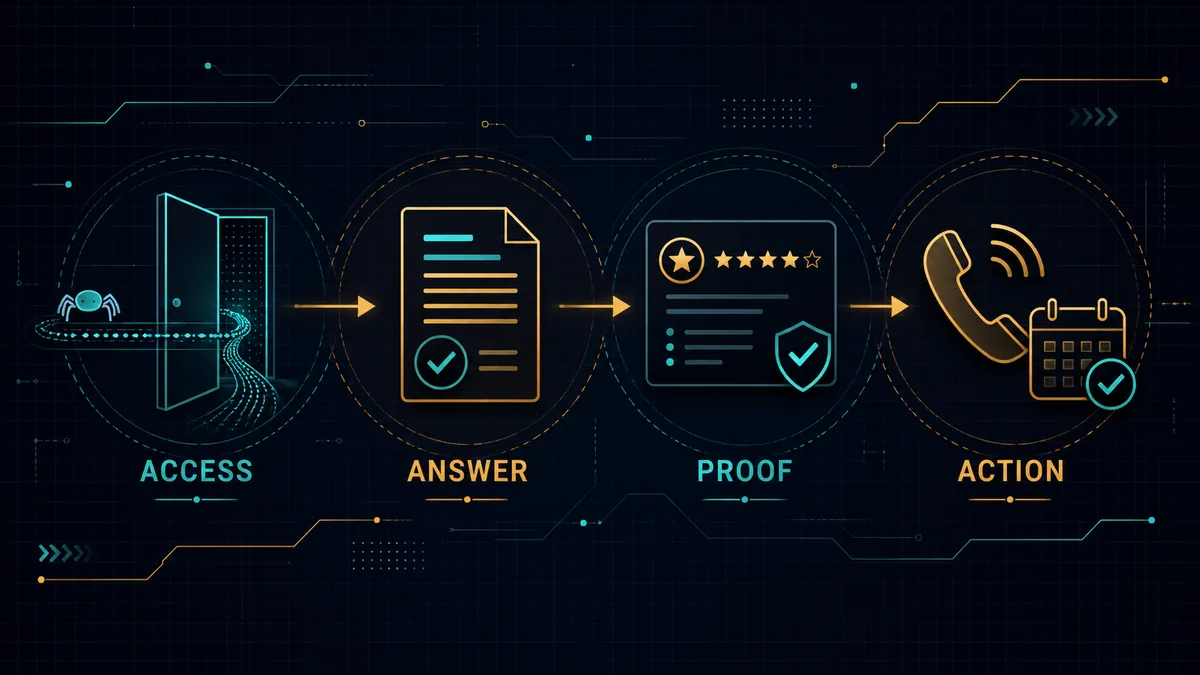
A useful AEO service should produce a prioritized fix list tied to customer acquisition, not just a report showing where your brand was mentioned. Mentions are nice. Customers are nicer. Revenue is extremely charming.
Access: can machines reach the useful parts of your site?
The first job is basic but not optional: make sure search and AI crawlers can access important public pages without getting blocked by sloppy robots rules, overzealous security settings, broken rendering, or buried content. Bing’s Webmaster Guidelines emphasize making sites crawlable and useful for users (https://www.bing.com/webmasters/help/webmaster-guidelines-30fba23a). Google’s guidance says pages need to be accessible and eligible for Search features, including AI experiences.
This is not glamorous work. Neither is checking the door before blaming customers for not entering the store.
Answers: do your pages handle real buying questions?
AEO services should review whether your content answers the questions buyers ask before they call: what you do, who you serve, where you work, what problems you solve, what makes you credible, what it costs or depends on, what happens next, and why someone should trust you over a nearby competitor.
A page saying “we provide industry-leading solutions” answers almost nothing. It is the marketing equivalent of a shrug wearing cologne.
Proof: can AI systems and customers verify the claims?
The service should check proof signals: reviews, service details, team credentials, location consistency, third-party mentions, comparison pages, case evidence where available, and structured business facts. Schema.org’s Organization and Service vocabularies can help clarify business and service information (https://schema.org/Organization, https://schema.org/Service). Helpful? Yes. Magic? No. Schema cannot turn vague content into trust any more than a label maker can turn a junk drawer into an operating system.
Action: does the visibility path lead to a lead?
AEO work should connect visibility to conversion. If a customer finds your business through AI search but lands on a confusing page with weak proof and no obvious next step, the recommendation leaked. Track calls, forms, booking starts, lead quality, and the pages that assist inquiries.
What a Good AEO Engagement Produces
A buyer should expect practical outputs. Not vibes. Not “we optimized your semantic footprint” with no receipts. Useful answer engine optimization services usually produce five things.
- A crawl and access review for important service, location, and proof pages.
- A buyer-question map showing which profitable questions are answered well, weakly, or not at all.
- A source and citation review showing what AI systems appear to use when discussing the business, competitors, or category.
- A proof-gap list covering reviews, directories, credentials, third-party mentions, schema, service details, and consistency.
- A prioritized repair plan that explains what to fix first, why it matters commercially, and how success will be measured.
That last point matters. AEO without prioritization becomes a scavenger hunt. Owners do not need 47 disconnected tasks. They need the next few fixes most likely to help the business get found, trusted, and contacted.
Red Flags When Hiring an AEO Provider
The first red flag is guaranteed AI recommendations. Nobody credible can guarantee ChatGPT, Google AI Overviews, Perplexity, or another answer system will recommend your business. Systems change, prompts vary, and sources shift. If someone guarantees citations, ask whether they also sell weather control.
The second red flag is tool-only reporting. Tools can help collect evidence, run prompt sets, and track visibility. They cannot decide whether your service page is persuasive, whether your reviews prove the right thing, or whether your “about” page sounds like it was assembled during a power outage.
The third red flag is schema theater. Structured data helps machines understand real information on the page. It does not replace useful content, credible proof, accessible pages, or clear conversion paths.
The fourth red flag is channel isolation. AEO touches SEO, local visibility, content, reviews, PR, analytics, and conversion. If the provider treats it as one plugin, one file, or one monthly screenshot, the scope is probably too thin.

How to Judge Whether the Service Is Worth Paying For
Use a simple owner test before hiring anyone.
Ask what customer decision the work is meant to influence. Ask which service or offer will be reviewed first. Ask how the provider separates proven outcomes from directional signals. Ask what they will do if AI systems mention competitors but not you. Ask how technical fixes, content fixes, proof fixes, and conversion fixes get prioritized.
Good answers sound specific. Weak answers sound like a keynote slid under your office door.
A practical AEO plan might start with one high-value service, one location or buyer segment, ten to twenty recurring customer questions, the main service page, the top proof sources, and a baseline prompt set. Then it turns gaps into repairs: clearer answers, stronger proof, better internal links, crawler access fixes, schema that matches the page, and a conversion path that does not make interested buyers solve a maze.
Where Nugentive Fits
Nugentive’s view is that AI visibility is not about tricking ChatGPT. It is about making your business retrievable, understandable, trusted, cited, and recommended across the places AI systems use to form answers.
That means answer engine optimization services should feel less like buying a secret hack and more like getting a practical diagnostic on why the right customer might not find, trust, or choose you. The best work reduces confusion. It shows what is broken, what matters, what can wait, and what to fix next.
If your business is already spending money on ads, content, SEO tools, or vague “AI visibility” reports, start by finding the leaks. Nugentive’s paid $297 detailed AI Visibility Audit does exactly that: inspect access, answers, proof, and conversion paths, then turn the mess into a fix list. No guaranteed recommendations. No acronym confetti. Just a clearer path to more customers and fewer expensive guesses.