
Citations Are Earned Before They Are Counted
AI citation authority is the practical work of making your business a source AI systems can reach, understand, trust, and cite when customers ask who to hire, compare, or believe. It is not a badge. It is not a plug-in. It is not a mystical “LLM blessing” handed down because someone added schema and said please.
The owner version is simpler: when an AI answer mentions businesses like yours, is there enough reliable evidence for your company to be included instead of your competitor?
A fresh Search Engine Land article in today’s collection framed AI citations as a compounding result of technical accessibility, useful content, and third-party authority (https://searchengineland.com/phases-build-authority-earn-ai-citations-485470). That is the right direction. The market has been trying to turn AI visibility into a reporting scoreboard, because dashboards are easier to sell than the unglamorous work of becoming a better source.
But customers do not buy dashboards. They ask for recommendations, skim the answer, and move on with their life. Very rude. Also very real.
Why AI Citation Authority Matters
Traditional SEO often treated authority as something that showed up indirectly through rankings, links, brand searches, and trust signals. AI search makes the idea more visible. If an answer system cites a source, repeats a claim, or recommends a business, it is relying on some mix of retrievable pages, indexed information, third-party references, reviews, entity understanding, freshness, and query fit.
That does not mean every AI citation is perfect evidence. AI systems can cite odd sources, miss better ones, summarize badly, or change behavior across models and prompts. Anyone promising fixed citation control is either confused or selling confidence by the gallon.
Still, the business problem is real. If your site is hard to crawl, your service pages are vague, your proof is thin, and better sources mention everyone except you, AI systems have less reason to include your business. That can cost you customers before they ever reach your website.
Google’s guidance for AI features points site owners back to normal Search eligibility, accessible content, and preview controls rather than a secret AI-only optimization switch (https://developers.google.com/search/docs/appearance/ai-features). Google’s helpful content guidance also emphasizes useful, people-first content (https://developers.google.com/search/docs/fundamentals/creating-helpful-content). Translation: make real information easier to use. Revolutionary? No. Frequently ignored? Painfully.
The Three Layers AI Systems Need
A business usually earns better AI citation potential through three connected layers. If one layer is missing, the rest has to work harder.
1. Technical access
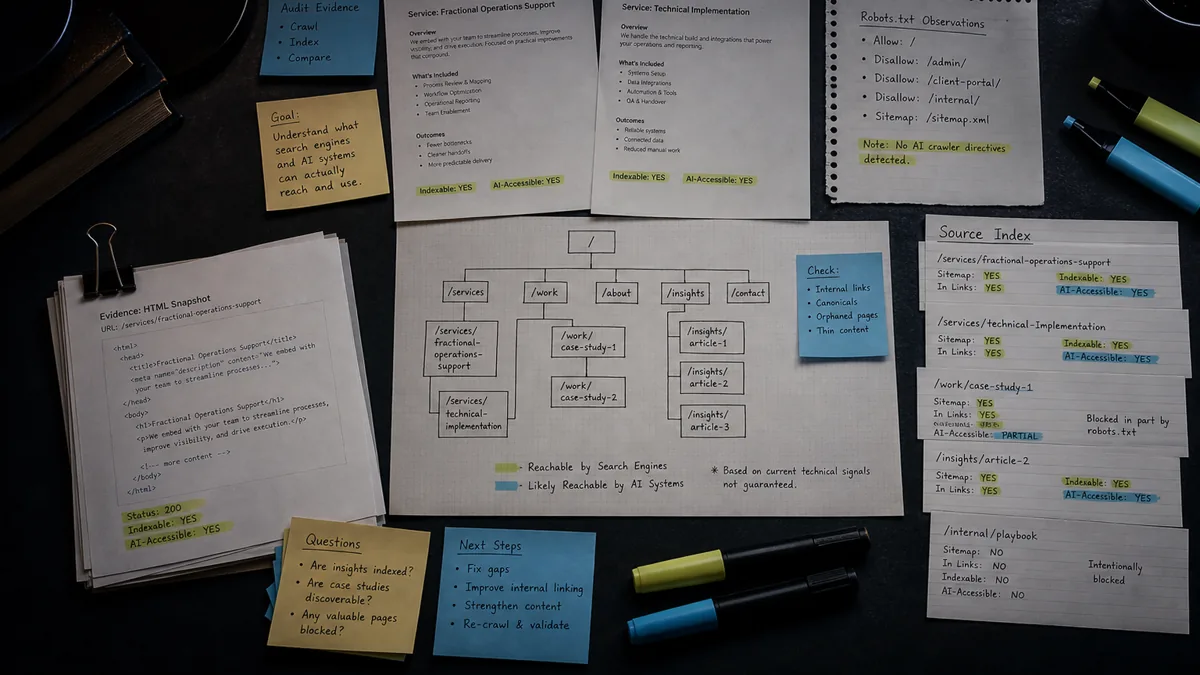
AI systems cannot cite or use what they cannot reach. Check robots.txt, noindex rules, canonical tags, sitemap coverage, server errors, CDN blocks, JavaScript-only paths, and whether important service and proof content appears as readable text.
OpenAI publishes crawler and user-agent documentation for site owners (https://developers.openai.com/api/docs/bots). Bing’s webmaster guidelines emphasize accessible, high-quality, relevant content for users (https://www.bing.com/webmasters/help/webmaster-guidelines-30fba23a). Different systems do not crawl, render, index, or cite exactly the same way, but the owner-safe starting point is consistent: do not hide the pages that explain why customers should choose you.
This is where many “AI visibility” projects quietly fail. The business writes more content while the best service page is orphaned, blocked, slow, thin, or reachable only through a menu that behaves like an escape room.
2. Useful answer content
Being crawlable only gets you into the building. The content still has to answer the questions buyers and answer systems are trying to resolve.
Useful AI citation content explains what you do, who you help, where you operate, what problems you solve, how your process works, what tradeoffs matter, what proof supports your claims, and what a buyer should do next. It should answer comparison, risk, cost, fit, timeline, and trust questions in plain language.
If your page says “we provide innovative solutions to empower businesses,” the AI system has learned almost nothing. So has the customer. The chair in the waiting room might also provide innovative solutions. Be specific.
3. Third-party proof
AI citation authority is not only what you say about yourself. It is also what credible outside sources, platforms, profiles, reviews, directories, articles, associations, partners, and customers say about you.
Third-party proof matters because recommendation-style answers need corroboration. A business saying “we are trusted” is marketing. A pattern of reviews, mentions, credentials, examples, local citations, press, partnerships, and useful expert commentary is evidence.
This does not mean buying sketchy mentions or stuffing Reddit with fake praise. That is not authority. That is leaving fingerprints on the fraud machine.
What Owners Should Fix First
Start with the revenue path, not the entire internet. The goal is not to become universally citeable for every phrase. The goal is to stop losing customers you should have had a fair shot at winning.
- Identify buyer questions that lead to money. Pull from sales calls, forms, reviews, Search Console, customer emails, and AI prompt tests. Focus on hiring, pricing, comparison, local fit, service scope, risk, and trust.
- Map those questions to pages and sources. Decide whether the answer belongs on a service page, location page, FAQ, comparison article, proof page, or third-party profile.
- Check whether the pages are reachable. Make sure crawlers and customers can get to the important content through plain links and clean technical access.
- Strengthen the answer. Add specifics, proof, examples, process details, service boundaries, review evidence, credentials, and next steps.
- Build corroboration. Clean up business profiles, pursue legitimate mentions, earn reviews, document real work, and make outside references consistent.
- Measure citations and business outcomes together. Track prompts, sources, competitor mentions, wrong facts, AI referral traffic where visible, calls, forms, bookings, and qualified leads.
That last point matters. A citation that does not influence trust or customers is a visibility souvenir. Nice to have. Not the same as revenue.
Common Mistakes With AI Citations
The first mistake is treating citation tracking as the strategy. Tracking is useful, but a report cannot fix weak pages, blocked crawlers, missing proof, or vague positioning. Measurement without implementation is just a prettier way to watch the leak continue.
The second mistake is chasing mentions instead of source quality. If a page is thin, outdated, self-serving, or disconnected from buyer intent, getting it cited is not much of a win. AI answers often compress information. Weak source material compresses into weaker recommendations.
The third mistake is trying to force authority with hacks. Hidden text, fake reviews, manufactured forum mentions, doorway pages, and bulk AI fluff are not sophisticated because the acronym changed. Bad SEO tactics do not become strategy when you sprinkle “GEO” on top.
The fourth mistake is ignoring conversion. If AI systems finally mention you but send customers to a page with no proof, unclear next step, or buried contact path, the work stops at attention. Owners need customers, not a collectible citation screenshot.

How Nugentive Thinks About Authority
Nugentive’s view is that AI visibility is not about tricking ChatGPT. It is about making the business retrievable, understandable, trusted, cited, and recommended across the sources and systems customers now use.
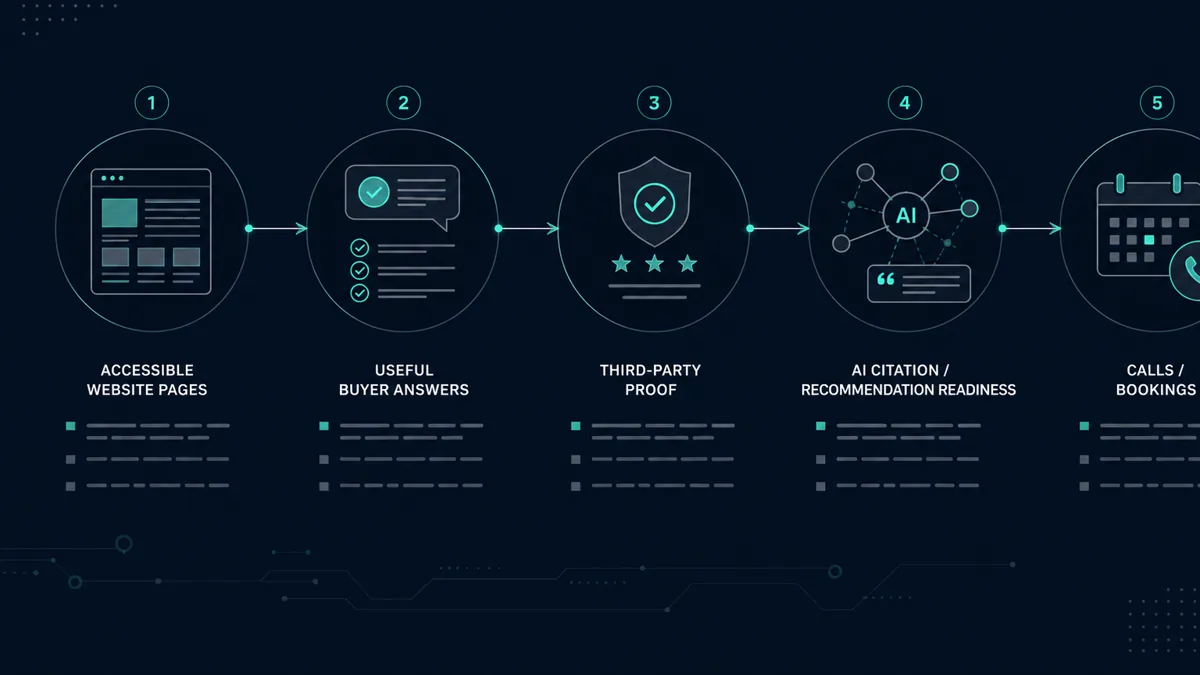
AI citation authority sits right in the middle of that. Technical access makes the evidence reachable. Useful content makes the business understandable. Third-party proof makes the claims more believable. Conversion work makes the attention worth something.
That sequence is less exciting than “dominate AI search in 14 days.” It is also much less likely to get you laughed out of a room by someone who has seen a website before.
The Bottom Line
AI citation authority is earned before it is counted. You build it by making important pages accessible, answering buyer questions clearly, proving claims with credible evidence, and strengthening the outside sources that AI systems may use to understand your business.
Do not start with the scoreboard. Start with the customer journey: can they find you, understand you, trust you, compare you, and take the next step? If the answer is shaky, an AI Visibility Audit can show which technical, content, proof, and conversion gaps are most likely costing you customers before you buy another report.