
Your Website Just Became Local AI Evidence
Local AI answers appear to be leaning harder on business websites than many owners expected. That is good news if your site clearly explains what you do, where you do it, who you serve, and why someone should trust you. It is less charming if your website still reads like a brochure from 2017 that was afraid to mention prices, service areas, staff, process, reviews, and anything resembling a useful answer.
The owner question is simple: if someone asks Gemini for the best local option, does your own website give the system enough evidence to include you?
A fresh Search Engine Land item in the daily collection reported a study of 14,472 Gemini local AI citations. The headline finding was practical: business websites led the cited sources in Gemini’s local results, while repeated searches rarely returned the same sources. Treat that as directional evidence, not a law of physics. AI citation data is noisy. Local results move. Models change. Very rude of them. Also normal.
The useful takeaway is not “Gemini loves websites forever.” The useful takeaway is that your website still matters in local AI discovery. In some cases, it may matter more than the owner assumed.
Why Gemini Local AI Citations Matter
Local search used to feel like a fairly visible contest. You worried about rankings, map pack placement, reviews, proximity, categories, links, and whether your competitor had somehow acquired 400 five-star reviews from people with suspiciously similar writing styles. Normal Tuesday.
AI answers compress that messy research process. A customer can ask a tool which contractor, clinic, restaurant, accountant, repair shop, or service provider to consider. The answer may cite sources, summarize options, compare evidence, and push the customer toward a shortlist before they ever click a traditional result.
That means a local business has two jobs now. First, be discoverable in the places AI systems can access. Second, be understandable and credible enough to survive comparison. Visibility without evidence is just waving in the dark.
Google’s own Business Profile guidance still tells businesses to keep core information accurate, complete, and current (https://support.google.com/business/answer/3038177). Google’s local business structured data documentation also shows how websites can provide explicit details about location, opening hours, contact information, and business identity (https://developers.google.com/search/docs/appearance/structured-data/local-business). Schema is not a magic citation button. If it were, every plugin would be wearing a tiny crown. But clear, consistent data helps machines understand the page they are already able to access.
Your Website Has to Carry Its Share
A lot of local businesses treat the website as a formality because Google Business Profile, directories, reviews, and social platforms feel more active. That is understandable. Those platforms are visible, noisy, and always asking for attention like a toddler with analytics.
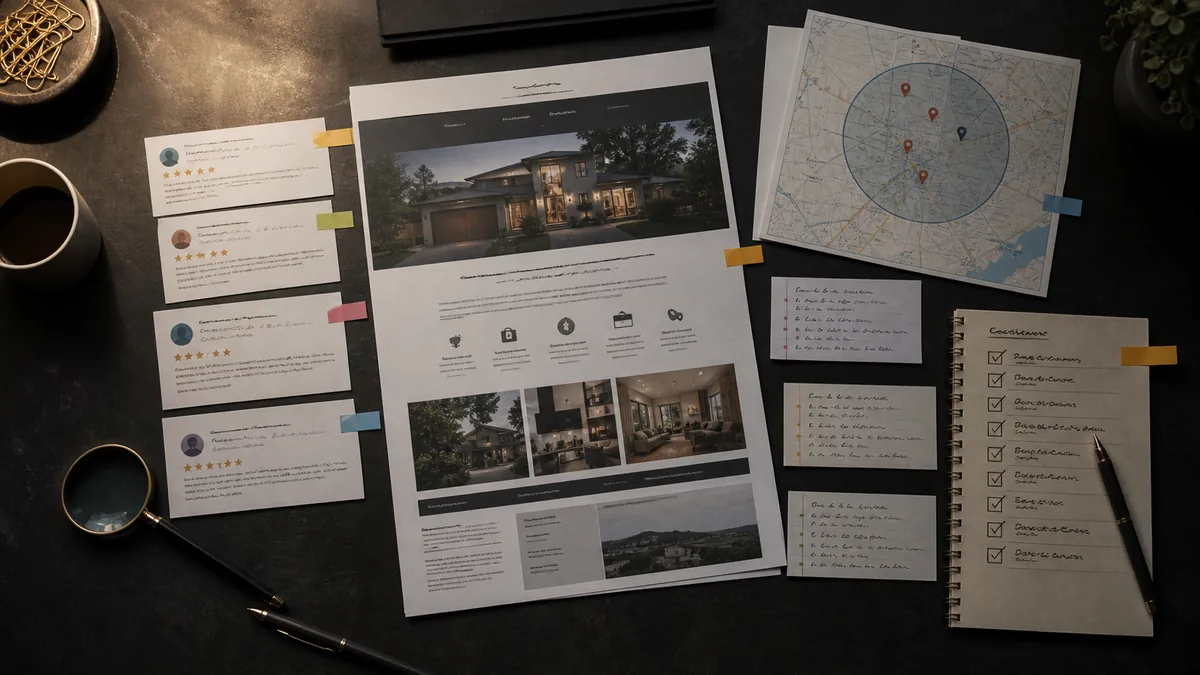
But third-party platforms rarely tell your full story. They may show reviews, hours, photos, categories, or short descriptions. Your own site can explain your service process, guarantees, service area boundaries, qualifications, pricing logic, before-and-after proof, FAQs, team background, and what makes a customer a good fit.
That matters because AI systems do not only need a name. They need decision evidence. If someone asks, “Who handles emergency HVAC repair near me and explains after-hours pricing?” a thin website gives the answer engine very little to work with. A clear service page, local page, FAQ section, review proof, and contact path create a better evidence trail.
The same principle applies across local categories. A dental practice should explain services, insurance, location, appointment flow, emergency handling, and patient proof. A home-services company should show service areas, response expectations, licensing, project photos, financing or pricing guidance, and common problems solved. A restaurant should keep menus, hours, reservation details, dietary notes, and location signals current. None of this is exotic. It is the basic information customers already want, now written so machines can retrieve it without needing a séance.
The Citation Stability Problem
The Search Engine Land summary also flagged that repeated Gemini local searches rarely returned the same sources. That should stop owners from treating one AI search test as a victory parade.
If you ask once and your business appears, good. Take the screenshot. Do not frame it above the fireplace. If you ask once and your business does not appear, that is also not final proof of failure. AI local results can shift because of query wording, location, personalization, source freshness, model behavior, and retrieval differences.
The practical move is to test patterns, not one prompt. Try variations that customers would actually use: “best emergency plumber near me,” “family dentist open Friday in [city],” “accountant for small construction business in [city],” or “roof repair company with financing near [area].” Track whether the same competitors, source types, and missing evidence keep showing up.
This is where owners can waste time chasing screenshots instead of fixing assets. A screenshot tells you what happened once. A pattern tells you what to improve.
What to Fix on the Website First
Start with the pages that influence money. Local AI visibility is not improved by adding fifty vague blog posts while the service page still says “quality solutions for all your needs.” That phrase has retired. Let it rest.
- Clarify services. Each important service should have a page or section that says what you do, who it is for, what problems it solves, and what the next step looks like.
- Clarify location and service area. Use natural language, address details where appropriate, service area descriptions, and location pages only when they are genuinely useful.
- Add proof close to the claim. Reviews, photos, credentials, examples, case notes, process explanations, and FAQs should support the exact service being described.
- Make contact paths obvious. Phone, booking, forms, hours, and response expectations should be easy for customers and machines to find.
- Keep business data consistent. Your website, Business Profile, directories, and major social profiles should not disagree on your name, services, hours, or location details.
- Use structured data where it fits. LocalBusiness schema can help express facts, but it should match visible page content. Do not use schema to whisper claims the page is too shy to say out loud.
Google’s sitemap guidance is also worth remembering: sitemaps help search engines discover URLs, especially on larger or newer sites, but they do not replace good internal links and useful pages (https://developers.google.com/search/docs/crawling-indexing/sitemaps/overview). For AI visibility, access and substance need to work together.
How Nugentive Would Score This
A practical local AI visibility review should not start with “Did Gemini mention us once?” It should start with a source-of-truth audit.
For each key service, ask:
- Can a crawler reach the page through normal links?
- Does the page state the service, location, audience, and next step clearly?
- Is there proof on or near the page?
- Does the page answer the questions a buyer would ask before contacting the business?
- Do outside sources repeat the same core facts?
- Are there obvious contradictions across listings, profiles, directories, and the website?
That checklist is boring in the best possible way. It focuses on controllable assets instead of waiting for an AI answer to become stable, kind, and emotionally supportive. We may be waiting a while.

The Bottom Line
Gemini local AI citations are another reminder that your website is not just a digital business card. It is a source of evidence. If AI systems are going to compare local options, your site needs to be retrievable, specific, consistent, and persuasive enough to help you make the shortlist.
Do not overreact to one study or one prompt test. Do repair the basics: clear service pages, local signals, proof, structured facts, crawlable paths, and current business information. Those improvements help traditional search, AI answers, and actual humans, the underrated audience that still pays invoices.
An AI Visibility Audit can show whether your website is strong enough to act as the source of truth for local AI recommendations, or whether answer engines are being left to piece together your business from stale directories and vibes.