
The Real Risk Is Not Losing Stars. It Is Losing Trust.
Google's expanded review guidance is not just a compliance footnote for SEO people who enjoy reading documentation recreationally. It is a business risk warning: if your reviews look fake, undisclosed, or manipulated, the damage can reach beyond a missing star snippet. It can affect whether customers and AI answer systems trust your business enough to include you in the shortlist.
A business owner usually does not wake up excited to think about review snippet structured data. Fair. There are healthier hobbies. But owners do care when a buyer asks Google, ChatGPT, Gemini, or Perplexity who to trust, sees a competitor with cleaner evidence, and never calls. Reviews are one of the few trust signals customers understand instantly. They are also one of the easiest signals to ruin with sloppy shortcuts.
The short version: review markup should describe legitimate reviews, not decorate weak evidence with stars and hope Google does not notice. Useful? Absolutely. Magic? No. If schema alone made questionable reviews trustworthy, every plugin would be printing money by now.
What Google Changed With Review Guidance
Search Engine Journal reported that Google expanded its review snippet documentation with additional examples of practices that can trigger manual actions, including fake or undisclosed incentivized reviews (https://www.searchenginejournal.com/google-expands-review-guidelines-and-warns-of-manual-actions/583674/). Search Engine Land covered the same update around fake or undisclosed incentivized reviews in review snippet structured data (https://searchengineland.com/google-says-dont-include-fake-or-undisclosed-incentivized-reviews-in-review-snippet-structured-data-483456).
Google's own review snippet documentation is the source that matters most here. It explains how review snippet markup can help Google understand reviews and ratings, while also setting rules for when review markup is eligible and when it can be considered misleading (https://developers.google.com/search/docs/appearance/structured-data/review-snippet). Google's spam policies also describe manual actions as penalties applied when a human reviewer determines pages violate Google Search spam policies (https://developers.google.com/search/docs/essentials/spam-policies).

For business owners, the practical message is simple: do not use structured data to make reviews look more credible than they are. Do not mark up fake reviews. Do not hide incentives. Do not treat testimonials, copied quotes, handpicked feedback, partner praise, or internal ratings as if they are normal customer reviews unless the format, source, and policy actually support that use.
Why This Matters For AI Visibility
AI visibility is not about tricking ChatGPT. It is about making your business retrievable, understandable, trusted, cited, and recommended across the places AI systems use to form answers. Reviews sit in the trusted part of that chain.
When an AI system tries to answer a buyer's question, it does not only need your service page. It needs confidence. That confidence may come from your website, your Google Business Profile, third-party directories, review platforms, local citations, news mentions, comparison content, and other public evidence. If those sources disagree, look thin, or smell like review theater, the AI answer has less reason to recommend you.
Review snippet structured data can help machines understand that a page contains review information. Schema.org defines Review as a way to represent an evaluation of an item, service, organization, or creative work (https://schema.org/Review). But structured data is a label, not a character witness. It tells machines what the content claims to be. It does not prove the claim is honest.

That distinction matters because some businesses are now trying to stack every possible visibility signal without cleaning the underlying evidence. They add review schema to thin testimonials. They recycle reviews across location pages. They run discount-for-review campaigns with disclosure buried somewhere only Indiana Jones could find it. Then they ask why AI tools do not recommend them consistently.
The answer is usually not one missing tag. It is a trust gap.
The Owner-Friendly Review Trust Checklist
Before you worry about whether your stars are showing in search results, check whether your review evidence would make a cautious customer believe you. That is the bar. Search engines and AI systems are trying to approximate it, with varying levels of success and occasional interpretive jazz.
Use this checklist before adding, expanding, or auditing review markup:
- Confirm the review source: Know where each review came from, who collected it, and whether it represents a real customer experience.
- Separate first-party and third-party reviews: Do not blur website testimonials, Google reviews, platform reviews, and private feedback into one suspicious soup.
- Disclose incentives clearly: If a discount, gift, contest entry, or other incentive influenced the review, disclose it where a normal human would actually see it.
- Avoid review duplication across pages: Reusing the same glowing quote on every location or service page can look convenient in the same way a fake mustache looks convenient.
- Match markup to visible content: If the review or rating is not visible to users on the page, do not pretend structured data makes it eligible.
- Check aggregate ratings carefully: Make sure rating counts, averages, and review sources are accurate, current, and not stitched together from unrelated systems.
- Remove or rework risky markup: If you cannot defend the source, format, disclosure, or accuracy, fix the content before you ask Google or AI systems to trust it.
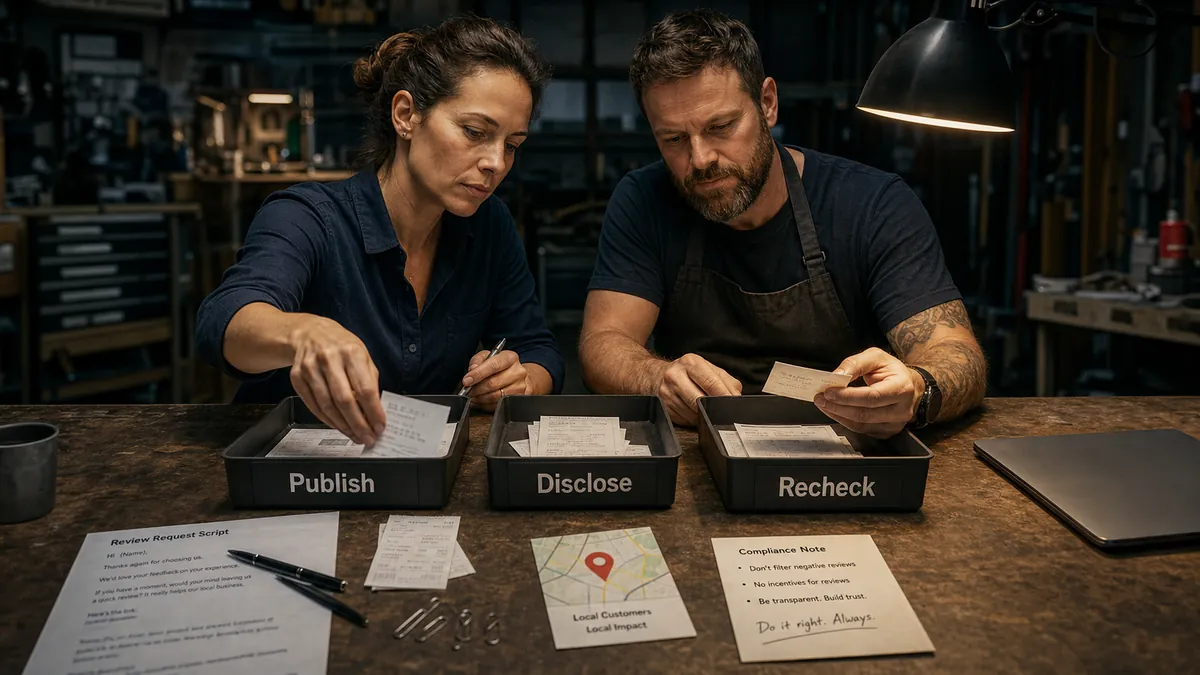
This is not about being timid. It is about protecting revenue. A review strategy should help customers choose you with confidence, not create a technical liability that quietly reduces visibility.
Common Review Mistakes That Create Expensive Guesswork
The first mistake is confusing review quantity with trust. More reviews can help, but a pile of vague five-star comments with identical timing, thin profiles, or hidden incentives does not look like proof. It looks like homework copied from the same kid in class.
The second mistake is using schema as a cosmetic layer. Review snippet structured data should clarify content that is already legitimate and visible. It should not be used to rescue a page that lacks real evidence. If your markup tells a cleaner story than the page itself, the markup is probably the part that needs to lose the argument.
The third mistake is treating manual actions as the only risk. Manual actions matter, obviously. But even without a manual action, weak review evidence can still reduce conversion, make AI answers less confident, and create inconsistent brand descriptions across search and answer engines. The customer may not know why they skipped you. They just did.
The fourth mistake is forgetting locations. Multi-location businesses often reuse reviews, ratings, and testimonials across city pages because it saves time. It can also blur which location earned which evidence. Local buyers want confidence that the nearby branch, office, clinic, shop, or crew can actually deliver.
What Nugentive Would Fix First
A practical review cleanup starts with visibility and evidence, not panic. First, inventory where reviews appear: your website, Google Business Profile, directory listings, industry platforms, landing pages, schema markup, and sales collateral. Then compare what each source says about rating counts, review dates, reviewer context, locations, services, and disclosures.
Next, identify the pages that matter most for revenue. Service pages, location pages, comparison pages, case studies, and high-intent landing pages should have the cleanest trust signals because those are the pages customers and AI systems are most likely to use when forming a shortlist.
Finally, decide what to keep, disclose, remove, or rebuild. Some issues are technical, like broken or mismatched structured data. Some are operational, like review request language that encourages employees to ask for feedback in a way that creates disclosure problems. Some are positioning issues, like testimonials that say nice things but never answer the buyer's real question: “Can I trust this company with my money?”
An AI Visibility Audit looks at those signals together: review evidence, crawler access, indexability, entity clarity, structured data, local citations, source consistency, and the answers AI tools give about your business. The goal is not prettier stars. The goal is fewer missed customers, fewer expensive guesses, and a cleaner path to being recommended when buyers ask who to trust.