
When Clicks Drop, Measure the Customer Path
AI Overviews KPIs are the measurements owners use to understand whether AI-powered search is helping or hurting customer acquisition when ordinary clicks no longer tell the whole story. If impressions rise, clicks fall, and your brand still appears in the answer, the real question is whether buyers are still moving toward you.
Search Engine Journal’s latest SEO Pulse roundup noted several AI-search changes at once, including Google’s August spam update, generative interfaces in AI Overviews, and shifting citation patterns for Reddit in ChatGPT Search (https://www.searchenginejournal.com/seo-pulse-spam-update-generative-ui-ai-overviews-reddit-drop/586597/). Meanwhile, Reddit SEO discussions keep circling the same owner-level anxiety: impressions and entity-style queries may climb while informational clicks decline, leaving teams unsure how to report success when buyers get answers before visiting the site (https://www.reddit.com/r/SEO/comments/1vtt57v/are_we_optimizing_for_traffic_anymore_or_are_we/).
Treat Reddit as market chatter, not court evidence. But the frustration is real: a business can show up more often and still feel poorer if reporting stops at clicks.
Why AI Overviews Make Old Reporting Feel Broken
Traditional SEO reporting trained owners to watch rankings, impressions, clicks, CTR, and conversions. Those still matter. Google’s Search Console Performance report is still one of the basic places to review queries, pages, clicks, impressions, CTR, and average position for Google Search (https://support.google.com/webmasters/answer/7576553?hl=en).
The problem is that AI Overviews can compress part of the research journey into the search result itself. Google’s guidance for AI features says site owners should make useful, accessible content available to Search systems and continue following Search essentials and helpful content guidance (https://developers.google.com/search/docs/appearance/ai-features). In owner language: your pages still need to be crawlable, useful, clear, and trustworthy.
When an AI Overview answers a question, some visitors may not click. Others may click later after a branded search, a direct visit, a map lookup, a phone call, or a referral from another page. Some may remember the business name without leaving an obvious trail. Marketing attribution was already a fog machine with a spreadsheet attached. AI Overviews just turned the fan up.

The KPI Mistake: Treating Fewer Clicks as Automatic Failure
A drop in clicks can be bad. Let’s not pretend otherwise. If qualified visits, calls, forms, bookings, and sales all fall with clicks, something is wrong and should be investigated quickly.
But fewer clicks on informational queries do not always mean fewer customers. Some pages answer early-stage questions that never converted directly anyway. Some zero-click exposure can create brand familiarity. Some AI answer mentions can influence a buyer before they later search your name, compare reviews, or ask another question.
“Clicks are down” is a symptom. It is not a diagnosis.
A better KPI conversation asks:
- Which queries lost clicks?
- Were those queries informational, commercial, local, branded, or support-related?
- Did the page lose qualified leads, or just low-intent traffic?
- Is the brand appearing in AI answers, cited as a source, mentioned without a citation, or absent entirely?
- Are branded searches, direct visits, calls, forms, bookings, or sales changing at the same time?
- Did competitors gain visibility in the same answer space?
That is more work than pointing at a red arrow. Unfortunately, red arrows are rarely a strategy.
Nugentive’s AI Overviews KPI Stack
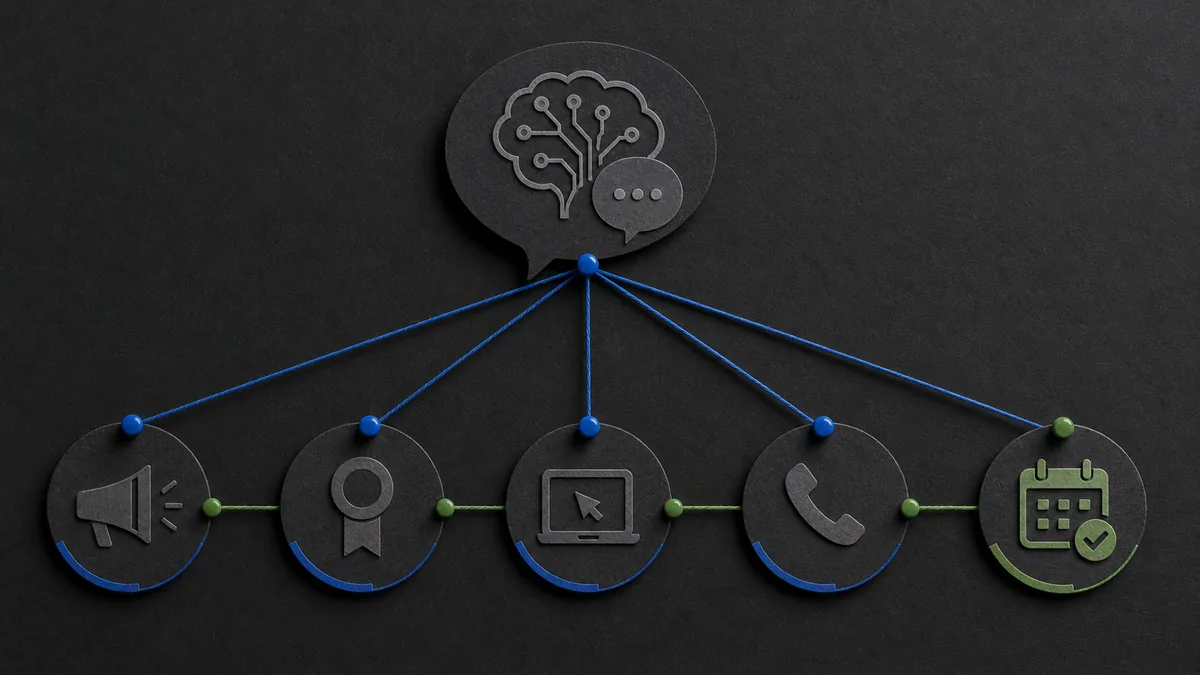
For owners, the goal is not to collect every possible metric. The goal is to connect visibility to revenue protection and customer decisions. Nugentive would split AI Overviews KPIs into five layers.
1. Search demand and exposure
Start with the basics: impressions, clicks, CTR, average position, landing pages, and query groups in Search Console. Segment branded, non-branded, local, informational, comparison, and commercial queries where possible.
If impressions rise while clicks fall, do not panic yet. Identify which query groups changed. Losing clicks on “what is answer engine optimization” is different from losing clicks on “AI visibility services near me” or a service comparison query. One may be education leakage. The other may be revenue leakage.
2. AI answer presence
Track whether your business, page, or competitors appear in relevant AI Overviews and other answer engines for priority buyer questions. Record the prompt or query, date, location assumptions, answer summary, cited sources, brand mentions, and whether the answer is accurate.
AI answers can vary by wording, user context, interface, location, and freshness. The goal is trend intelligence, not pretending the machine handed you stone tablets.
3. Citation and source quality
A citation is useful only if it supports the buyer’s decision. Track whether AI systems cite your own pages, third-party profiles, directories, reviews, news coverage, Reddit threads, or competitor pages.
If AI Overviews cite weak directory pages instead of your service page, that is a fixable signal. Your page may be unclear, thin, inaccessible, slow to answer the question, missing proof, or weaker than external sources. Schema can help clarify information, but it will not magically turn a vague page into the best answer. If schema alone made AI cite you, every plugin would be printing money by now.
4. Downstream demand
Pair AI visibility signals with branded search, direct traffic, referral traffic, Google Business Profile actions, phone calls, forms, bookings, email inquiries, CRM notes, and sales conversations. The buyer may not click the first result, but they may still move toward the business.
Ask sales or front-desk teams what customers mention. “I saw you in Google,” “ChatGPT suggested you,” “your reviews came up,” or “I compared you with X” are not perfect attribution, but they are useful field signals.
5. Fix velocity
The final KPI is whether the team is improving the pages and proof assets that actually affect visibility. Track fixes completed: answer-first rewrites, better service definitions, pricing context, FAQs, internal links, review proof, local citations, crawl access, page speed, author expertise, and third-party corroboration.
Google’s helpful content guidance still emphasizes creating useful, people-first content rather than content made primarily to attract search visits (https://developers.google.com/search/docs/fundamentals/creating-helpful-content). That fits AI visibility too.
What to Do When AI Overviews Seem to Eat Traffic
First, separate traffic loss from customer loss. Pull the affected pages and queries. Group them by intent. Compare clicks, conversions, branded demand, direct visits, calls, forms, and sales outcomes over the same period.
Second, manually review the live search results for the most important queries. Is there an AI Overview? Is your brand mentioned? Are you cited? Are competitors cited? Are outdated directories or low-quality sources shaping the answer? Screenshot and date the findings, because AI answers are not famous for sitting still politely.
Third, inspect the page. Does it answer the question near the top? Does it explain who the service is for, what problem it solves, where the business operates, what proof supports it, and what the next step is?
Fourth, improve the off-site evidence. AI systems often lean on corroboration. Reviews, profiles, citations, trusted mentions, industry references, and consistent business data all help make the answer less dependent on your own website saying “we are great,” which, historically, every website has bravely attempted.

Common Reporting Traps
The first trap is replacing SEO KPIs with AI vanity scores. A visibility score is only useful if it explains prompts, sources, competitors, errors, and next fixes. Otherwise it is a mood ring with a login screen.
The second trap is treating every lost informational click as lost revenue. Some traffic was never close to buying. Protect the customer path, not the ego metric.
The third trap is ignoring commercial pages because the drama is happening on blog traffic. If a service page is unclear, blocked, thin, or missing proof, AI visibility can fail at the exact moment a buyer is ready to choose.
The fourth trap is reporting AI mentions without accuracy. Being mentioned in a wrong or weak answer can create confusion, bad-fit inquiries, or lost trust.
The Bottom Line
AI Overviews KPIs should help owners answer a practical question: are search and AI answers still helping customers find, trust, and choose the business, or are they creating a gap between visibility and revenue?
Clicks still matter. Rankings still matter. But they are no longer enough on their own. The better reporting stack connects impressions, AI answer presence, citations, source quality, branded demand, calls, forms, bookings, and completed fixes.
If AI Overviews are changing your traffic, do not settle for panic or a prettier dashboard. Find the broken part of the customer path, fix the pages and proof that matter, and measure whether more qualified buyers can reach the next step. An AI Visibility Audit can help identify which visibility gaps are actually costing customers and which scary-looking numbers are mostly noise.