
Start With Decisions, Not Dashboards
An AI brand visibility report should answer one owner-level question: are qualified customers finding enough evidence to trust us, choose us, and contact us? If not, it is probably a very attractive spreadsheet wearing a tiny consultant hat.
The topic is getting louder because AI search has turned brand visibility into a multi-source problem. A buyer may ask ChatGPT, Gemini, Perplexity, or an AI-powered search result who to compare. They may see a summary, skim citations, notice reviews, search the brand, and call without following the neat path your attribution model drew. Very rude. Also very normal.
Semrush published a fresh guide on creating an AI brand visibility report, including share of voice, citations, sentiment, and conversion context (https://www.semrush.com/blog/create-ai-seo-search-marketing-report/). That framing is useful, but owners need one more filter: every metric should either explain a customer-acquisition problem or point to a fix. Visibility is not the prize. Customers are.

What an AI Brand Visibility Report Is
An AI brand visibility report is a recurring snapshot of how your business appears when AI systems, search engines, and answer tools respond to buyer questions. It can include whether your brand appears, where it is cited, what competitors appear beside you, answer accuracy, sentiment, and downstream business signals.
For Nugentive, the report is not a scoreboard. It is a diagnostic tool. The goal is to find why buyers may be choosing competitors before they ever reach your website.
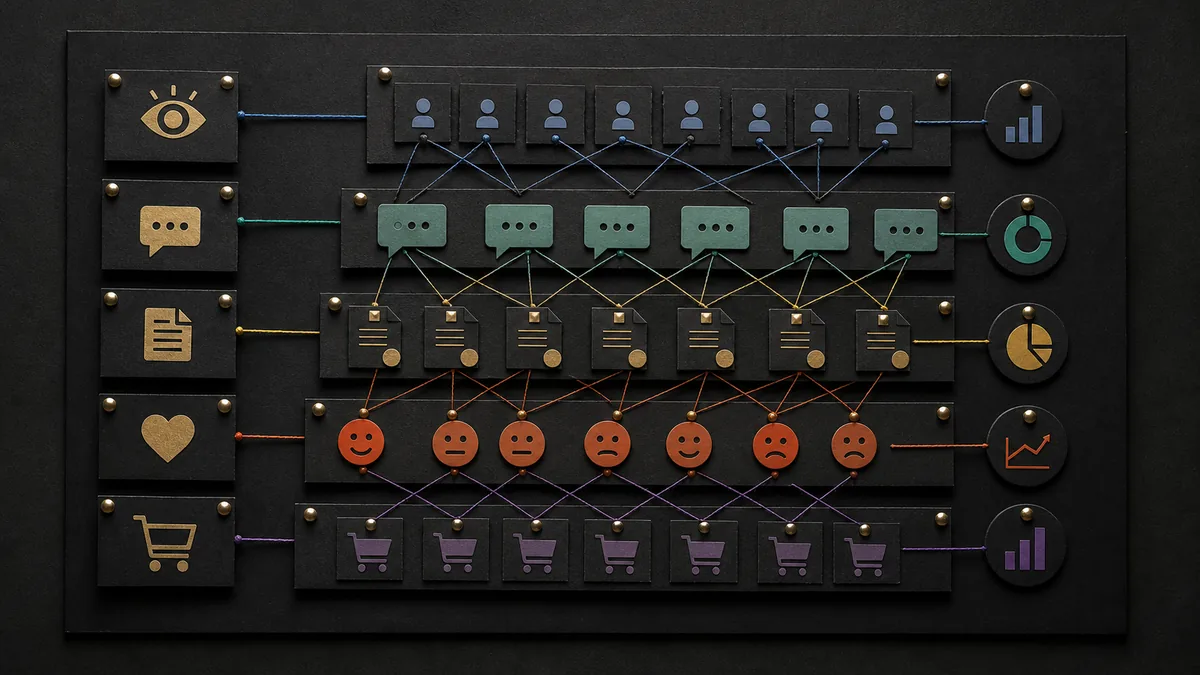
Connect the report to five layers:
- Access: Can search engines and relevant AI crawlers reach the important pages and sources?
- Answer coverage: Does your content answer real buyer questions clearly enough to be retrieved and summarized?
- Evidence: Are claims supported by reviews, profiles, case details, citations, examples, and third-party mentions?
- Accuracy and sentiment: Are AI answers describing the business correctly and favorably enough to support trust?
- Customer action: Are calls, forms, bookings, branded searches, assisted conversions, or qualified leads moving in the right direction?
Why Owners Should Care Now
Your customer used to search, click, compare, and contact. That path still happens, but it is no longer the only path. AI systems can summarize options before the click. Google Search Essentials still emphasize crawlable, indexable, useful content that follows search policies (https://developers.google.com/search/docs/essentials). Those fundamentals remain the floor. AI visibility adds another practical challenge: public evidence has to be easy for machines to retrieve, interpret, and trust.
Google Search Console helps site owners monitor search performance and indexing signals (https://developers.google.com/search/docs/monitor-debug/search-console-start). GA4 can connect events to business outcomes when configured responsibly (https://support.google.com/analytics/answer/10089681). Those tools matter, but they do not automatically explain whether AI answers are recommending the right competitor because your service pages are vague, your reviews are thin, or your best proof is trapped in a PDF from 2019.
An owner does not need another report to admire. They need fewer expensive guesses. A good AI brand visibility report should show where the business is absent, misunderstood, under-proven, or losing trust before the sale.
The Metrics Worth Tracking
Start with brand appearance. For a fixed set of buyer prompts, record whether your brand appears. Do not use one prompt and declare victory or doom. Prompt wording, geography, model version, freshness, and source access can change the answer. Use a repeatable prompt set tied to the way customers actually ask.
Then track competitor presence. If three competitors appear repeatedly and you do not, the useful question is not “why does AI hate us?” It is “what public evidence do they have that we lack?” Look at service clarity, location signals, reviews, comparison content, third-party mentions, and the pages being cited.
Next, track citations and source quality. Are AI systems citing your website, profiles, reviews, industry mentions, social profiles, or competitor pages? A citation is not automatically a win. If it points to an outdated listing with the wrong service area, congratulations, you are visible and inaccurate.
Also track accuracy. Record whether the answer gets your services, locations, differentiators, contact path, and eligibility details right. Inaccurate visibility can cost customers because it creates friction or sends buyers away before they call.
Finally, track business signals. Branded search growth, AI referral traffic, form quality, phone calls, quote requests, booking rates, and sales conversations matter more than vanity visibility. The cleanest report connects AI exposure to the customer path without pretending attribution is perfect.

What to Diagnose When the Report Looks Bad
If your business does not appear in AI answers, check access first. Robots.txt, noindex tags, canonical errors, blocked resources, weak internal links, security rules, and slow or script-heavy rendering can all reduce retrievability. Google’s robots.txt documentation explains how crawling directives work for search crawlers (https://developers.google.com/search/docs/crawling-indexing/robots/intro). OpenAI and Perplexity also publish crawler documentation for their bots and user agents (https://developers.openai.com/api/docs/bots and https://docs.perplexity.ai/docs/resources/perplexity-crawlers). The boring plumbing matters. Sorry. It usually does.
If your business appears but is described vaguely, inspect entity clarity. Your site should make it obvious who you serve, where you work, what you sell, who is not a fit, what proof exists, and how buyers should take the next step. Structured data can support clarity by giving search systems explicit clues about page content (https://developers.google.com/search/docs/appearance/structured-data/intro-structured-data), and Schema.org provides shared vocabulary for structured data (https://schema.org/). Useful? Absolutely. Magic? No. Schema over weak pages is just a nicer label on an empty drawer.
If competitors appear more often, inspect proof. Do they have more specific reviews, better service pages, clearer comparison content, stronger profiles, or more third-party mentions? AI systems often reflect the evidence around a brand, not just the claims on the brand’s own website.
If visibility improves but leads do not, inspect the handoff. The page may answer the question but fail to convert. The phone number may be buried. The quote form may ask for a blood sample and three references. AI visibility can create attention, but the business still has to turn attention into action.
A Simple Reporting Framework
Build the report around four sections an owner can actually use.
First, show the executive readout: where the brand appears, where it is missing, which competitors dominate, what answers are wrong, and which issue is most likely costing opportunities.
Second, show the evidence internally, but summarize it for humans. Include prompt set, source tested, location, date, brand presence, cited sources, competitor mentions, and accuracy notes. Keep the raw data available without forcing the owner to become a prompt-forensics hobbyist.
Third, prioritize fixes. Put revenue-facing pages, high-intent service content, review/profile gaps, crawler access issues, and conversion handoffs above low-impact cleanup. A report that finds everything but prioritizes nothing has not finished its job.
Fourth, connect the work to outcomes. Track what changed after fixes: more accurate answers, stronger citations, better branded search, more qualified calls, higher form quality, or clearer sales conversations.
Common Reporting Mistakes
The first mistake is treating AI visibility like rankings. AI answers vary, so use repeated tests, stable prompt groups, and notes about geography and source context. One answer is an anecdote. Repeated patterns start to become evidence.
The second mistake is reporting share of voice without customer context. Appearing more often for vague educational prompts may feel nice. Appearing for a comparison prompt that precedes a sales call matters more.
The third mistake is ignoring inaccurate positives. If an AI answer recommends you for a service you no longer offer, or lists the wrong location, the visibility is not harmless. It creates wasted calls and disappointed buyers. Reality remains annoyingly important.
The fourth mistake is separating the report from the repair plan. Measurement does not fix access, content, proof, profiles, reviews, or conversion paths. The report should create a work order.
The Bottom Line
An AI brand visibility report is useful when it helps an owner make better decisions. It should show whether the business is retrievable, understandable, trusted, cited, and chosen across the sources AI systems use.
Do not chase a prettier dashboard before you know what is blocking customers. Start with buyer prompts, verify access, inspect citations, check accuracy, compare competitor evidence, and connect changes to real customer signals. That is the difference between reporting AI visibility and improving it.
If the report shows that your business is absent, misdescribed, or losing comparison prompts to better-supported competitors, the next step is not panic. It is diagnosis. A paid AI Visibility Audit can identify which fixes are closest to revenue before you spend another month guessing.