The Leak Usually Starts After the Click
Website traffic not converting is not a traffic problem first. It is usually a trust, offer, proof, or next-step problem wearing a traffic costume.
That distinction matters because owners often respond to weak leads by buying more visitors. More Google Ads. More SEO content. More social posts. More “awareness.” Then the same unclear page receives more people and disappoints them at scale. Very efficient, in the way a leaking bucket becomes more dramatic when you pour faster.
Nugentive’s validated keyword research found website traffic not converting as an unowned adjacent owner-outcome phrase with direct business relevance. The volume is small. The problem is not. If people land on your site and do not call, book, buy, or ask for a quote, the expensive part may not be visibility. It may be the moment after visibility.
Why More Traffic Can Make the Problem Worse
Paid traffic makes this painfully obvious because the meter is running. Google Ads documentation explains that advertisers can set budgets and use cost-per-click bidding where they pay for clicks on ads (https://support.google.com/google-ads/answer/6385083, https://support.google.com/google-ads/answer/1704424). A click is not a lead. It is not an appointment. It is not a customer. It is a visitor with potential, which is a polite way of saying “still unpaid.”
DataForSEO estimates captured for Nugentive on July 30, 2026 showed some AI visibility searches with high estimated U.S. CPCs: ai visibility audit at $62.08, ai seo services at $78.77, and generative engine optimization services at $39.88. Those are provider estimates for one paid-ad click in that market, not invoices, guarantees, or instructions to buy ads. But they make the owner math hard to ignore.
At $62.08 per click, 10 clicks would imply about $620.80 in ad spend before conversion. Fifty clicks would imply $3,104. One hundred clicks would imply $6,208. If the landing page does not explain the offer, prove credibility, and make the next step obvious, that is an expensive way to learn your website is shrugging at buyers.
Four Reasons Visitors Do Not Become Customers
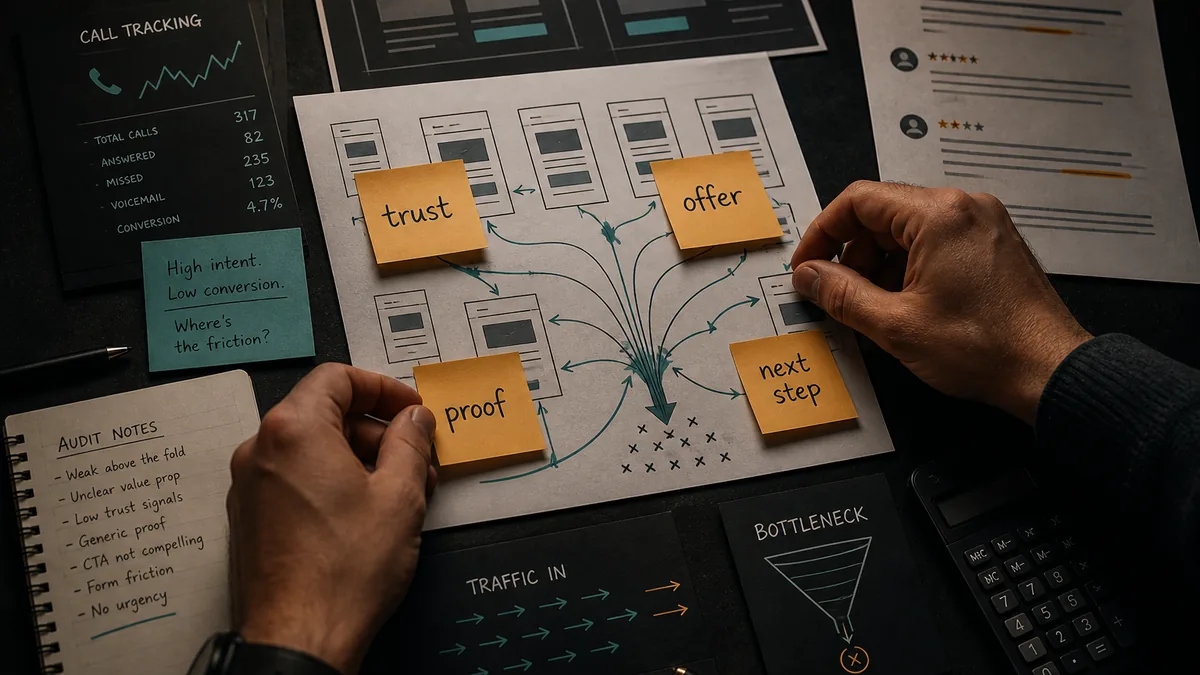
Most conversion problems are less mysterious than they feel. The page usually fails one of four jobs: message, proof, path, or fit.
1. The message is vague
A visitor needs to understand what you do, who it is for, why it matters, and what happens next. “We provide innovative solutions” does none of that. It is a sentence-shaped fog machine.
Google’s helpful content guidance asks site owners to create people-first content that provides useful, reliable information (https://developers.google.com/search/docs/fundamentals/creating-helpful-content). That standard applies to service pages as much as blog posts. If a buyer has to decode your page before deciding whether you can help, many will leave. Customers are busy. They are also ruthless, but in a normal consumer way.
2. The proof is too thin
Trust is not built by saying “trusted” seven times. Buyers want evidence: specific reviews, service examples, credentials, location consistency, team details, third-party mentions, useful comparisons, and clear answers to objections.
AI search raises the stakes because customers may encounter your business through summaries and recommendations before they ever reach your site. Google’s AI features guidance still points owners back to accessible, eligible, useful content for Search systems rather than special AI-only tricks (https://developers.google.com/search/docs/appearance/ai-features). In plain English: make the evidence visible, understandable, and consistent.
3. The next step is weak
A visitor who is ready to act should not have to solve a maze. Call buttons, booking links, quote forms, service-area details, and expectation-setting copy need to be obvious. If the page makes someone wonder whether you serve their area, whether you handle their problem, or whether the form goes into a black hole, you are creating hesitation at the most expensive moment.
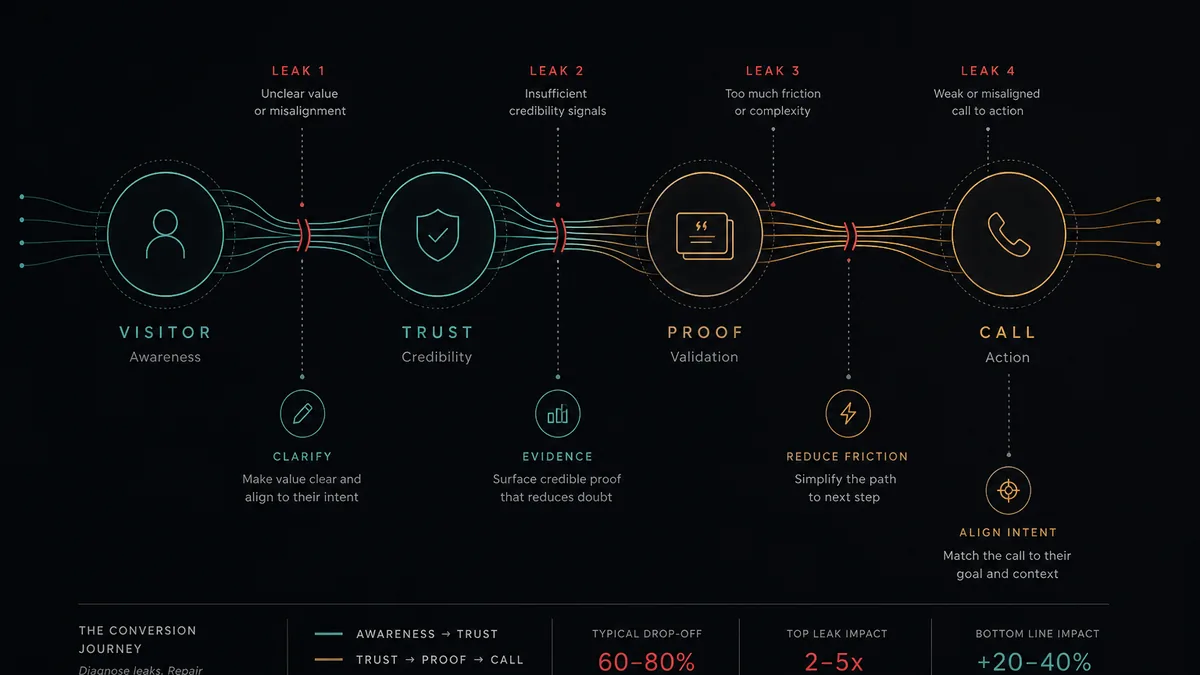
4. The traffic is wrong for the offer
Sometimes the page is fine and the audience is wrong. A broad informational query may bring people who are researching, not buying. A paid campaign may use loose targeting. A blog post may attract other marketers instead of customers. A social post may generate curiosity with no intent.
This is why conversion diagnosis should not start with “make the button bigger.” It should start with the buyer path. Who arrived? What did they expect? What decision were they trying to make? What page did they land on? What proof did they need before acting?
The Owner-Friendly Conversion Audit
You do not need a 90-page CRO report to find the obvious leaks. Start with one high-value service or offer and inspect the path like a cautious customer with money to spend and no patience for decorative copy.
Use this pass:
- Choose one profitable traffic source, such as paid search, organic service pages, AI referrals, local search, or a top blog page.
- Identify the landing page and the action you want: call, form, booking, purchase, consultation, or quote request.
- Read the page as if you have never heard of the business.
- Write down the first unanswered buying question.
- Check whether the page has specific proof, not just claims.
- Check whether the next step is visible without hunting.
- Compare calls, forms, bookings, and qualified leads before deciding whether the page needs more traffic.
The point is not to make every page do everything. The point is to stop sending expensive attention into pages that do not know what job they have.
What to Fix Before Buying More Clicks
Fix the offer clarity first. A good service page should say what you do, who you help, what problem you solve, where you serve, what makes you credible, and what the buyer should do next. If the page cannot pass that test, extra traffic mostly creates extra bounce.
Fix the proof layer second. Add specific reviews, project details where appropriate, credentials, service examples, before-and-after explanations, pricing context, FAQs, and third-party references. Do not invent proof. Do not decorate claims with fake urgency. Real proof beats louder copy because buyers are not as gullible as bad landing pages hope.
Fix the action path third. Make calls, forms, booking links, and quote requests obvious. Explain response time, what information the buyer needs to provide, and what happens after submission. That tiny expectation-setting step can reduce hesitation because people like knowing whether they are starting a process or launching a message into a cave.
Fix measurement fourth. Track calls, forms, booking starts, qualified inquiries, and lead quality by source where possible. Google Ads conversion tracking documentation explains that conversion actions help advertisers measure valuable customer activity after an ad interaction (https://support.google.com/google-ads/answer/1722054). The same principle applies beyond ads: measure the behavior that matters to the business, not just visits.

Where SEO and AI Visibility Fit
SEO and AI visibility still matter. A great conversion path cannot help if the right buyers never find it. But visibility and conversion are connected assets, not separate hobbies. More search visibility sends more people into the page. AI recommendations may send better-informed buyers. Reviews and third-party proof can support both discovery and trust.
That is why “website traffic not converting” belongs in the same conversation as AI visibility. If AI systems can find your business but the source material is vague, they may describe you poorly or skip you. If they recommend you and the landing page fails, the opportunity leaks after the answer. Either way, the owner sees the same result: not enough good customers.
Bing’s Webmaster Guidelines emphasize useful, discoverable, high-quality content and warn against practices that mislead users or degrade experience (https://www.bing.com/webmasters/help/webmaster-guidelines-30fba23a). That is a search guideline, but it is also decent business advice. Make the page useful. Make the claim provable. Make the next step easy.
The Bottom Line
If website traffic is not converting, do not automatically buy more traffic. Diagnose the leak.
Look at the message, proof, path, and fit. Then repair the highest-value page closest to revenue before asking paid ads, SEO, or AI visibility work to send more people there. Traffic is attention. Conversion is the business result. Confusing the two is how owners end up funding very busy websites that do not make enough money.
Nugentive’s paid $297 detailed AI Visibility Audit looks for those leaks across search, AI answers, source proof, and conversion paths. The goal is not to admire the dashboard. The goal is to show what to fix next so more of the right customers can find you, trust you, and take action.