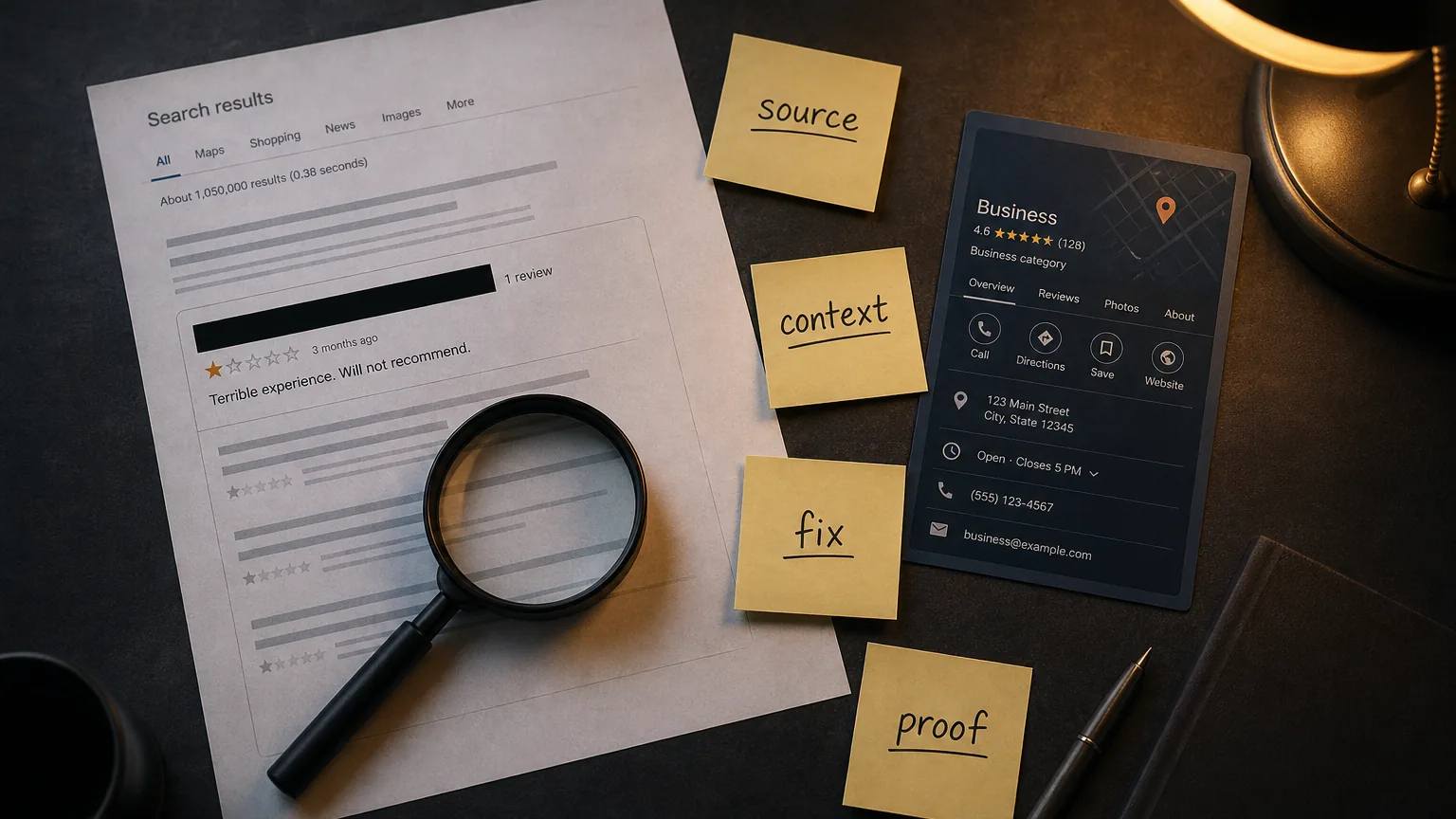
Start With the Source, Not the Summary
Negative content in AI answers is not a new kind of reputation problem. It is the old reputation problem with faster summarization and fewer places to hide. A bad article, angry review, outdated court record, scraped complaint, or half-true forum thread can become one of the sources an answer engine uses when a customer asks whether your business is trustworthy.
That does not mean you can wave at ChatGPT and ask it to please forget the internet. Very therapeutic. Not a strategy.
The practical question for an owner is simpler: if negative content is showing up in Google or being echoed by AI answers, what can actually be removed, corrected, buried by better sources, or monitored before it costs you customers?
Search Engine Journal covered the issue in a fresh August 2026 article about removing negative content from Google before AI answers cite it (https://www.searchenginejournal.com/how-to-remove-negative-content-from-google-before-ai-answers-cite-it-spa/582989/). The useful takeaway is not “panic because AI saw a bad thing.” The useful takeaway is that source cleanup, accurate public information, and stronger proof now matter before the buyer ever lands on your site.

Why AI Makes Reputation Cleanup More Urgent
Traditional search already exposed negative content. A prospect could Google your business, see a bad result, and make a decision. AI-assisted search changes the shape of that moment. Instead of making the customer interpret ten results, an assistant may summarize patterns, compare providers, cite a source, or mention a concern directly in the answer.
Google’s AI features guidance still points site owners back to the same baseline: make useful content available to Google Search systems and follow normal Search fundamentals rather than chasing special AI-only markup (https://developers.google.com/search/docs/appearance/ai-features). That is reassuring and annoying in equal measure. The answer is not a secret AI reputation tag. The answer is source quality.
If the visible web mostly contains stale, thin, or negative information about your business, AI systems may have a weak evidence base. If the visible web contains clear service pages, consistent business facts, credible reviews, useful explanations, and accurate third-party mentions, you give both customers and machines better material to work with.
This is why reputation work and AI visibility are now closer than many owners expect. Your customer does not care whether the lost sale came from a blue link, an AI answer, a review snippet, or a Reddit thread. They only know they did not trust you enough to call.
The Three Real Paths: Remove, Correct, or Outrank
Not every negative result can be removed. Some can. Some should be corrected. Some need to be outranked or diluted by stronger, more accurate sources. Pretending every problem has the same fix is how reputation cleanup turns into expensive fog.
1. Remove what violates a policy or the law
Google provides processes for removing certain personal information from search results, including some sensitive personal data (https://support.google.com/websearch/answer/9673730). Google also has legal removal request pathways for content that may violate applicable laws (https://support.google.com/legal/troubleshooter/1114905). Those paths are narrow. They are not a general “I dislike this article” button, because sadly the internet remains committed to being difficult.
Removal may be appropriate for exposed personal information, doxxing, certain explicit material, impersonation, copyright issues, court-ordered removals, or content that clearly violates platform policies. If the content is accurate, newsworthy, or opinion-based, removal is usually much harder.
2. Correct what is wrong or outdated
Some negative content is not removable, but it may be inaccurate, incomplete, or stale. In that case, the work is documentation and outreach. Gather proof, contact the publisher or platform, request a correction, update the source record, and make sure your own site explains the current facts clearly.
This matters for AI visibility because answer systems can pull from outdated or inconsistent sources. If a directory lists the wrong service area, a profile shows an old address, or a review platform has an unanswered recurring complaint, the machine is not being mean. It is reading the mess you left in public.
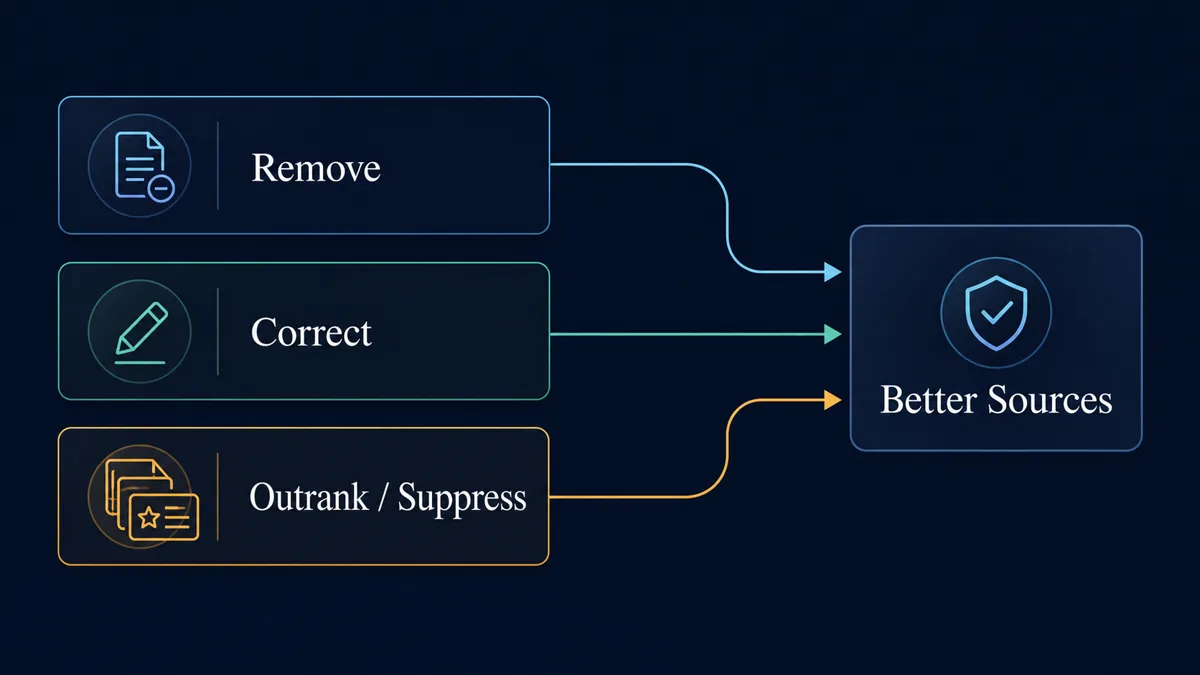
3. Outrank weak negatives with stronger proof
Suppression is not magic. It means creating and strengthening better sources so customers and search systems see a more complete, accurate picture. That may include improved service pages, comparison pages, FAQs, case studies, review responses, local listings, partner mentions, expert quotes, and useful educational content.
Google’s helpful content guidance emphasizes content made for people that demonstrates value and usefulness (https://developers.google.com/search/docs/fundamentals/creating-helpful-content). That is exactly the standard owners should apply here. Do not publish ten thin “we are trustworthy” posts. Publish the pages a cautious buyer would actually need before hiring you.
What to Audit Before Blaming the AI
Before treating AI answers as the villain, audit the source layer. AI systems are not always right, but they often expose problems that were already visible.
Start with the negative result itself. Is it ranking in Google? Is it cited by an AI answer? Is it showing in a review summary, knowledge panel, directory page, social result, forum, article, or legal database? Record the exact URL, date seen, query or prompt, screenshot, and what claim appears.
Then classify the issue:
- Is the content false, outdated, private, illegal, policy-violating, opinion-based, or simply unflattering?
- Is the source authoritative enough that customers may believe it?
- Is your own website answering the related concern clearly?
- Are your reviews recent, specific, and representative?
- Are directories and profiles consistent across name, address, services, hours, and location?
- Are better sources available for AI systems and customers to trust?
That last question is where most owners find the actual work. A business can spend weeks yelling about one bad result while its own website has vague service pages, unanswered reviews, and zero third-party proof. Bold choice. Usually not profitable.
A Practical 30/60/90-Day Repair Plan
In the first 30 days, document the problem and fix obvious accuracy issues. Capture the URLs and prompts where negative content appears. Submit legitimate removal requests only where policy or legal grounds exist. Correct outdated listings, answer recent reviews professionally, and update the core service pages that prospects use to decide whether you are credible.
In days 31 to 60, build stronger owned proof. Add clearer service explanations, pricing or process guidance where appropriate, comparison content, FAQs, team or credential details, and evidence that addresses the concern without sounding defensive. If the issue is a customer-service pattern, fix the operational problem too. Content cannot permanently outrank reality. Rude, but fair.
In days 61 to 90, strengthen third-party signals. Ask satisfied customers for specific reviews, clean up major directory profiles, pursue legitimate local press or partner mentions, and monitor whether AI answers, branded searches, and high-intent queries show better source patterns. Track changes monthly rather than declaring victory after one prompt test.

Mistakes That Make Negative Content Stickier
The first mistake is trying to bury everything with generic blog posts. Search and AI systems do not need more decorative content confetti. They need better evidence from better sources.
The second mistake is ignoring review quality. If the negative source says customers complain about response time and your reviews say the same thing, the problem is not the citation. The problem is operations wearing a marketing hat.
The third mistake is blocking crawlers without understanding the tradeoff. Google’s robots.txt documentation explains how site owners can manage crawler access (https://developers.google.com/search/docs/crawling-indexing/robots/intro), but blocking systems from reading your best pages while bad third-party sources remain visible is not a reputation strategy. It is locking the front door after handing everyone the side entrance.
The fourth mistake is demanding guaranteed AI answer cleanup. No agency can guarantee that every AI system will stop mentioning a source. The realistic goal is to reduce harmful visibility where legitimate, correct inaccurate information, and make stronger sources easier to retrieve, understand, trust, and cite.
The Bottom Line for Owners
Negative content in AI answers should not send you into panic mode. It should send you into source-audit mode.
Find the exact source. Decide whether removal, correction, or suppression is realistic. Fix your own pages and profiles. Build proof that helps a cautious customer choose you. Then monitor the queries and prompts that actually affect revenue.
That is less dramatic than promising to erase the internet. It is also more useful. Nugentive’s job in this kind of work is to show where customers and AI systems are getting the wrong story, what sources are causing it, and which fixes are most likely to protect trust before more money goes into guesses.