
The Visitor Already Heard the Sales Pitch
LLM traffic conversion is not just normal referral traffic with a novelty hat. A visitor who arrives after asking ChatGPT, Perplexity, Gemini, Copilot, or another assistant may have already compared options, absorbed a summary, checked objections, and formed an opinion before your website ever loads.
That matters because many business owners still judge every channel by the same old question: did the click convert right away? Fair question. Incomplete question.
Search Engine Land recently argued that LLM traffic converts differently because AI shapes the decision before the visitor reaches the site (https://searchengineland.com/llm-traffic-converts-differently-what-to-do-484964). The practical takeaway is not “AI visitors are magical.” Please do not give them tiny capes. The takeaway is that your landing pages, proof, and tracking need to account for a buyer who may arrive more informed, more skeptical, or already halfway through the shortlist.

Why LLM Traffic Behaves Differently
Classic paid search usually captures demand at the query. Someone types “emergency plumber near me,” clicks an ad or result, scans a page, and decides whether to call. The landing page has to answer fast because the buyer is still gathering confidence.
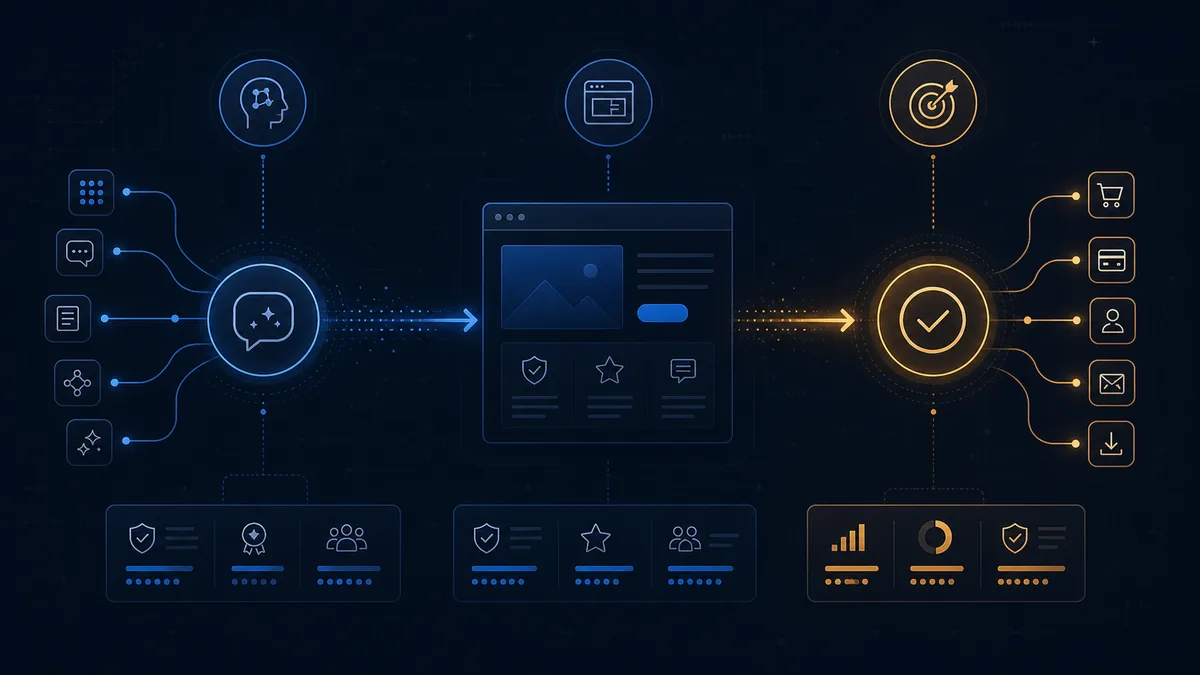
AI-assisted discovery can move some of that confidence-building upstream. A customer may ask an assistant for options, compare companies, ask for pros and cons, request local fit, check reviews, then click only after the assistant has narrowed the field. By the time that visitor reaches your site, they may not need a generic introduction. They need confirmation.
Google’s guidance for AI features still points site owners back to making useful content accessible and eligible for Search systems rather than chasing a separate AI-only trick (https://developers.google.com/search/docs/appearance/ai-features). Google’s helpful content guidance also emphasizes content that is useful and satisfying for people, not content made mainly to manipulate search rankings (https://developers.google.com/search/docs/fundamentals/creating-helpful-content). That combination matters: AI does not remove the need for a good page. It raises the cost of a vague one.
If an AI answer summarized three providers and sent a customer to your site, your page should not make them restart from zero. “Welcome to our innovative solutions” is not confirmation. It is fog with a contact form.
The Conversion Problem Is Confirmation
LLM traffic often arrives with a question already in motion. The visitor is not always asking, “Who are you?” They may be asking, “Are you really the right fit?”
That means the page needs to confirm four things quickly.
Fit
Does the page match the exact problem, location, industry, budget range, urgency, or buyer type that brought the visitor in? If an AI answer recommended a company for “commercial HVAC maintenance in Denver,” the landing page should not dump the visitor onto a generic homepage and wish them luck.
Proof
AI answers often cite or summarize sources. Your site still needs visible proof: reviews, examples, credentials, photos, case details, policies, third-party mentions, comparison context, and clear service specifics. The visitor should see why the assistant’s recommendation made sense.
Next step
If the buyer is ready to act, do not hide the action behind a scavenger hunt. Calls, quote requests, booking links, location details, response expectations, and intake steps should be obvious. Conversion friction is expensive when the visitor already did the research.
Consistency
The answer, the ad, the organic result, the profile, and the landing page should not disagree. If AI says you serve one area and the page says another, or reviews mention one specialty while the site never states it, you have built a hesitation machine. Efficient, but not in the way anyone wants.
What to Measure Besides the Click
A clean AI referral session is useful. It is also not the whole story. Some AI-influenced buyers may come through direct traffic, branded search, local profiles, review sites, paid search, or a return visit after the assistant planted the idea. Very inconsiderate of them to ignore your attribution model.
Google Analytics documentation defines traffic acquisition reporting around how users arrive at a site, including channels and source/medium dimensions (https://support.google.com/analytics/answer/9756891). Google Analytics conversion guidance explains that key events are user interactions that matter to a business, such as purchases, form submissions, or other valuable actions (https://support.google.com/analytics/answer/9234069). Those basics still matter. The difference is that AI influence may sit before the visible session.
For a practical monthly view, track these together:
- AI assistant referrals where analytics can identify them.
- Branded search impressions and clicks in Search Console.
- Direct traffic and returning visitor behavior on high-intent pages.
- Calls, forms, bookings, quote requests, and lead quality.
- Prompt tests for buyer questions that should surface your business.
- Source pages and third-party proof that AI answers cite or summarize.
- Sales-call notes when prospects mention ChatGPT, Gemini, Google AI answers, Reddit, reviews, or comparisons.
Do not pretend this creates perfect attribution. It creates a better operating picture than staring at one referral report and declaring the channel dead because the number is small.
How to Improve LLM Traffic Conversion
Start with the pages closest to money. Core service pages, location pages, comparison pages, pricing-context pages, proof pages, and booking paths deserve attention before another charming blog post about industry trends. Yes, including this one. The irony has been noted.
First, rewrite pages around the questions a buyer asks after an AI answer. They may want to know whether you serve their area, whether you handle their specific problem, what the process costs, how long it takes, what makes you credible, and what happens after they reach out.
Second, place proof near the decision point. Do not bury reviews, case details, credentials, photos, or guarantees on a separate page that only determined archaeologists will find. If proof matters to the choice, put it near the call to action.
Third, make source consistency a maintenance task. Check your website, Google Business Profile, Bing Places, directories, review platforms, social profiles, and major third-party mentions. AI systems often build answers from multiple sources. If those sources conflict, the buyer gets uncertainty and you get fewer calls. Lovely trade.
Fourth, segment follow-up. A visitor from an AI assistant may already understand the basics. Your intake form, confirmation message, sales script, or nurture email should not assume they are starting cold. Ask what they are trying to solve, what they compared, and what would make the decision easier.

Mistakes That Waste AI-Influenced Visits
The first mistake is sending every AI-influenced visitor to the homepage. A homepage can be useful, but it is often too broad for a buyer who asked a specific question. Match the page to the intent whenever possible.
The second mistake is measuring only last-click conversions. If AI helps create demand and paid search captures the final click, the paid channel gets the trophy while the influence layer disappears. Attribution models have been rude like this for years; AI just makes the rudeness harder to ignore.
The third mistake is treating AI visitors as automatically high-intent. Some are. Some are researchers, competitors, bots, students, vendors, or people who will never buy. Look at lead quality and sales outcomes, not just session labels.
The fourth mistake is assuming more traffic fixes a weak page. If the page does not confirm fit, proof, and action, more visitors just give you more ways to be disappointing at scale.
The Bottom Line
LLM traffic conversion is different because the customer journey is no longer neatly contained inside your website visit. AI systems can shape the shortlist, explain the options, expose objections, and send a buyer to your site only after the decision has already started.
That does not make analytics useless. It makes lazy analytics dangerous.
Owners should track AI referrals, branded demand, high-intent page behavior, calls, forms, bookings, and lead quality together. More importantly, they should fix the pages and proof sources that determine whether an AI-influenced visitor becomes a customer.
Nugentive’s job in this world is not to worship AI traffic as a shiny new metric. It is to make your business retrievable, understandable, trusted, cited, recommended, and easy to choose when the buyer finally lands. The click is not the finish line. It is the handoff.