The Booking Is Now Part of Search
ChatGPT restaurant reservations are not just a cute product integration for people who do not want to open another app. They are a sign that AI search is moving from “tell me who looks good” to “help me act on the recommendation.” For a local business, that shift matters because visibility is no longer finished when somebody sees your name.
Search Engine Land reported that Yelp has brought restaurant reservations and waitlists into ChatGPT, allowing users to reserve a table or join a waitlist without leaving the conversation (https://searchengineland.com/yelp-brings-restaurant-reservations-and-waitlists-to-chatgpt-484554). The practical lesson is bigger than restaurants. Discovery, trust, and action are starting to compress into one flow.
Your customer used to search, compare, click, read, call, maybe book, and then forget where they put their keys. Now they may ask an AI assistant for a recommendation, review the answer, and complete the next step inside the same experience. Very rude to your old funnel diagram.
If your business depends on calls, bookings, appointments, reservations, quotes, or store visits, the owner question is simple: when AI systems help customers act, are your facts, proof, and booking paths clean enough to be chosen?
Why This Is Bigger Than Restaurants
The Yelp and ChatGPT reservation news is restaurant-specific, but the pattern is not. AI assistants are becoming more action-oriented. OpenAI’s Apps SDK documentation describes a way for apps to be built into ChatGPT experiences (https://developers.openai.com/apps-sdk/). That does not mean every small business needs to build an app tomorrow morning.
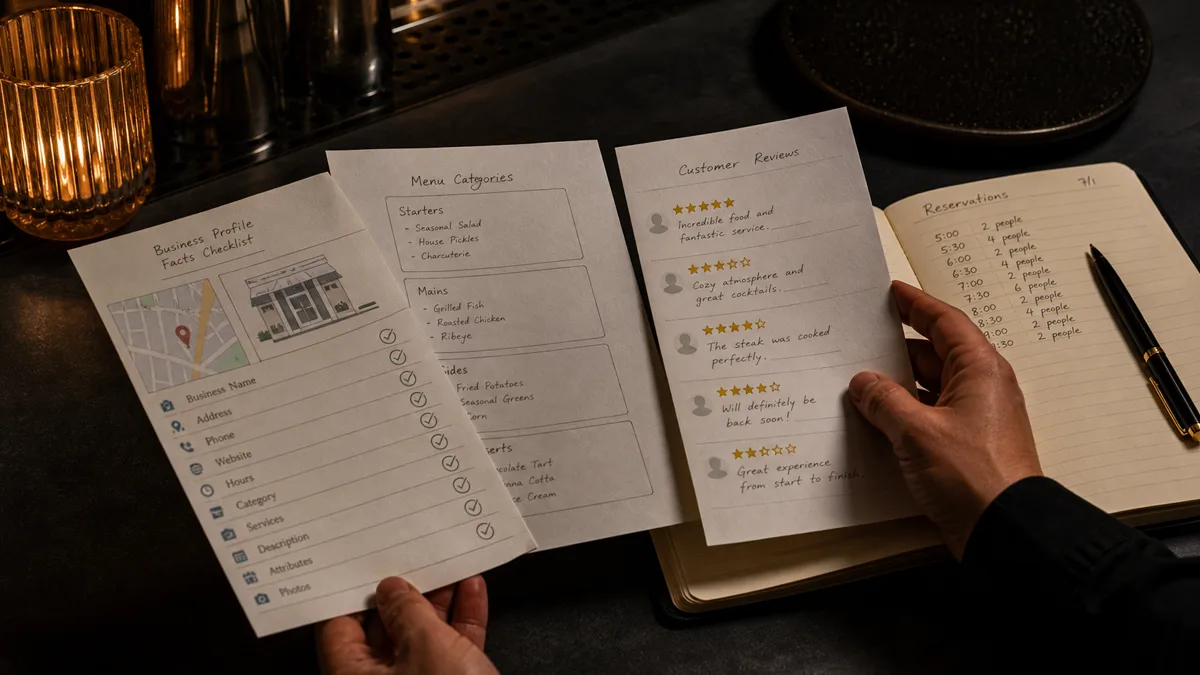
It does mean business information has to survive a shorter path from question to action. A customer asking “where should we eat tonight?” may care about cuisine, distance, availability, reviews, price, photos, dietary fit, and whether booking is easy. A customer asking for a plumber, med spa, accountant, roofer, dentist, attorney, or consultant has the same basic pattern: who is credible, who fits my situation, and what is the next step?
Google’s AI features guidance still points businesses back to normal search fundamentals: make content useful, accessible, and eligible for Google Search systems rather than chasing special AI-only tricks (https://developers.google.com/search/docs/appearance/ai-features). Translation: AI action flows do not replace the evidence layer. They make weak evidence more expensive.
If your hours are wrong, your booking link is buried, your reviews do not mention the services you want to sell, and your site describes everything as “solutions,” an AI assistant has less reason to move a customer toward you.
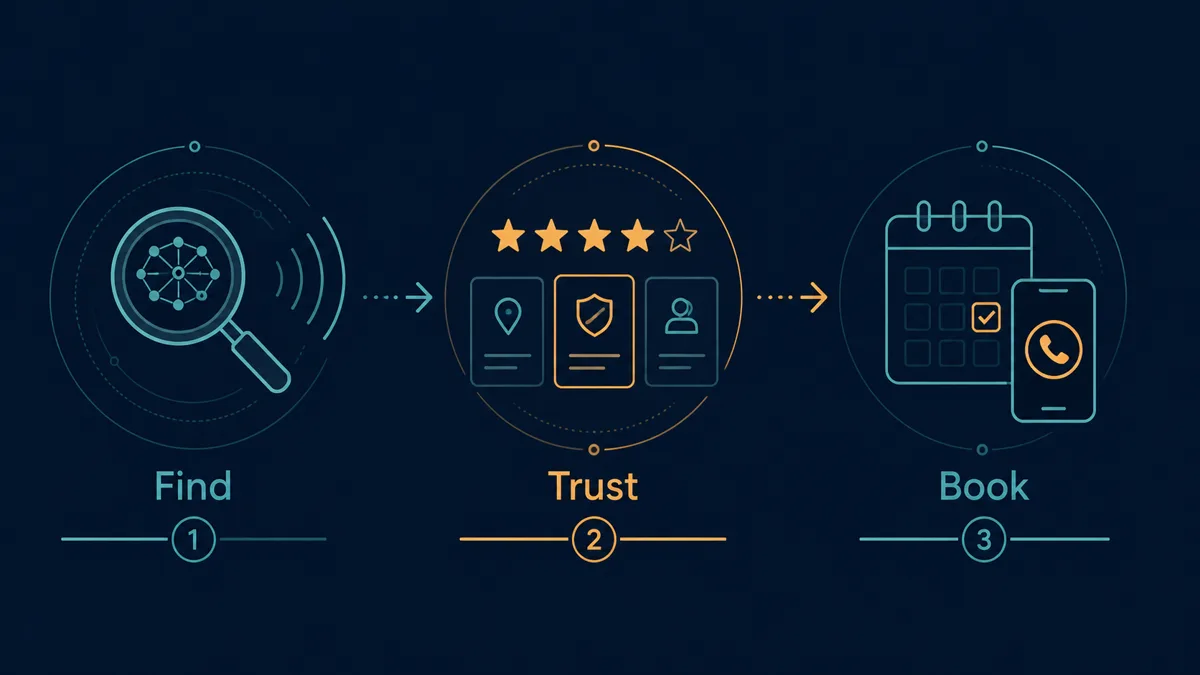
The Find, Trust, Book Framework
A business that wants to benefit from ChatGPT restaurant reservations or similar AI-assisted booking behavior needs three layers working together.
1. Find: make the business easy to retrieve
Start with the basics that feel too boring to matter until they break. Your name, address, phone number, hours, categories, services, location pages, menu or service details, and availability signals should match across your website, Google Business Profile, Yelp, Apple Maps, major directories, and category-specific platforms.
Google’s Business Profile guidance explains that owners can update important profile information such as hours, attributes, and business details (https://support.google.com/business/answer/3038177). That sounds administrative. In an AI-assisted discovery flow, it is revenue protection. If an assistant sees conflicting hours or unclear categories, it may skip the business rather than risk a bad recommendation.
For restaurants, this means cuisine, menu, hours, reservation availability, waitlist status, photos, and review themes. For service businesses, it means service area, specialties, appointment paths, credentials where relevant, and what type of customer you are actually a fit for.
2. Trust: give the assistant and the buyer enough proof
Being found is not the same as being recommended. AI systems can mention a business without presenting it as the best next step. Customers do the same thing when they say, “I found three options,” which is usually code for “I trust none of them yet.”
Trust comes from specific proof. Reviews that describe the actual experience. Service pages that answer real buyer questions. Photos that match the business. Third-party mentions. Accurate profiles. Clear policies. Case studies or examples where appropriate. A website that explains what happens after someone books, calls, submits a form, or joins a waitlist.
Google also provides guidance on reading and replying to reviews from a Business Profile (https://support.google.com/business/answer/3474122). Review responses are not just reputation theater. They can clarify service fit and reduce hesitation for the next customer reading the pattern.
The mistake is treating reviews as decoration. A review that says “great place” is nice. A review that says “they handled our party of eight with a gluten-free menu, fast seating, and clear wait time” is more useful evidence. Specificity helps humans decide. It also gives machines a cleaner description of what the business is known for.
3. Book: remove friction from the action path
If AI-assisted discovery shortens the path to action, your conversion path cannot be a scavenger hunt. The booking link, phone number, reservation system, quote form, service-area confirmation, and response expectations should be obvious.
For restaurants, the reservation or waitlist path should work on mobile, reflect accurate availability where possible, and align with the platforms customers already use. For appointment-based businesses, calls, forms, calendar tools, and “what happens next” copy should be clear enough that a cautious buyer does not hesitate.
This is where many visibility programs quietly fail. The business wins attention, earns trust, and then sends the customer into a confusing form, outdated calendar, disconnected phone tree, or page that looks like it was assembled during a power outage.
What Owners Should Audit This Week
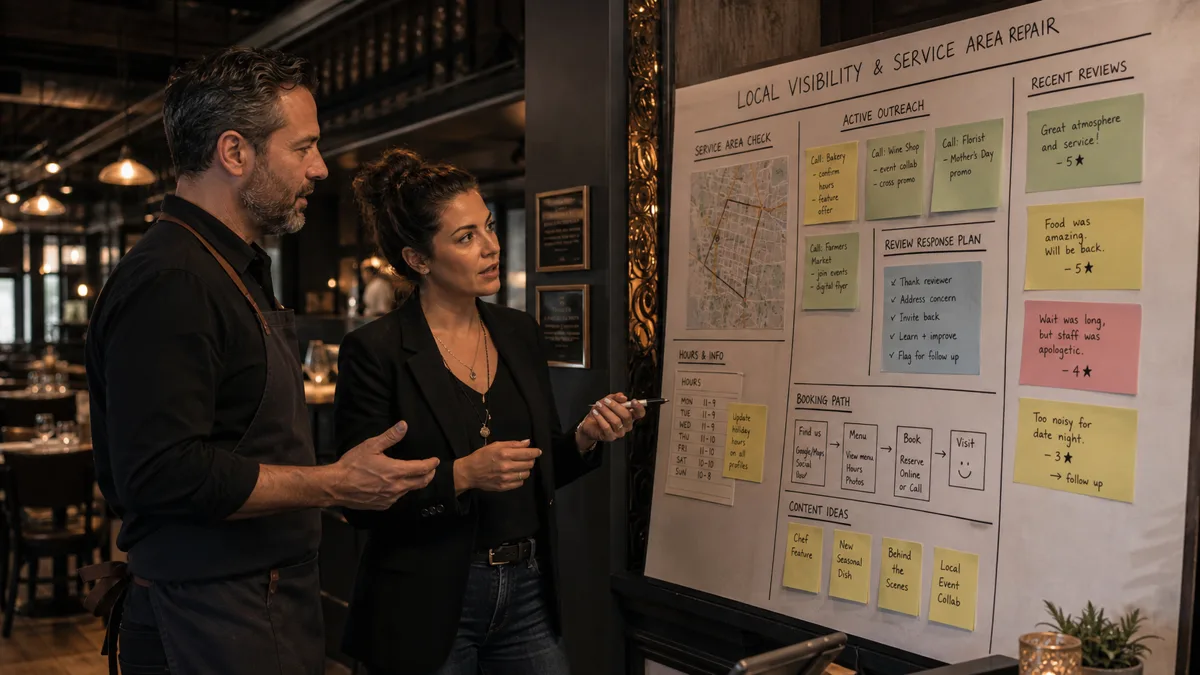
Start with the customer actions that create revenue. For a restaurant, that may be reservations, waitlists, private events, takeout orders, and directions. For a local service business, it may be calls, quote requests, appointment forms, financing inquiries, or emergency service requests.
Then audit the path from AI-style discovery to action:
- Ask the buyer question your customer would ask, not just your brand name.
- Record which businesses appear, what sources are cited or implied, and what details are included.
- Check whether your website and profiles clearly describe the service, location, hours, pricing context, proof, and next step.
- Compare your Google Business Profile, Yelp profile, Apple Maps listing, website, and major directories for conflicting facts.
- Test the booking, call, waitlist, form, or quote path on mobile.
- Look at whether reviews mention the reasons a customer would choose you.
- Fix the highest-revenue friction first.
The goal is not “more AI mentions” in isolation. The goal is more qualified customers making it from discovery to decision with fewer reasons to leave.
Common Mistakes to Avoid
The first mistake is assuming this only matters to restaurants because today’s headline has Yelp in it. Restaurants are early and obvious because reservations are structured actions. The same pattern applies anywhere a customer asks for a recommendation and then needs to call, book, compare, request, buy, or visit.
The second mistake is chasing an AI integration before fixing public facts. If your business information is inconsistent across major sources, another technology layer just distributes confusion more efficiently.
The third mistake is optimizing for mention instead of action. A business can be named in an AI answer and still lose the customer if the answer lacks proof, the booking path is unclear, or the next step feels risky. Visibility is only useful when it helps a buyer move.
The fourth mistake is treating AI systems as one channel. ChatGPT, Google AI features, Yelp, maps, directories, review platforms, and websites all shape different parts of the decision. The assistant is often the interface. The evidence still lives across the web.
The Bottom Line for Local Businesses
ChatGPT restaurant reservations are a useful warning shot: AI search is becoming less like a list of pages and more like a guided decision path.
For owners, the work is not mystical. Make your business retrievable. Make your proof specific. Make your next step obvious. Keep public facts consistent. Test the buyer questions that matter. Then fix the gaps closest to revenue.
Nugentive looks at this through an AI Visibility Audit because the problem is rarely one missing keyword. It is usually a chain: weak source data, vague service pages, thin proof, inconsistent listings, and an action path that asks customers to do detective work.
If AI assistants are going to help customers decide and act, your business needs to be ready for both parts. Being visible is good. Being bookable, callable, and credible is better.