
Dashboards Cannot Fix the Leak
AI visibility reports are becoming easier to buy and harder to interpret. That is a dangerous combination for owners, because a fresh dashboard can feel like progress even when it has not fixed one page, won one customer, or stopped one bad marketing guess.
Search Engine Journal reported that Microsoft Advertising added AI Visibility insights, alongside other advertising updates, giving marketers more ways to see how AI search experiences may affect visibility and performance (https://www.searchenginejournal.com/microsoft-advertising-adds-ai-visibility-insights-pmax-testing-and-creative-preview-updates/584760/). That is a useful signal. Reporting is moving from “we should probably think about AI search someday” to “your ad platform may now show you another chart before lunch.”
But the owner question is not, “Can I get another report?” The owner question is: will this help me understand why customers choose a competitor, why paid clicks are getting expensive, or which visibility problem to fix first?
If the answer is no, the report is decoration. Possibly expensive decoration. The marketing equivalent of buying a treadmill and using it as a coat rack.

What AI Visibility Reporting Can Actually Help With
Good AI visibility reporting can reduce confusion. It can show whether a business appears in AI answers, which competitors get named, which sources are cited, and whether the answer frames the company accurately. That matters because customers are no longer moving through one neat path from keyword to ad to website to form. They compare across ads, AI answers, organic results, maps, reviews, videos, directories, and whatever summary the machine decides to serve with great confidence.
Google’s guidance for AI features still points site owners back to the basics: make content eligible, accessible, helpful, and available to Google Search systems instead of chasing a special AI-only markup switch (https://developers.google.com/search/docs/appearance/ai-features). That does not make AI reporting useless. It means reports should lead back to practical fixes: content clarity, source proof, crawlability, reviews, landing pages, and conversion paths.
A useful report should answer questions like:
- Which buyer questions trigger AI answers?
- Is our business named, cited, recommended, misdescribed, or absent?
- Which competitors appear repeatedly?
- Which sources seem to support the answer?
- Are the cited sources pages we control, third-party proof, reviews, directories, or publishers?
- Does any of this connect to calls, forms, bookings, pipeline, or revenue?
If the report cannot move from visibility to action, it may still be interesting. So is a submarine documentary. Interesting is not the same as a customer acquisition plan.
Where Owners Get Misled
The first trap is treating an AI visibility score as a business outcome. A score can be a useful shorthand, but only if you know what went into it. Prompt set, geography, engine, date, answer type, source access, personalization, and competitor list all change the result. If those inputs are hidden, the number may be less “strategy metric” and more “mystery smoothie.”
The second trap is measuring mentions as if they were leads. Being named in an AI answer can help. Being cited as a source can help. Being recommended can help more. But none of those automatically means the phone rang, the form converted, or the buyer trusted you enough to stop comparing.
The third trap is separating AI visibility from paid and organic performance. Google Ads documentation explains that conversion tracking helps advertisers see what happens after a user interacts with an ad, including valuable actions such as purchases, sign-ups, phone calls, or app installs (https://support.google.com/google-ads/answer/1722054). That principle matters here too. Visibility is only useful when it is connected to what happened after the customer saw, clicked, searched, called, booked, or bought.
A business can look weak in AI answers because the website is vague. It can look weak because competitors have stronger third-party proof. It can look weak because reviews say one thing, service pages say another, and local listings are doing interpretive dance with the business category. The report is the symptom map, not the treatment.
The Report-to-Revenue Framework
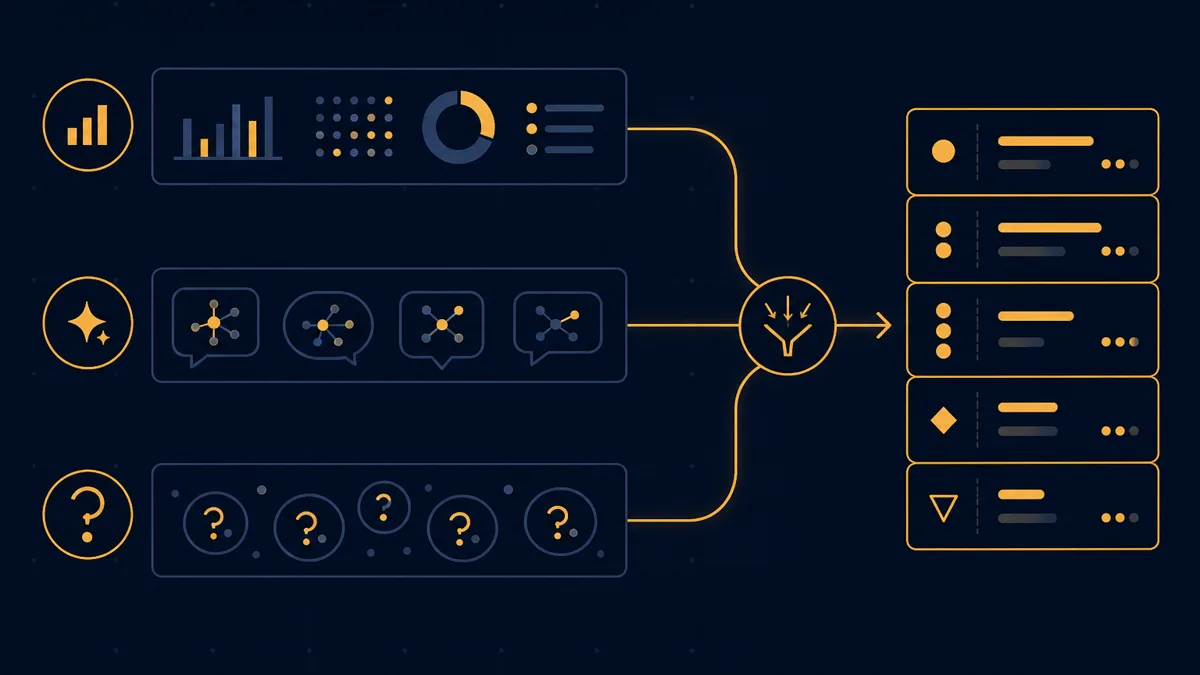
Morgan’s rule is simple: do not buy or review an AI visibility report unless it can move through four stages: question, evidence, fix, outcome.
Question means the report starts with real buyer prompts, not vanity prompts. “Who should I hire for emergency roof repair near me?” is a different business problem than “what is roof repair?” One can lead to revenue. The other may lead to a very educational afternoon and no booked job.
Evidence means the report shows what the answer used. Did it cite your service page, a competitor comparison, Reddit, Yelp, Google Business Profile content, a trade association, a news mention, or a review site? Sources reveal what the machine considers usable proof.
Fix means the report identifies what to improve. Maybe the service page needs clearer pricing context. Maybe reviews mention a specialty the website never states. Maybe a comparison page is missing. Maybe the site blocks important crawlers. Maybe the landing page explains the business with all the force of a damp napkin.
Outcome means the work is tied back to customer behavior. Watch branded search, qualified calls, form submissions, booked appointments, paid search conversion rate, assisted revenue, and close rate where the data exists. Google Ads attribution documentation notes that attribution models assign credit across ad interactions differently depending on the model used (https://support.google.com/google-ads/answer/6167122). Translation: even paid channels struggle to explain the whole journey. AI visibility needs humility, not magic dashboards.
What To Do Before Trusting the Chart
Before you act on any AI visibility report, run a quick sanity check.
- Confirm the prompt set matches revenue-producing services, locations, comparisons, and objections.
- Separate citations, mentions, recommendations, and sentiment instead of blending them into one happy blob.
- Record the date, engine, location, and source list for every finding.
- Compare named competitors against your actual sales competitors, not just whoever appeared once.
- Inspect the pages and third-party sources behind the answers.
- Tie findings to fixes that can influence a buyer decision.
- Track whether those fixes change qualified inquiries, not just report screenshots.
This is slower than celebrating a new dashboard. It is also how owners avoid paying for measurement that never becomes movement.

Where Nugentive Fits
Nugentive likes reporting when it tells an owner what to fix next. We are less impressed by reports that create ten pages of AI visibility theater and then recommend “more content” with the emotional depth of a vending machine.
The practical goal is to make your business retrievable, understandable, trusted, cited, recommended, and easy to choose across search and AI-assisted buying paths. Reporting can reveal where that chain breaks. Strategy turns the finding into a prioritized repair plan.
If your new AI visibility report says competitors show up more often, that is not the end of the story. The useful next question is why. Are they clearer? Better reviewed? Better cited? Easier to crawl? More specific about the service? Better aligned with buyer questions? Or are you measuring the wrong prompts entirely?
A paid $297 detailed AI Visibility Audit is built to answer that practical layer. Not just “how visible are we?” but “what is blocking customers from finding, trusting, and choosing us, and what should we fix first?” Reports are useful. Strategy is what keeps them from becoming another subscription with a login nobody wants to open.