
AI Search Is Not One Moment
An AI search sales funnel matters because customers do not ask one tidy question, receive one tidy answer, and then politely fill out your contact form while a trumpet plays. They move through messy stages: problem, options, comparison, proof, risk, price, and action. AI systems are starting to sit inside more of those stages.
Search Engine Land published a September 1 article on mapping AI search prompts to every stage of the sales funnel (https://searchengineland.com/map-ai-search-prompts-sales-funnel-486060). The useful point for owners is simple: your brand can lose long before the customer searches your name. If AI introduces competitors, frames the buying criteria, or summarizes your market badly, the buyer may arrive at your website already tilted away from you.
That does not mean you need 300 blog posts answering every sentence a customer might type into ChatGPT. Please do not build a content landfill and call it strategy. It means you need to know which buyer questions influence revenue and whether your business has evidence for those moments.
Why Prompt Mapping Changed the Job
Traditional SEO often starts with keywords. That still matters. Nugentive’s validated keyword research found useful owner-language like how to rank in chatgpt search, how to optimize for chatgpt search, and improve ai search visibility. Those phrases are not huge by volume, but they show a real question: “How do I make sure buyers can find and trust us when AI tools shape the search?”
Prompt mapping takes that one step further. Instead of asking only, “What keyword should this page rank for?” ask, “What decision is the customer trying to make when this question appears?”
A prompt like “best emergency plumber near me” is not the same job as “is trenchless sewer repair worth it?” The first needs local proof, availability, reviews, and clear contact paths. The second needs explanation, cost factors, tradeoffs, and credibility. If both prompts land on the same vague service page, the page is doing two jobs badly. Very efficient, if the goal is losing money with fewer documents.
Google’s AI features guidance still points site owners back to eligible, helpful, crawlable content for Search experiences rather than special AI-only markup (https://developers.google.com/search/docs/appearance/ai-features). Google’s helpful content guidance also emphasizes content made for people, not content created mainly to attract search traffic (https://developers.google.com/search/docs/fundamentals/creating-helpful-content). In owner terms: build useful answers around real decisions, not robot bait.
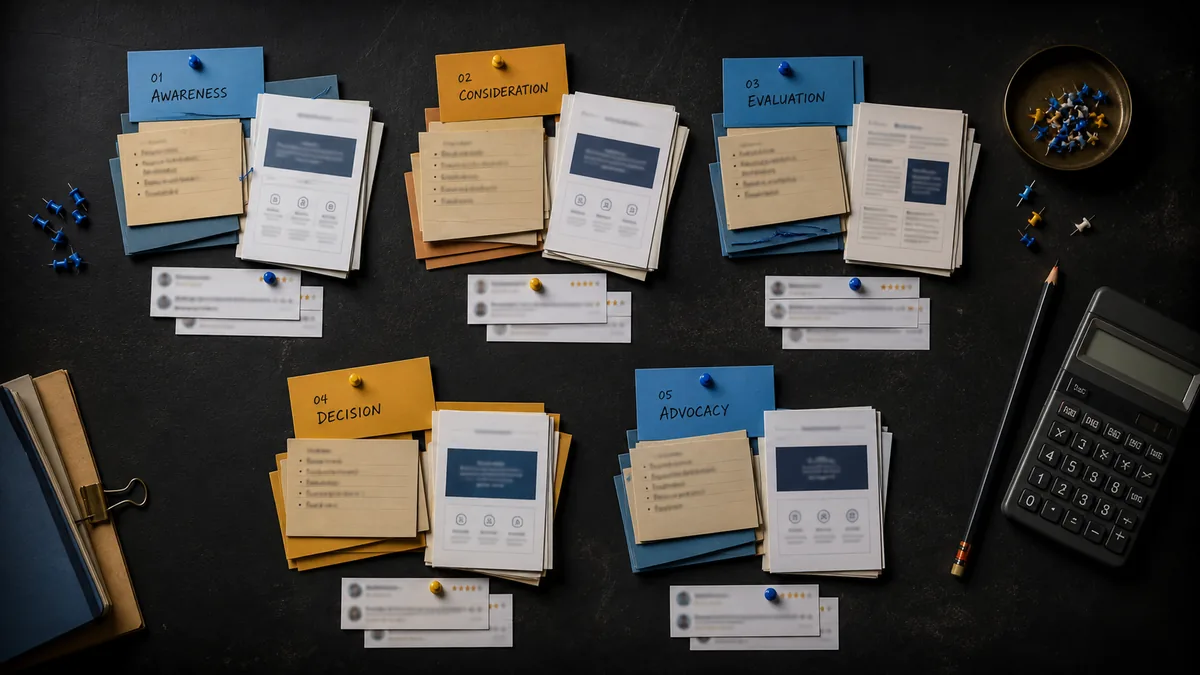
The Five Prompt Stages Worth Mapping
Most businesses do not need an elaborate funnel diagram with 47 emotional microstates. They need five buckets that connect search behavior to revenue.
- Problem prompts. The buyer is naming pain: “why is my basement drain backing up,” “why are my ads getting clicks but no leads,” or “why does ChatGPT recommend competitors.”
- Option prompts. The buyer is looking for possible solutions, providers, tools, or approaches.
- Comparison prompts. The buyer is weighing tradeoffs: one provider versus another, paid ads versus organic, repair versus replacement, DIY versus hiring.
- Proof prompts. The buyer wants evidence that a provider is credible, local, experienced, safe, or worth the cost.
- Action prompts. The buyer is ready to call, book, request a quote, visit, or shortlist.
Map your content and public evidence to those stages. You will usually find one of three problems: missing pages, weak proof, or pages that answer the wrong stage.

What Owners Should Check First
Start with the questions closest to money. If you are a service business, that means the prompts that happen before calls, quote requests, bookings, and high-value consultations. If you sell B2B services, it means prompts that happen before a shortlist, sales call, competitor comparison, or budget conversation.
For each stage, ask four questions.
First, can a search engine or AI-connected search system retrieve a useful page? Google Search Console’s Performance report can show queries, impressions, clicks, CTR, and average position for Google Search (https://support.google.com/webmasters/answer/7576553). It will not show every AI prompt across every platform. Nothing does. Anyone selling perfect omniscience should also be required to explain why their dashboard needs a login.
Second, does the page answer the decision quickly? A problem-stage page should diagnose the issue in plain English. A comparison page should explain tradeoffs honestly. A proof-stage page should show evidence: reviews, examples, credentials, service areas, process details, photos, case context, or third-party mentions.
Third, does the wider web support the same story? AI visibility is not only your website. It can involve business profiles, reviews, directories, earned mentions, forums, videos, citations, and partner pages. If your website says one thing and the rest of the internet shrugs, the answer engine has less confidence.
Fourth, is the next step obvious? If the prompt is action-ready and the page hides the phone number, buries the form, or makes the buyer decode your process, visibility leaks before revenue.
A Simple AI Search Sales Funnel Audit
Create a spreadsheet if you must, but do not let the spreadsheet become the project. The audit should produce decisions.
For each revenue-relevant service or offer, list five to ten prompts across the five stages. Use sales call notes, contact form questions, customer emails, reviews, Google Search Console queries, internal search data, and public discussions. Then test whether your website and public evidence can support each prompt.
Score each prompt as:
- Covered: there is a clear page and enough proof.
- Weak: there is a page, but it is vague, thin, or missing evidence.
- Missing: the business has no useful answer for that decision.
- Blocked: the answer exists, but crawlability, indexing, rendering, or navigation makes it hard to retrieve.
Do not fix everything at once. Fix the prompt gaps closest to customer action first. A comparison page that helps a buyer choose your higher-margin service may matter more than another top-of-funnel explainer. A proof page that supports a sales conversation may beat a broad trend post. Strategy is mostly choosing what not to do, which is rude because doing everything feels busier.

The Mistakes That Waste Time
The first mistake is treating prompt mapping like keyword stuffing with longer sentences. If a page repeats “best AI visibility agency for local business” twelve times but never explains fit, proof, cost, process, and next steps, it is not optimized. It is just sweaty.
The second mistake is building content for curiosity prompts while ignoring buying prompts. A local contractor may have endless educational ideas, but if customers mainly need price factors, emergency availability, neighborhood proof, and service comparison, start there.
The third mistake is measuring visibility without revenue context. A brand mention in an AI answer is useful only if it supports a business outcome: better awareness, better-qualified visitors, more calls, more form fills, more sales conversations, or stronger close rates. Screenshot collecting is not a business model. It is a hobby with file names.
The fourth mistake is assuming AI prompts replace SEO. They do not. Good AI search funnel work still needs accessible pages, clear headings, internal links, structured information, helpful content, conversion paths, and trustworthy evidence. SEO did not die. It got dragged into more of the sales conversation.
What This Means for Nugentive Clients
For Nugentive, an AI search sales funnel is a practical planning tool. It shows where a business is retrievable, where it is misunderstood, where competitors have better evidence, and where visibility fails to become action.
That is more useful than asking whether the business “does GEO” in the abstract. The owner does not need another acronym to feed. The owner needs to know why qualified customers are choosing someone else and what to fix next.
A good prompt map can reveal that the homepage is fine but the comparison content is absent. Or that the service page ranks but lacks proof. Or that AI answers understand the category but not the company. Or that buyers are asking price and risk questions the site avoids because everyone agreed “premium brands do not discuss cost.” Premium brands still receive bills. So do their customers.
The Bottom Line
AI search is changing the customer journey by influencing more than the final click. It can introduce options, define decision criteria, compare providers, surface proof, and send buyers toward or away from a business before analytics records anything clean.
The fix is not panic content. It is mapping the prompts that matter, tying them to buyer decisions, checking whether your pages and public proof support those moments, and fixing the gaps closest to revenue first.
If you want more customers from search and AI-assisted discovery, stop treating visibility like a single ranking event. Treat it like a decision path. Then make each high-value step easier for machines to retrieve, easier for buyers to trust, and easier for customers to act on.